Published
Quick answer
What is right speech in Buddhism? It is the third factor of the Noble Eightfold Path: speaking what is true, helpful, well-timed and kind, while avoiding lying, divisive words, harsh speech and idle chatter.
Key takeaways
- Right speech (samma vaca) is the third factor of the Noble Eightfold Path, grouped with ethical conduct.
- It has four trainings: no lying, no divisive words, no harsh speech, no idle chatter.
- The Buddha's test for speech: is it true, useful, well-timed and kind.
- Right speech is not the same as staying silent about a needed truth.
- A day spoken through carefully leaves fewer loose threads to replay at night.
What is right speech in Buddhism? It is the third factor of the Noble Eightfold Path, the guideline that speech should avoid lying, divisive words, harsh language and idle chatter, and instead be true, kind, helpful and well-timed.
The term in Pali is samma vaca — "right" or "skillful speech." It is not a rule handed down from outside but a training the speaker takes up voluntarily, because careless words complicate a life and careful words settle it, including the kind of settling that makes it easier to lie down at night without replaying every conversation.
Where does right speech fit in the Noble Eightfold Path?
Right speech is the third of the Noble Eightfold Path's eight factors, placed alongside right action and right livelihood under the heading of ethical conduct. The Path does not rank its eight factors as a ladder to climb one at a time; they support one another at once, the way posture supports breath. Ethical speech makes the mind calmer to sit with, and a calmer mind in turn makes it easier to speak with care the next day.
See also: What Is Right Effort in Buddhism? A Clear Guide.
The Five Precepts cover similar ground from a narrower angle: the fourth precept is a commitment to refrain from false speech, and right speech widens that single rule into a fuller practice that covers not only lies but everything spoken carelessly. Where the precept is a line not to cross, right speech is a direction to grow into, training the ear as much as the tongue, since most unskillful speech starts with not listening closely enough to what is actually true or needed.
What are the four parts of right speech?
Right speech is traditionally described as four trainings, each named first as something to set aside and then as something to grow in its place.
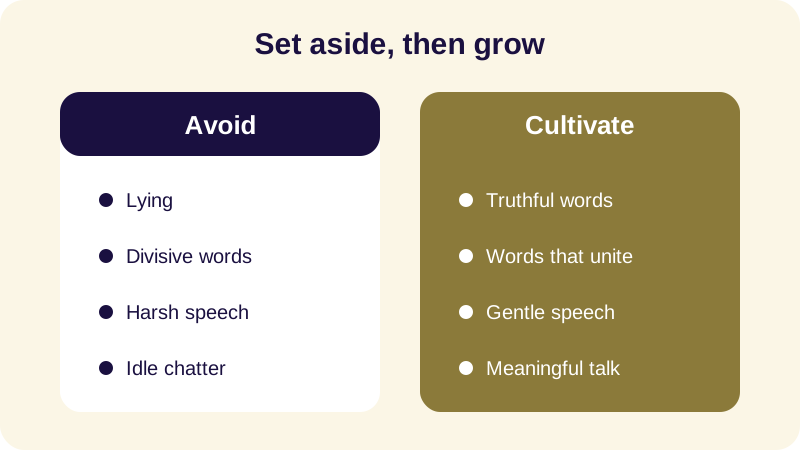
The first is to refrain from lying and instead speak the truth. The second is to refrain from divisive words — speech that sets one person against another, repeats gossip to widen a rift, or takes sides for the pleasure of taking sides — and instead to use words that bring people back together. The third is to refrain from harsh speech: insults, sarcasm meant to wound, words delivered in anger to cause pain, replacing them with speech that stays gentle even when it needs to be firm. The fourth is to refrain from idle chatter, the kind of talk that fills a silence without adding anything, in favor of speech that is actually worth the other person's attention.
None of the four asks for silence as a default. The training is not to speak less but to speak with more attention, so that what leaves the mouth matches what is actually true, needed and kind.
How did the Buddha decide what was worth saying?
A well-known teaching frames the question as a short test: is it true, is it beneficial, is it timely, and is it spoken with a kind intention. Words that fail even one of these are, by this measure, not worth saying yet, even if every word of them happens to be accurate.
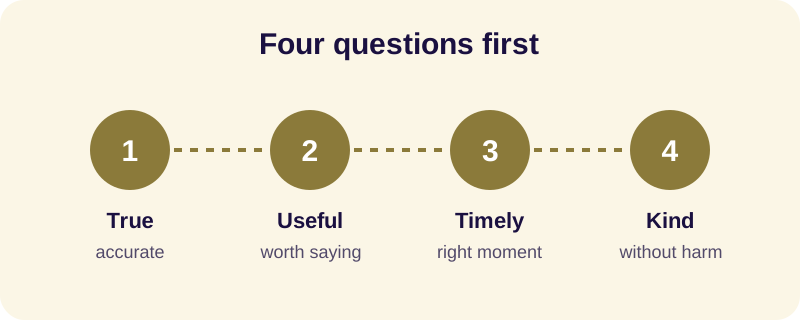
This is harder than it sounds, because true and unkind statements are everywhere, and so are kind statements that are not quite true. The test asks for all four at once: true enough to trust, useful enough to matter, timed so the listener can actually hear it, and offered without the wish to wound. A true, beneficial thing said at the wrong moment, or in the wrong tone, can do almost as much damage as a lie.
Why does right speech matter for a mind at night?
Most of the conversations that keep a person awake are not ones happening right now; they are ones already finished, replayed for what was said, what should have been said, or what was left unsaid and now feels unfinished. Careless speech during the day tends to leave more of this residue than careful speech does, simply because it gives the mind more to revise.
Right speech does not promise an end to these replays — a difficult day does not disappear because it was spoken through carefully — but it does tend to leave fewer loose threads. A true, timely, kind word rarely needs defending at midnight the way an exaggeration, a jab, or an unnecessary comment does. For more on settling the kind of looping thought that follows a hard conversation, see how to quiet a racing mind at night.
How can I start practicing right speech?
Right speech is easiest to build one habit at a time rather than all four at once.
- Pick one category — gossip, harsh jokes, exaggeration or filler talk — and simply notice it for a week before trying to change it.
- Before a tense reply, pause for one breath. A single breath is often enough time for the four-part test to do its work.
- When you catch an unkind or untrue word after it is already spoken, correct it plainly rather than letting it stand. Repair matters more than never slipping.
- Pair the practice with the Middle Way: the aim is neither blunt honesty that wounds nor polite silence that hides, a balance worth returning to.
How can the Buddha Story app help with this?
The Buddha Story app narrates the teachings right speech comes from, including the Dhammapada's 423 verses and episodes from the life of Siddhartha Gautama, in slow English narration meant for listening in the dark rather than study at a desk.
- A Sleep Timer that stops the story and sounds at the point you choose, without a fade-out.
- Offline Mode, so a weak signal never interrupts an evening routine.
- A sound mixer to layer a story with rain or other ambient sound.
- Background playback, so the story keeps going once the screen is locked.
A day spoken through carefully is already a quieter day to fall asleep after. The stories simply give the mind somewhere gentle to land once the talking is done.
Frequently Asked Questions
What does right speech mean in Buddhism?
Right speech, samma vaca in Pali, is the third factor of the Noble Eightfold Path. It is the training to avoid lying, divisive words, harsh speech and idle chatter, and to replace each with speech that is truthful, unifying, gentle and worth saying.
Is right speech the same as the precept against lying?
They overlap but are not identical. The fourth of the Five Precepts is a commitment to refrain from false speech. Right speech widens that single commitment into four related trainings, covering divisive words, harsh speech and idle chatter as well as lies.
Does right speech mean never saying anything difficult?
No. Right speech is about how and when something is said, not about avoiding every hard subject. A true, necessary point delivered without cruelty and at a fair moment still counts as right speech, even if it is unwelcome to hear.
How do I know if what I'm about to say is right speech?
A traditional test asks four questions: is it true, is it useful, is it well-timed, and is it spoken without the wish to harm. If a statement fails any of the four, it is usually worth holding back or rephrasing before speaking.
