Published
Quick answer
How did Siddhartha Gautama find an answer to his question about ending suffering? Buddhist belief holds that he meditated until he became enlightened beneath the Bodhi tree — not a god, a wait, or a scroll.
Key takeaways
- The correct answer: he meditated until he became enlightened, under the Bodhi tree.
- Mara is a Buddhist mythological tempter figure, not a Hindu god.
- No scroll appears in the early accounts of that night.
- He did not wait passively; the story describes active, sustained meditation.
- His insight became the Four Noble Truths and the Noble Eightfold Path.
How did Siddhartha Gautama find an answer to his question about ending suffering? According to Buddhist belief, he did not talk with a god, wait for one, or read a scroll — he sat down and meditated until he became enlightened.
This is one of the oldest and most retold episodes in the tradition: a prince who had left a sheltered life to understand why living things suffer, and who found his answer not from an outside source but through his own sustained inner practice. The story has been passed down for 2,500 years, and it still shows up today as a multiple-choice question with some tempting wrong answers attached. Here is which one is correct, and why the others are not.
What is the correct answer among these four options?
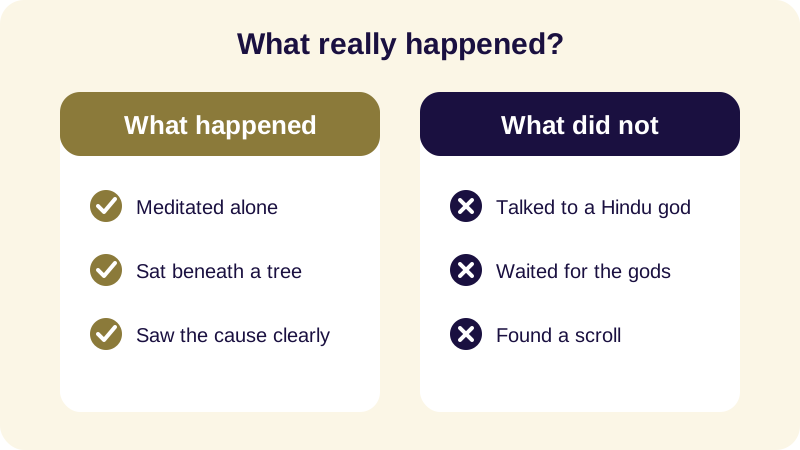
The correct answer is that Siddhartha Gautama meditated about his question until he became enlightened. He sat beneath a tree — later known as the Bodhi tree, the tree of awakening — and stayed there through a long night until he had seen clearly into the cause of suffering and the way beyond it. The other three options describe confused retellings, modern inventions, or a misunderstanding of a mythological figure; none of them appears in the early accounts.
Was Mara a Hindu god the Buddha spoke with?
No. Mara does appear in the story of that night, but he is not a Hindu deity — he belongs to Buddhist mythology, where he is usually described as a tempter, a personification of fear, craving and death who tries to pull a meditator's attention away from clear seeing. The two traditions share a long historical backdrop, which is probably how the confusion starts, but Mara's role in this particular story comes from the Buddhist telling, not from Hindu scripture. You can read more about Mara and other figures like him in our guide to Buddhist mythology.
What actually happened during the night under the Bodhi tree?
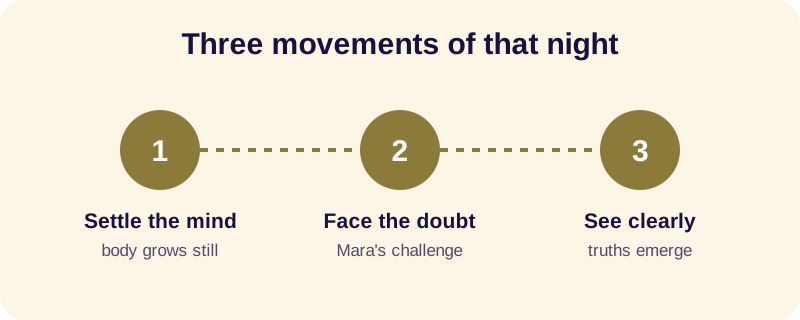
The story describes a long stretch of sustained meditation, not a conversation and not a passive wait. Three broad movements are usually described: the mind settling into deep stillness, a confrontation with doubt and fear often personified as Mara and his forces, and finally a clear seeing into how suffering arises and how it can end.
What he is described as seeing, in the end, is close to what later became known as the Four Noble Truths: the nature of suffering, what causes it, that it can end, and a path that leads there — laid out further as the Noble Eightfold Path. None of this required a scroll or a message handed down from outside. It is described as insight reached from within, through the meditation itself.
Why do the other three answers keep getting repeated?
Each wrong answer usually comes from somewhere understandable. The "talked with Mara" option mistakes a mythological tempter for a deity who gives guidance, when his actual role is to resist the meditation. The "waited patiently for the gods" option flattens a long, active, effortful night into something passive, which it was not. The "scroll under a tree" option seems to borrow from other traditions built around a found or revealed text — that is simply not how this story is told. If you want the fuller narrative in order, our story of the Buddha and his enlightenment and our account of how the Buddha attained enlightenment both walk through it in more detail.
What does this story offer a restless mind at night?
The practical point of the story has nothing to do with trivia. It is that the mind's own stillness, not an outside rescue, is what settles a hard question. Siddhartha Gautama did not get an answer delivered to him; he sat with a difficult question long enough, and skillfully enough, for the answer to become visible. That is also roughly what a short meditation before bed is trying to do on a much smaller scale — not solve the day's problems, but let the mind stop grabbing at them.
The Middle Way he taught afterward grew directly out of this: neither forcing the mind nor indulging its every pull, but finding a steady, sustainable middle. That balance is worth remembering on a night when sleep feels like something you have to fight for. It usually responds better to being allowed than to being chased.
How can I listen to this story before sleep?
The Buddha Story app narrates episodes from the life of Siddhartha Gautama, including this night under the Bodhi tree, alongside Jataka tales and verses from the Dhammapada, in slow English narration meant for listening in the dark rather than for study. A sleep timer stops the story and sounds for you after the length you choose, so you are not left holding a phone once you have drifted off, and everything downloads for offline, background listening.
If this particular question brought you here out of curiosity about the Buddha's life rather than a search for sleep, our summary of the Buddha's life is a good next stop. If it was the restless-mind part that caught your attention, our guide to Buddhist meditation for a sleepless mind goes further into the practice itself. Either way, the short version holds up on its own: no god handed Siddhartha Gautama the answer, and no scroll waited for him under the tree. He meditated, and he found it himself.
Frequently Asked Questions
According to Buddhist belief, how did Siddhartha Gautama find an answer to his question about ending suffering?
He meditated. Sitting beneath what became known as the Bodhi tree, he settled his mind through sustained meditation until he was enlightened, seeing clearly into why beings suffer and how that suffering ends. He did not consult a god, wait for one, or read a scroll.
Was Mara a Hindu god that Siddhartha Gautama talked with?
No. Mara is a figure from Buddhist mythology, not Hindu scripture, usually described as a tempter who personifies fear, doubt and death. In the story he tries to disrupt the meditation under the Bodhi tree, not to hand over any answers.
Did Siddhartha Gautama find a scroll under the Bodhi tree?
No surviving account describes a scroll. The tradition is explicit that the insight came from within, through meditation, not from a found text. The scroll version is a modern invention, not part of any early telling of the story.
Did the gods give Siddhartha Gautama the answer after he waited?
No. He did not wait passively for divine help. The accounts describe active, sustained meditation over a long night, through doubt and distraction, until he reached enlightenment on his own. Waiting for an outside answer is not part of the earliest tradition.
What did Siddhartha Gautama actually realize that night?
He is described as realizing what came to be taught as the Four Noble Truths: the nature of suffering, its cause, its end, and the path leading there — later laid out as the Noble Eightfold Path.