Published
Quick answer
What happens during walking meditation is a slow, deliberate walk where attention rests on the sensations of each step rather than on thoughts. The pace is slower than normal, usually back and forth along a short path, with the mind returning to the feet whenever it wanders.
Key takeaways
- Walking meditation slows your pace and rests attention on lifting, moving and placing each foot.
- The mind still wanders here too; you simply notice and return attention to the feet.
- It comes from the same mindfulness instructions that cover standing, sitting and lying down.
- A short, calm walking session before bed can settle a restless mind without forcing stillness.
What happens during walking meditation is simple to describe: you slow your pace and rest attention on the physical sensations of walking — the weight shifting, a foot lifting, moving forward, touching down — rather than on your thoughts. Nothing mystical occurs; it is an ordinary walk, made slow and noticed.
What happens during walking meditation, step by step?
Most forms of walking meditation follow a similar shape, whether it comes from a Zen tradition, where it is called kinhin (walking meditation, usually done between periods of sitting), or from a wider mindfulness approach. You choose a short path — ten to twenty paces is plenty — and walk it slowly, back and forth, for a set stretch of time.
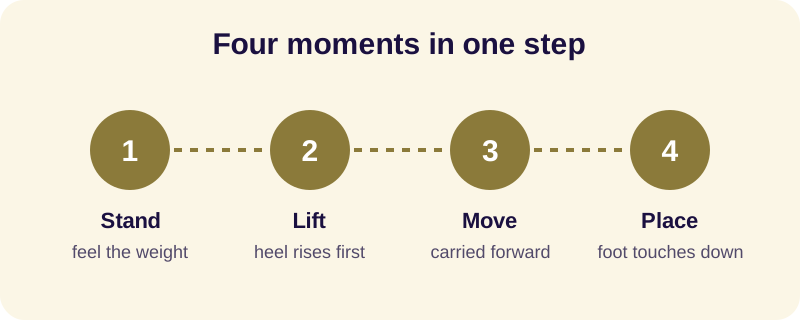
In practice, this usually means standing still for a moment first, feeling your feet on the ground, then taking one step at a time, slowly enough to notice the lift, the carry, and the placing of each foot. At the end of the path, you pause, turn, and walk back. That is the whole of the walking meditation steps — there is no further technique hidden underneath.
Some styles add a quiet mental note at each phase — "lifting," "moving," "placing" — as a way of keeping attention anchored. Others simply rest attention on the raw sensation without naming it. Both are common, and neither is more correct than the other; the naming is a tool, not the point. Pace varies too: a very slow, formal kinhin walking meditation might take a full minute to cross a short room, while a more everyday version is closer to an unhurried stroll, attention simply resting on the feet instead of racing ahead to the next errand.
What is the mind doing while the body walks?
The mind does roughly what it does in any seated practice: it wanders. You notice a plan for tomorrow, an old conversation, an itch, a sound outside, and at some point you realise your attention has left the feet entirely. This is not a failure of walking meditation — it is the expected texture of it, the same as in meditation for beginners generally.
The instruction, each time, is the same: notice that attention has wandered, and bring it back to the next step, without scolding yourself for having left. Over a walking session, this happens many times. The practice is not the absence of wandering; it is the repeated, gentle return.
This approach to the body's postures has old roots. Early instructions on mindfulness, found in texts like the Satipatthana Sutta, describe paying close attention to the body in whatever position it is in — walking, standing, sitting, or lying down — simply knowing "I am walking" while walking, without adding commentary. Walking meditation is this instruction applied to one ordinary posture most people perform without a moment's attention all day. The same quality of attention can later be carried into sitting practice, or into the kind of slow, narrated listening described in our guide to dharma stories for sleep, where the point is likewise to let one steady thing hold the mind's interest.
What usually goes wrong for beginners?
The most common mistake is treating walking meditation as a performance of slowness rather than an exercise in attention. People sometimes move so deliberately that the body feels stiff and effortful, or they stare hard at their feet as though checking for a mistake. Neither helps; both add tension where the practice is meant to remove it.
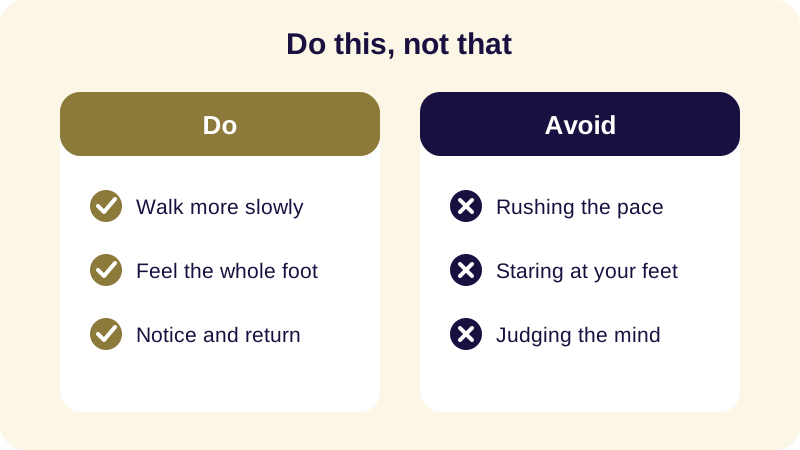
Another common mistake is expecting the mind to go quiet. It usually does not, especially at first. The value of the practice is not a silent mind but a steadier one — attention keeps finding its way back to something simple and physical, which is itself a kind of rest from the usual churn of planning and replaying. A third, smaller mistake is picking a path that is too long or too busy, so that navigating turns or obstacles becomes the main task instead of noticing the steps.
Can walking meditation help you settle before bed?
A short, slow walk of this kind can be a useful part of winding down in the evening, in the same family as other calming routines described in our guide to mindfulness for sleep. Ten minutes of walking meditation before bed gives the body something gentle to do and the mind something simple to rest on, which can make the transition to lying down and settling feel less abrupt.
Walking meditation before bed is not a cure for sleeplessness, and it is not a substitute for addressing a real sleep problem. If restlessness at night is a persistent, ongoing difficulty, that is worth raising with a doctor rather than managing through practice alone. For an ordinary evening where the mind is simply busier than you would like, though, a slow walk followed by lying down quietly — perhaps with a story or guided practice from our piece on buddhist meditation for insomnia — is a reasonable and gentle thing to try.
See also: Buddhist Blogs: What to Read and Where to Start.
What happens during walking meditation, in the end, is modest by design: a slower walk, a steadier attention, and a mind given something plain to return to whenever it drifts. That modesty is exactly what makes it suitable for the last hour before sleep, when nothing elaborate is wanted and something quiet is enough.
Frequently Asked Questions
What happens during walking meditation, exactly?
You walk slower than usual along a short, fixed path, attention resting on the physical sensations of each step: the weight shifting, the foot lifting, moving forward and touching down again. When the mind wanders off into planning or worry, you simply notice this and bring attention back to the feet.
How is walking meditation different from a normal walk?
A normal walk is usually a means of getting somewhere, with attention on the destination or on thoughts. Walking meditation has no destination; the path is short and often walked back and forth, and the point of the exercise is the walking itself, noticed closely.
Do I need a special place to practise walking meditation?
No. A hallway, a quiet room, or ten paces along a bedroom floor are enough. What matters is a short, uninterrupted stretch you can walk back and forth on slowly, without needing to watch your step for obstacles or traffic.
Can walking meditation help with sleep problems?
A short, slow walking session can help settle an overactive mind before bed, the way any calming routine might. It is not a treatment for insomnia or any sleep disorder; persistent sleeplessness is worth discussing with a doctor rather than managing alone.
What is kinhin?
Kinhin is the Zen term for walking meditation, traditionally practised between periods of seated meditation. It uses the same slow, step-by-step attention as other walking meditation styles, often with very small, deliberate steps timed to the breath.
