Published
Quick answer
The Buddhist teaching on the nature of thoughts says a thought is a conditioned, impermanent event, not a fact and not the self. Watching it arise and pass, rather than arguing with or obeying it, is the practice described as mindfulness of mind.
Key takeaways
- Thoughts are treated as passing mental events, not commands from a fixed self
- Feeling urgent is not the same as being true for a late-night thought
- Noticing a thought without following it is the core of mindfulness of mind
- A one-word label like thinking or worrying often loosens a thought's grip
- Persistent sleeplessness or anxiety belongs with a doctor, not a teaching alone
The Buddhist teaching on the nature of thoughts is that a thought is a passing mental event, not a fact and not an order you must obey. It arises because conditions are present, it lasts a few seconds, and then it is gone, whether or not you follow it.
What does Buddhist teaching say about the nature of thoughts?
In the early discourses, a thought is counted alongside sight, sound, smell, taste and touch as one of six kinds of contact the mind registers. It is not treated as special or exempt from the same rules that govern everything else that arises: it depends on conditions, it has a brief duration, and it changes. A thought is simply an event in the mind, not a verdict handed down by some inner judge.
This connects to a wider teaching on causality: nothing, including a single thought, arises on its own. Each thought depends on something that came just before it — a sound, a memory, a sensation in the body, an unfinished worry from earlier in the day — the way one wave depends on the water and wind before it. Readers who want the fuller picture of how one event conditions the next can follow dependent origination, which lays out this chain in more detail.
The same teaching applies the idea of impermanence directly to the mind. A thought is born, stays briefly, and dissolves, in exactly the way a sound fades or a breath completes itself. Some descriptions compare thoughts to clouds crossing a clear sky, or to guests arriving at a house: they come, they stay a while, and the sky or the house remains underneath them, more or less unchanged by their passing. The Buddhist teaching on impermanence covers this principle as it applies to the body, to relationships, and to the mind alike.
Why are thoughts not the same as facts or commands?
A thought that says "something is wrong" or "you need to fix this now" feels urgent. Feeling urgent is not the same as being true. The discourses separate the raw event — a thought showing up — from the story built on top of it: the interpretation, the argument with yourself, the plan to resolve it immediately. The event is largely unavoidable. The story is optional, and most of a sleepless hour is spent entirely inside the optional part.
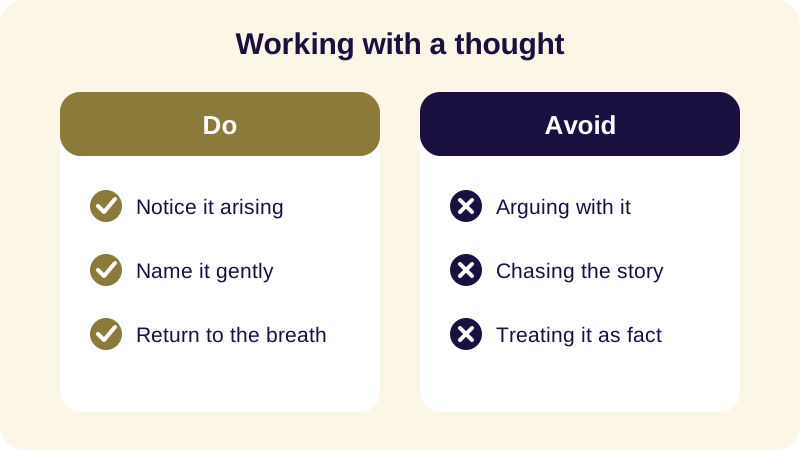
This is close to the teaching of the second arrow: the first arrow is the thought itself, which you did not choose and cannot fully prevent. The second arrow is believing it, arguing with it, or treating it as an instruction you must act on immediately. The story of the second arrow makes this distinction in plain, practical terms rather than abstract ones.
At night, the same few thoughts tend to recur in familiar shapes:
- Replaying a conversation and rewriting what you should have said
- Planning tomorrow in more detail than tomorrow actually requires
- Reviewing a decision that has already been made
- Worrying about whether you will sleep, which itself becomes another thought to watch
How does watching thoughts calm a racing mind at night?
With nothing left to distract it, a tired mind often treats every thought as a task: a problem to be solved before sleep is permitted. Watching thoughts arise and pass, without immediately picking each one up, removes that sense of obligation. After a few minutes you may notice that a thought you set aside earlier has already changed shape or disappeared on its own, without your help.
The Satipatthana Sutta describes this as mindfulness of mind: observing the mind's state honestly, without pretending a thought is calmer or worse than it actually is, and without chasing it into a longer train of thinking. For how this applies specifically to a restless night, see Buddhist meditation for insomnia; for an anxious thought in particular, see Buddhism and anxiety.
This also connects to non-attachment: the aim is not to feel nothing, but to hold a thought a little more loosely, so that letting it pass does not feel like a loss. The Buddhist teaching on non-attachment looks at that distinction between letting go and simply not caring.
What simple practice helps you notice thoughts without being swept away?
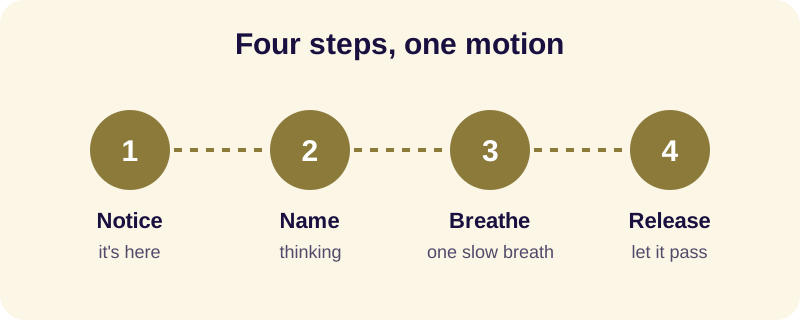
A short sequence is enough to begin: notice that a thought is present, name it in a word or two, take one slow breath, and let it go rather than developing it further. None of this requires believing anything in particular; it only asks you to repeat the same small motion each time a thought pulls at your attention.
If you want a specific line to return to rather than a method alone, short verses from the Dhammapada — a collection of 423 verses, many of them directly about the mind — give a restless evening something plain to hold onto instead of its own noise. If sitting quietly with the breath is new to you, meditation for beginners covers the basic posture and timing without assuming prior experience.
None of this is a treatment for insomnia or anxiety, and it is not presented as one. If sleeplessness or worry is a lasting problem rather than an occasional restless night, it belongs with a doctor. For an ordinary night when thoughts will not quiet down, the Buddha Story app narrates teachings like these slowly, including Dhammapada verses and guided meditation for breath awareness, with a sleep timer that pauses the story and sounds once the time is up, so you are not left reaching for your phone in the dark.
Frequently Asked Questions
What does Buddhist teaching say about the nature of thoughts?
It treats a thought as one of six kinds of sense contact, arising from conditions such as a prior mood, memory or sensation, lasting briefly, and passing away on its own. A thought is not denied, but it is not taken as a trustworthy report from a fixed self either.
Are thoughts the same as facts in Buddhism?
No. A thought can feel urgent or certain without being accurate. The teaching separates the raw event of a thought appearing from the story, argument or plan built on top of it; the event is largely unavoidable, but the story is optional.
What is the practice of watching thoughts called?
The Satipatthana Sutta describes it as mindfulness of mind: observing the mind's state honestly, without exaggerating or minimizing a thought, and without chasing it into further thinking. It is one of four foundations of mindfulness taught in that discourse.
Can this help with a racing mind at night?
Many people find that naming a thought and returning attention to the breath reduces the sense that every thought must be solved before sleep. It is an ordinary calming practice, not a treatment, and it works alongside normal sleep habits rather than replacing them.
Does this teaching mean I should try to stop my thoughts?
No. Trying to force thoughts to stop is itself another thought, usually a tense and effortful one, and it tends to make the mind busier. The practice is to watch thoughts arise and pass without pushing them away or pulling them closer.
