Published
Quick answer
The best-known Buddhist story about a lost traveler is the Mahajanaka Jataka, where a shipwrecked prince swims on for days with no land in sight, refusing to stop. It offers a steady image for a mind that feels lost at night: not frantic, just quietly continuing.
Key takeaways
- The Mahajanaka Jataka is a genuine Jataka tale, one of the 547 stories of the Buddha's past lives.
- A shipwrecked traveler swims on without seeing land, refusing to give in to despair.
- The story models steady effort rather than panic when the way forward isn't clear.
- The caravan leader Jataka carries the same theme: how to act when you don't know the way.
- Popular tales like the Two Wolves or Sai Weng's horse are not Buddhist, unlike the Jataka tales.
A Buddhist story about a lost traveler does exist in the old texts, not only in modern retellings: it is the Mahajanaka Jataka, where a shipwrecked prince swims for days with no land in sight. It is one of the 547 Jataka tales, the traditional stories of the Buddha's past lives.
What is the Buddhist story about a lost traveler called?
The story is the Mahajanaka Jataka. Prince Mahajanaka sets out on a trading voyage across open water, and partway through the journey the ship breaks apart in a storm. Most of the passengers do what anyone would do: they cling to broken planks, cry out to sea gods, and wait to be found. Mahajanaka does something else. He eats as much as he can hold, coats his body in oil so the salt water will not wear down his strength, and starts swimming in the direction he judges land to be — with no island, no coastline, nothing visible to steer by, only a steady stroke repeated for a long stretch of time with no sign that it is working.
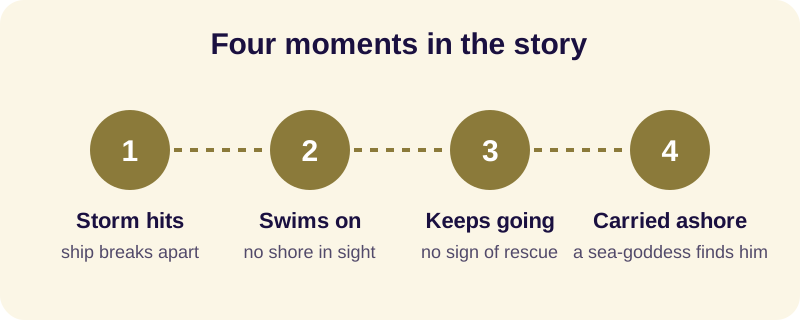
Eventually a sea-goddess, Manimekhala, notices him and asks the obvious question: why keep swimming when there is no land to be seen and no help in any direction? His answer is the heart of the tale. He says he will keep making the effort for as long as he has strength, because stopping guarantees failure, while continuing at least leaves open the chance of reaching shore. Moved by this, she lifts him from the water and carries him to safety. The story does not reward him for knowing the way. It rewards him for not quitting before the way appeared.
What does this story offer a mind that feels lost at night?
Lying awake with an unresolved worry can feel a lot like Mahajanaka in open water: no shore in sight, no confirmation that anything you are doing is helping, only the next breath to take. The mind wants a map before it will rest, and at two in the morning no map is coming. What the story offers instead is a different question: can you keep going steadily, without thrashing and without giving up, even while the outcome stays invisible? That steadiness — neither frantic effort nor collapse — is close to what the Middle Way points at in a much larger sense: not forcing, not abandoning, just a sustainable pace.
The story also refuses to rush its own rescue. It does not tell you when the goddess will appear, only that the swimming has to continue regardless. That is oddly useful training for a mind that wants certainty before it can let go for the night. You do not need to solve the worry before you rest; you only need to stop fighting the not-knowing for a while and let the next breath, like the next stroke, be enough.
Are there other Buddhist stories about being lost or without a clear path?
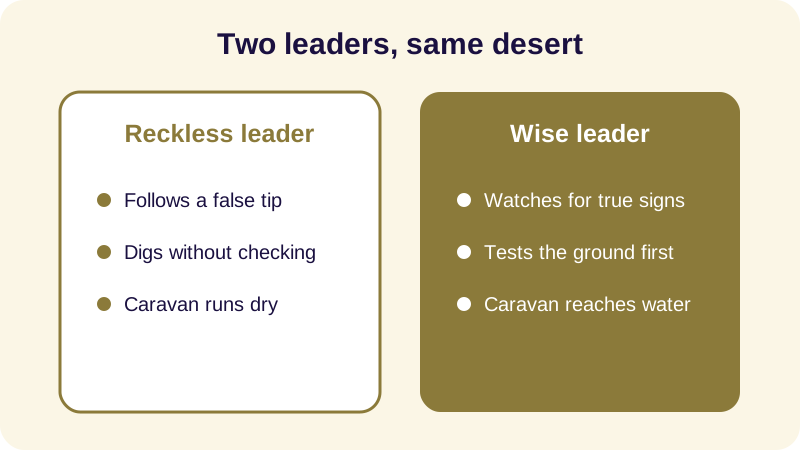
The Mahajanaka Jataka is not the only one. The Apannaka Jataka, often translated as the tale of the wise caravan leader, follows two merchants crossing a waterless stretch of desert. One trusts a stranger's claim that water lies just ahead and digs blindly through the night; his caravan runs dry. The other checks for real signs before he commits, tests the ground rather than taking anyone's word for it, and brings his people through to water. Both leaders are equally lost at the start. Only one of them stays lost.
Other figures in the tradition are lost in a different way. Kisa Gotami, grieving, wanders from house to house searching for a mustard seed from a family untouched by death — lost not on a sea or in a desert, but inside a grief that will not let her see clearly until she stops searching the wrong way. The theme that runs through all of these is not that the Buddha's path removes you from difficult ground. It is that how you move through it — carefully, honestly, without panic — matters more than whether the ground itself is clear.
It is worth saying plainly: not every popular "lost traveler" story circulating online is Buddhist in origin. The Two Wolves and the tale of Sai Weng's horse are both widely shared as Buddhist wisdom, and both are not. The Jataka tales, by contrast, come from the actual canon — 547 of them, with clear sources — which is one reason the Mahajanaka story holds up better than a borrowed fable.
See also: Buddhist Story About a Stubborn Donkey and Its Lesson.
How can I use this story to settle a restless night?
The simplest approach is also the one the story itself models: do not rush it, and do not try to extract a lesson from it while you are still listening. Let the swimming take as long as it takes. A few ways to let it work:
- Follow the stroke, not the plot. You already know how it ends. The part worth dwelling in is the long, uncertain middle, which is closer to where your own mind usually is at night.
- Breathe at the pace of the swimming. A slow, steady breath mirrors the steady effort in the story better than trying to breathe "correctly."
- Stop reaching for the moral. Understanding the story fully is not the goal tonight. Resting while it plays is.
Stories like this one are part of what the Buddha Story app narrates slowly for exactly this moment: a Jataka tale, the life of Siddhartha Gautama, or a passage from the Dhammapada, read at a pace meant for a dark room rather than a commute, with a sleep timer that stops the story for you instead of running all night. If this particular tale suited you, the wider collection of Jataka tales and the broader set of Buddhist bedtime stories carry the same unhurried quality.
Mahajanaka never knew, while he was swimming, how the story would end. Neither do you, most nights, when you are still turning something over in the dark. The story does not ask you to know. It only asks for the next stroke, the next breath, continued without drama until, one way or another, the night lets go of you.
Frequently Asked Questions
What is the Buddhist story about a lost traveler?
It is the Mahajanaka Jataka. A prince's ship breaks apart in a storm, and while others cling to planks and pray, he swims steadily in the direction he judges land to be, with no shore in sight, until a sea-goddess eventually carries him to safety.
Is the Mahajanaka Jataka a real Buddhist story?
Yes. It is one of the 547 Jataka tales, traditional stories of the Buddha's past lives told in the Pali canon. That makes it genuinely Buddhist in a way that some popular online "lost traveler" fables are not.
What does the story teach about feeling lost at night?
It models steady, unglamorous continuation rather than panic or giving up. The prince keeps swimming without knowing when or whether rescue will come, which mirrors how a worried mind can keep breathing and resting without needing the night's problems solved first.
Are there other Buddhist stories about being lost?
The Apannaka Jataka follows two caravan leaders lost in a waterless desert, one reckless and one careful. Kisa Gotami's story describes a different kind of lostness, wandering from house to house in grief, searching for something that cannot be found that way.
Can this story actually help me fall asleep?
It can give a restless mind a slow, simple narrative to follow instead of its own worries, which is what the app's narrated Jataka tales are built for. It is not a treatment for insomnia or anxiety; persistent sleep problems are worth raising with a doctor.