Published
Quick answer
The best-known Buddhist story about a king and a beggar is the Vessantara Jataka, where a prince gives away everything, including his children, to a beggar before being reunited with his family and crowned king.
Key takeaways
- The story is the Vessantara Jataka, Jataka 547, the last of the 547 Jataka tales.
- A beggar named Jujaka asks the exiled prince Vessantara for his two children.
- The tale is a parable about letting go, not a literal rule to follow.
- Hearing it slowly at night gives a restless mind one calm story to follow.
- Persistent sleeplessness or anxiety is worth discussing with a doctor, not just a story.
A Buddhist story about a king and a beggar appears in the Vessantara Jataka, the last and most celebrated of the 547 Jataka tales. It tells of a prince raised to inherit a kingdom who gives away everything he owns, including his own children, to a beggar who asks for them.
What is the Buddhist story about a king and a beggar?
The tale is counted as Jataka 547, the longest and final story in the Pali collection of Jataka tales that trace the Buddha's earlier lives. Prince Vessantara, heir to his father's throne, has taken on one demanding vow: never to refuse anyone who asks him for something, whatever it costs him to give.
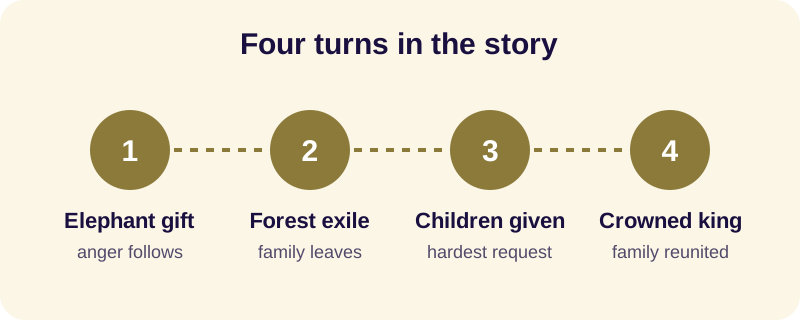
The vow is tested almost at once. Vessantara gives away his kingdom's sacred rain-bringing elephant to envoys from a drought-stricken neighboring land, and his own subjects, furious at the loss, demand that he be sent away. He leaves for the forest with his wife Maddi and their two young children, hoping to live quietly away from the court. There an old and poor brahmin named Jujaka, sent by his much younger wife to find servants, comes upon the family and asks Vessantara for the children themselves. True to his vow, Vessantara gives them away, and Maddi returns from gathering forest food to find them gone.
The story does not end in that forest clearing. The children are later ransomed by their grandfather, the family is reunited, and Vessantara is finally called home to take up the crown — the beggar's hard request turns out to be one of the last steps on the road back to the throne. For the fuller telling, with its full cast and its resolution, the complete Vessantara Jataka retelling carries the whole arc from palace to exile and back again.
Across the Buddhist world this tale is often treated as the crown of the Jataka collection, the story told last and listened to most carefully, because it asks more of its listener than almost any other.
Why does Vessantara give his children to the beggar?
This is the question almost everyone asks the first time they hear the story, and it is meant to unsettle. The Jataka tales are not case studies meant to be copied; many of them, like the Golden Deer or the Monkey King, place an extreme or even impossible situation in front of the listener in order to make one quality visible at its full strength. Vessantara's tale is the traditional culmination of the perfection of giving, pushed further than any ordinary life would ask of a reader.
Read that way, the beggar in the story stands for whatever life eventually asks us to release before we feel ready — a plan, a possession, a version of ourselves we expected to keep for longer. The crown Vessantara is finally given, in the logic of the tale, belongs to someone who has already practiced letting go of smaller things first.
What does this story teach about generosity and letting go?
The deeper teaching sits closer to non-attachment than to charity in the ordinary sense of the word. Giving, in this story, is the outward sign of something inward: the less tightly Vessantara holds anything, the less its loss can wound him. That is a different proposal from simply being generous with what is easy to spare, and it rewards sitting with rather than rushing past on the way to sleep.
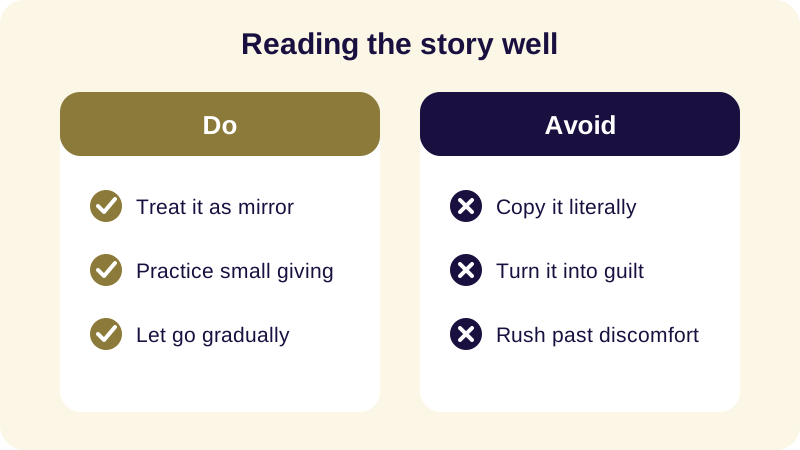
Three smaller threads run through the larger story and are easier to carry into an ordinary week than the story's central act:
- Giving is tested by what it costs, not by how it looks from the outside.
- Holding loosely to possessions and plans is practiced in small moments long before it is needed in large ones.
- A request that feels unreasonable can still be a teacher, even when it cannot be granted in full.
Buddhist ethics does not ask a listener to copy Vessantara's exact choice. The Five Precepts describe a much gentler, everyday training in generosity and restraint, and the Middle Way warns against either extreme — neither grasping everything nor renouncing everything by force. Vessantara's tale sits at one far edge of the tradition precisely so the middle ground is easier to see and easier to live.
How can this story help a restless mind at night?
A mind that will not settle at night is often still gripping something left over from the day — an argument unfinished, a worry unsolved, a small loss not yet accepted. Following the long, patient shape of a story like Vessantara's gives that gripping mind somewhere else to rest: the plot is already decided, nothing is left to solve, and the ending is calm rather than open.
The app narrates stories like this one slowly, built for listening in the dark rather than for daytime study. It also holds shorter Jataka tales and the Buddhist stories for sleep collection for nights when a gentler, shorter tale suits better than the full sweep of exile and return.
None of this replaces care for a genuinely sleepless or anxious mind; ongoing insomnia or persistent worry is worth raising with a doctor rather than a story. What a tale like this offers on an ordinary restless evening is simpler: one slow narrative, told at the pace of someone who has already let go of what it describes.
Inside the app, this story sits alongside the rest of the Jataka tales, episodes from the Buddha's life, and Dhammapada verses, each narrated in English with a sleep timer that pauses the story and sounds rather than fading them, so the room stays quiet once you have drifted off. Background playback and offline listening mean the story can keep running on a locked, dark screen without any further tapping.
Frequently Asked Questions
What is the Buddhist story about a king and a beggar?
It is the Vessantara Jataka, Jataka 547, the final tale in the 547 Jataka tales. A prince named Vessantara, raised to inherit his father's throne, has vowed never to refuse anyone who asks him for something. A poor brahmin, Jujaka, eventually asks him for his own children, and he gives them away.
Why does the prince give his children to a beggar?
The story pushes generosity to its furthest possible edge on purpose, the way other Jataka tales use an extreme situation to make one quality visible. It is not meant as literal guidance for family life, but as a mirror for the reader's own attachments and how tightly they are held.
Is the Vessantara Jataka a real Buddhist story?
Yes. It is counted as Jataka 547, part of the traditional collection of 547 Jataka tales that describe the Buddha's earlier lives, and it survives as one of the most widely told stories in that collection.
How can a story like this help with sleep?
A long, settled story gives a racing mind somewhere else to rest, since the ending is already decided and nothing is left to solve. It is not a treatment for insomnia; ongoing sleep trouble is worth discussing with a doctor rather than relying on a story alone.