Published
Quick answer
A Buddhist story about adapting to change tells how the Buddha left six years of extreme fasting for a workable Middle Way. It shows that changing course is clarity, not failure, useful for a mind resisting change at night.
Key takeaways
- The Buddha changed course after six years of extreme fasting brought no insight.
- Adapting to change followed from seeing clearly, not from giving up on effort.
- The Middle Way keeps steady practice while adjusting what no longer works.
- Impermanence (anicca) explains why resisting a change already made adds extra suffering.
- Hearing this story slowly at night can soften resistance to an unwelcome change.
A Buddhist story about adapting to change comes straight from the Buddha's own life, from the night he gave up six years of extreme fasting and chose a workable Middle Way instead. It shows that changing course under new evidence is not failure but clear sight.
The story is worth knowing on its own terms, and it is also useful at two in the morning, when a mind circles an unwelcome change it cannot undo. The Buddha's turn away from a method that was clearly failing him is one of the oldest examples in the tradition of letting go of a plan because the plan stopped working.
See also: Buddhist Story About a Stubborn Donkey and Its Lesson.
What story shows the Buddha adapting to change?
Before his awakening, Siddhartha Gautama tried the hardest path available to a seeker of his time. He joined ascetics who ate almost nothing, slept on thorns, and held their breath until they shook. For six years he pushed his body past what it could bear, believing that enough suffering would force open the truth he was looking for.
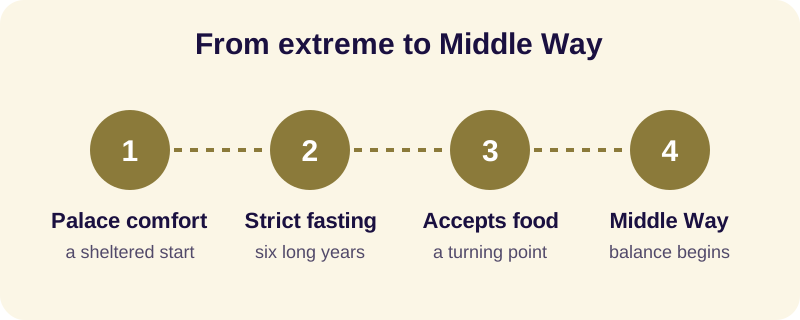
It did not work. He grew so thin, the old accounts say, that pressing his stomach he could feel his spine. He was closer to dying than to understanding anything. One day he accepted a simple offering of food from a passer-by, against the disapproval of the companions he had practised alongside for years. They left him, certain he had failed. He sat down instead, rested, and began again with a steadier body and a different approach: not indulgence, not punishment, but a workable path between the two, under what would come to be called the Bodhi tree.
That sitting led to his awakening and, soon after, to the Four Noble Truths and the Noble Eightfold Path, taught through what the tradition calls the Middle Way. None of it would have happened if he had stayed loyal to a method that was no longer serving him.
Why did the Buddha need to change his approach?
The simplest answer is that the old approach had stopped producing results, and he was willing to look at that plainly instead of trying harder at the same thing. There is also a deeper reason, tied to the Buddhist teaching on impermanence: everything conditioned changes, including a body, a plan, and a method of practice. A path that fits one stage of a journey can stop fitting the next one.
This is also the logic behind impermanence as a teaching rather than just an observation: resisting a change that has already happened is its own, separate source of distress, on top of whatever the change itself cost. The Buddha's six years were not wasted either way. They showed him exactly where the edge of usefulness was, which he could only have learned by going there.
What does this story teach about handling change at night?
A racing mind at night is often rehearsing a version of this same scene: a plan that changed, a diagnosis, a job, a relationship, a routine that no longer fits, and the mind keeps running the old version forward as if insisting hard enough could restore it. The story offers a quieter alternative. Noticing that a method has stopped working, and adjusting, is not a defeat to replay. It is simply what a changing situation asks of anyone inside it.
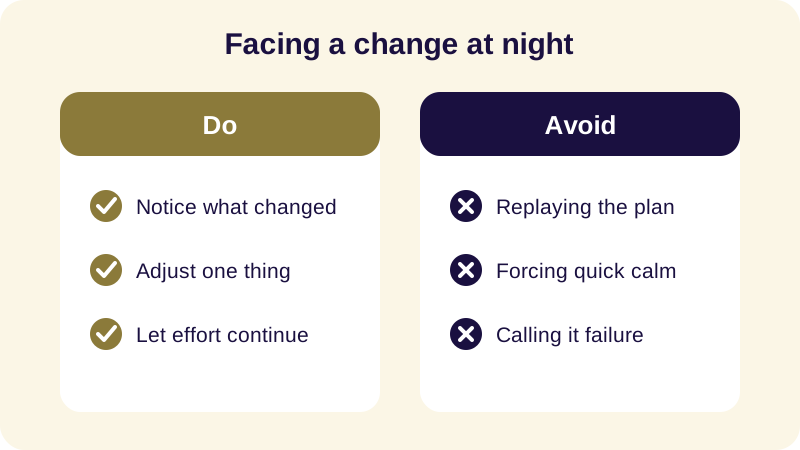
None of this means forcing acceptance on command, which rarely works and can feel like one more task on a long list. It means holding the question more loosely: what here has already changed, and what small adjustment would actually fit it, rather than the one version I keep insisting on.
How can I bring this story to a restless mind before sleep?
Hearing the story slowly, instead of thinking it through, is usually gentler at night. A few ways to use it:
- Follow the shape of it, not the lesson. Let the scene — the thin body, the offered food, the walk to rest under a tree — carry your attention instead of trying to extract a moral while lying in bed.
- Pair it with the breath. A few slow breaths before or after the story settles the body the way the Buddha's own change of diet settled his.
- Keep one line for the morning. "This has already changed; what fits it now?" is enough to carry forward without turning the night into a planning session.
Other tellings from the tradition work the same way. The Jataka tales, the 547 stories of the Buddha's earlier lives, are full of characters who adapt to a changed situation — a new danger, a broken trust, a lost advantage — and the Buddhist wisdom on accepting change found across the Dhammapada's 423 verses returns to the same idea from many angles.
The app narrates this part of the Buddha's life, along with Jataka tales and Dhammapada verses, slowly enough to listen to in the dark, with a sound mixer for rain or singing bowls underneath if that helps you settle further. A breath awareness or body scan practice before the story can settle the body first, and the sleep timer pauses the story and sounds for you at 10, 20, 30 or 60 minutes if you drift off before it ends.
Frequently Asked Questions
What is the Buddhist story about adapting to change?
It is the account of the Buddha abandoning six years of extreme fasting, accepting food again, and choosing the Middle Way instead. He changed course because the old method had clearly stopped working, and that change led directly to his awakening under the Bodhi tree.
Is this story actually part of the Buddhist tradition?
Yes. It comes from traditional accounts of the Buddha's own life, unlike popular tales such as Two Wolves or Sai Weng's horse, which are not Buddhist in origin. This one is grounded in the life of Siddhartha Gautama himself.
How can this story help with a change I can't control?
It reframes adjusting to new circumstances as clear seeing rather than defeat. The Buddha did not abandon effort, only the part of his method that was harming him, which can be a gentler way to think about a change you are resisting at night.
Can I listen to this story before bed?
Yes. The app narrates the Buddha's life, Jataka tales, Dhammapada verses and Zen parables slowly, suited to listening in the dark, and its sleep timer stops the story for you if you fall asleep before it ends.