Published
Quick answer
The classic Buddhist story about letting go is the parable of the raft: a traveler builds a raft to cross a river, then must decide whether to keep carrying it. The teaching is to set down even useful things once they've served their purpose.
Key takeaways
- The raft parable teaches that even useful tools should be set down once they've done their job
- Letting go isn't rejection — it's releasing what no longer serves you, including nighttime thoughts
- The Kisa Gotami story shows letting go of grief through shared human experience, not force
- A racing mind at night often grips a thought the way a traveler might cling to an unneeded raft
A Buddhist story about letting go that gets told again and again is the parable of the raft. A traveler builds a raft to cross a dangerous river, reaches the far shore safely, and then has to decide what to do with it.
The story is short, plain, and almost deceptively simple. It comes from the Pali Canon, in a discourse called the Alagaddupama Sutta, and it was told by Siddhartha Gautama himself to make a point about attachment — not just to harmful things, but to good and useful ones too.
What is the Buddhist story about letting go?
A man is traveling and comes to a wide stretch of water. The near shore is dangerous and uncertain; the far shore looks safe. There is no bridge and no boat, so he gathers branches, reeds, and grass, and ties them together into a raft. Paddling hard with his hands and feet, he crosses the river and arrives safely on the other side.
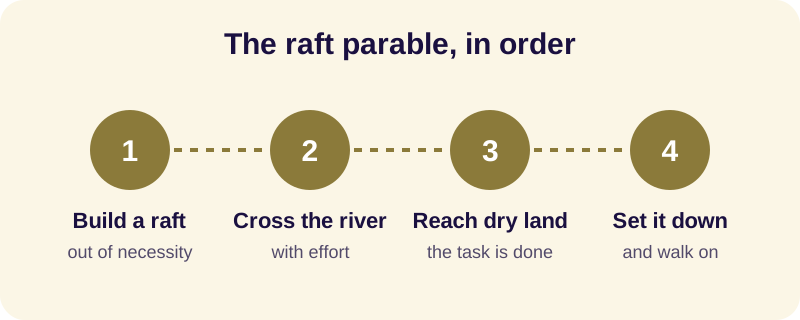
Standing on the far bank, the traveler looks back at the raft that saved him and thinks: this raft has been so helpful, maybe I should hoist it onto my shoulders and carry it with me wherever I go. The Buddha asks his listeners: would that be a sensible thing to do? The answer is obviously no. A wiser choice is to leave the raft on the bank, thank it in a manner of speaking, and continue the journey unburdened.
Why does the Buddha say to let go, even of good things?
The raft in this story stands for something specific: the Dharma itself, the teaching that gets a person safely across the water of suffering. Even the teaching, the Buddha says, is "for crossing over, not for retaining." If that is true of the teaching, it is even more true of the smaller things people carry — old arguments, finished griefs, decisions already made.
This is the part of the parable that tends to surprise people. Most teachings about letting go focus on releasing what clearly hurts: anger, resentment, fear. The raft parable goes further. It says attachment can form around useful, even wholesome things too — a method that worked once, an identity built around having overcome something, a story you tell yourself about who you are. The raft did real work. That is exactly why it's tempting to keep carrying it.
The deeper point connects to the Four Noble Truths: suffering is tied to clinging, and clinging doesn't limit itself to things that are bad for you. A mind that grips even good things too tightly is still gripping. Letting go, in this sense, isn't about judging the raft as worthless. It's about recognising when its job is finished.
What other Buddhist stories teach letting go?
The raft parable isn't the only one. A quieter, sadder story often told alongside it is that of Kisa Gotami, a woman whose young child died. Unable to accept the loss, she carried the child's body from house to house searching for a medicine to revive him. She was eventually told to find a mustard seed from any household that had never known death. She went from door to door and found mustard seed everywhere — but never a house untouched by loss. Slowly she understood: death touches every household, and her grief, as sharp as it was, was not hers alone. She was able to let go of the child's body and bury him, and she went on to live a changed life.
Where the raft parable is almost logical — a clear-eyed look at usefulness and timing — the Kisa Gotami story works through shared experience rather than argument. It doesn't tell her to stop grieving. It shows her, gently, that she is not uniquely singled out, and that recognition is what allows the letting go to happen on its own. Zen traditions carry similar stories, often shorter and stranger; a few are collected in our piece on Zen stories, including one about two monks and a river crossing that makes a nearly identical point to the raft parable in far fewer words.
How can this story help a restless mind at night?
Lying awake, most people aren't thinking about rivers or mustard seeds. They're replaying a conversation, rehearsing tomorrow, or circling back to a decision made hours or years ago.
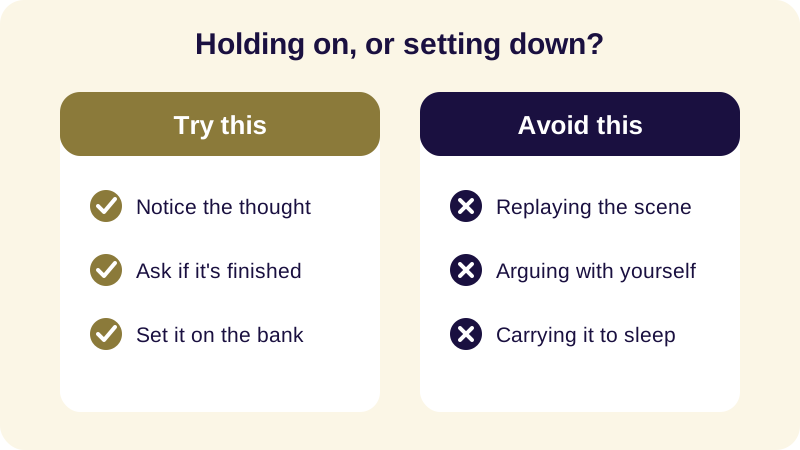
But the pattern is the same one the raft parable describes: something that may have been useful once — vigilance, problem-solving, caution — is still being carried long after the crossing is finished. You can use the raft as a mental image rather than a lecture. When a thought surfaces for the third or fourth time, picture it as a raft already on the shore — it did its work earlier in the day, and dragging it into bed now adds weight without adding safety.
This isn't a trick for falling asleep instantly, and it isn't a treatment for anything; it's simply a way of naming a familiar habit of mind so it loses a little of its grip. Reading or hearing the story itself, slowly, before bed can help more than reasoning about it. Short Buddhist narratives are built for exactly this — our guide to Dhammapada verses for a restless mind covers short passages with a similar quality, and mindfulness for sleep walks through simple ways to notice and release a thought without wrestling it.
The Buddha Story app narrates the parable of the raft alongside other short Buddhist stories, told slowly for listening in the dark rather than studying in daylight. It pairs narrated stories with relaxing sounds like rain or singing bowls, a sleep timer that stops the story for you, and offline listening, so the raft — and whatever else the mind has been carrying — can be set down before the eyes close.
See also: The Buddhist Story About the Lotus Flower Explained.
Frequently Asked Questions
What is the Buddhist story about letting go called?
It is usually called the parable of the raft, found in the Alagaddupama Sutta. A traveler crosses a dangerous river on a raft he built, then wonders whether he should carry the raft on his shoulders afterward. The Buddha says no — set it down and walk on.
What does the raft parable actually teach?
That even good, useful things — teachings, habits, even the raft itself — are meant to be used and then released, not carried forever out of habit or attachment. The point is not to cling even to what helped you, once it has done its work.
Is letting go the same as giving up?
No. Letting go in this teaching means releasing something because its purpose is finished, not abandoning responsibility or effort. A traveler who sets down a raft on dry land hasn't failed the crossing — he has simply recognised the crossing is done.
Are there other Buddhist stories about letting go of grief?
Yes. The story of Kisa Gotami, who searched for a cure for her dead child and was sent to find a mustard seed from a house untouched by death, is a well-known Buddhist story about letting go of loss through shared human experience rather than denial.
How can this story help with a racing mind at night?
It gives the mind a concrete image for a familiar pattern: gripping a thought past its usefulness. Picturing the raft on the riverbank can make it easier to notice a replaying worry and quietly set it down instead of carrying it into sleep.