Published
Quick answer
What did Siddhartha Gautama do after six years of wandering? He sat beneath the Bodhi tree and meditated through the night, reaching enlightenment at dawn, without returning to the palace or asking any god for advice.
Key takeaways
- The correct answer: he sat beneath the Bodhi tree and meditated, not back at the palace or consulting a god.
- Six years of wandering had already included endless searching and asking other teachers for answers.
- Vishnu is a Hindu deity; Buddhist accounts of this night do not feature him giving advice.
- The turning point was turning inward after years of looking for the answer somewhere outside himself.
- The story is often retold as a model for sitting still with a difficult question rather than escaping it.
What did Siddhartha Gautama do after six years of wandering? He stopped searching outside himself, sat down beneath a Bodhi tree, and meditated there until he reached enlightenment at dawn.
That is the short version. The longer version explains why the other common answers to this question — that he went home, that he consulted a Hindu god, or that he simply kept asking people for advice — do not match the story as it has been told for roughly 2,500 years.
Why had he been wandering for six years in the first place?
Siddhartha Gautama left a comfortable life as a young prince because comfort had not answered the questions he carried: why people age, sicken, and die, and whether any of it can be met without despair. For years afterward he studied with respected teachers, mastered the meditative states they taught, and then pushed his own body through extreme fasting and austerity, on the theory that suffering the body enough might free the mind.
None of it worked. By the end of six years he was weakened, no closer to an answer, and the methods available to him had been exhausted. This is the detail that the "returned to his family's palace" and "continued asking others" answers both miss: he had already spent the six years doing the asking, and going home would have meant abandoning the question rather than answering it. What changed was not where he looked, but how.
What happened under the Bodhi tree?
He chose a spot beneath a Bodhi tree, near a river, and sat down with a simple resolve: not to get up until he had found what he was looking for. This is the part of the story most traditions agree on in some form, and it is the actual answer to what he did after six years of wandering.
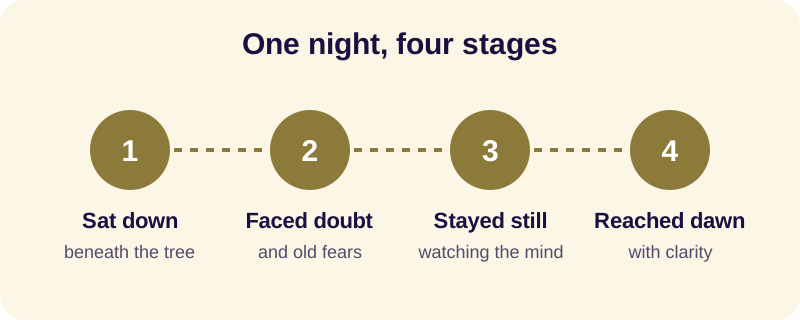
The accounts describe inner resistance arising before any outer peace — restlessness, fear, old desires, all personified in the tradition as Mara. None of it was answered by leaving the seat. He stayed, kept his attention on what was actually happening in the body and mind, and by morning had arrived at a clear understanding of suffering and how it ends. That understanding became the Four Noble Truths, and the tree became known as the place of awakening.
Why don't the other answers fit the story?
Each of the other common answers sounds plausible, which is exactly why they are worth untangling one at a time.
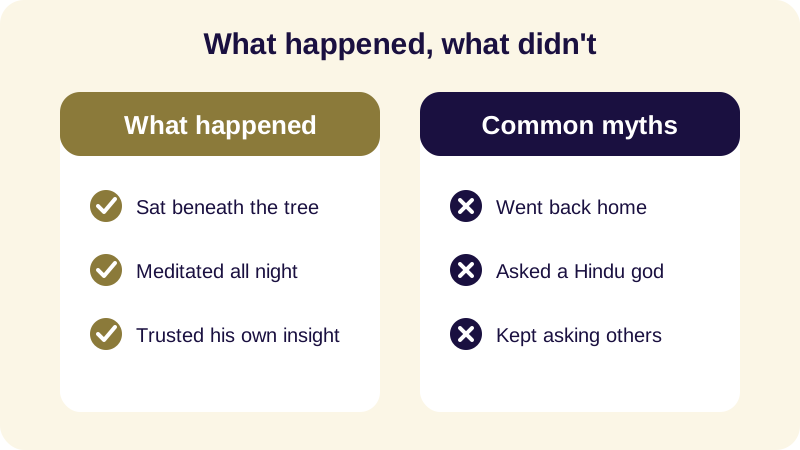
Returning to the palace does not fit, because the whole six years had already been a refusal to go back to that life; walking away from the search would have undone the point of leaving in the first place. Asking the Hindu god Vishnu for advice does not fit either, because Vishnu belongs to a different tradition altogether and plays no part in the Buddhist telling of this night — the inner opposition Siddhartha met is described instead as Mara, a figure of doubt and temptation, not a source of guidance. And "continued asking others how to end suffering" describes the six years that had just ended, not what came after them. The turn under the tree was precisely the decision to stop outsourcing the question.
See also: How Did Siddhartha Gautama Find an Answer?.
It is worth noticing what made that turn possible: a path that was neither indulgent nor punishing, which the tradition later named the Middle Way. Extreme comfort in the palace and extreme deprivation on the road had both failed him. What was left was steady, moderate effort — which is also a reasonable description of what a good bedtime practice looks like.
What can this night offer a mind that won't settle?
You do not need to be solving the nature of suffering to recognise the shape of this story. A racing mind at night is often doing exactly what Siddhartha had been doing for six years: searching outward, replaying conversations, hoping the next thought will be the one that finally settles things. The story's quiet suggestion is that the answer sometimes comes from staying still with the question rather than chasing it further.
This is also why the fuller account of that night — the fear, the doubt, the eventual clarity — reads less like a sermon and more like a story, and why it is often told slowly as one. If you want the whole account in sequence rather than in fragments, the complete story of the Buddha's enlightenment walks through it step by step, and a companion piece looks specifically at how the Buddha attained enlightenment across that single night.
None of this is a claim that listening to the story will solve insomnia or anxiety; persistent sleep or mental health problems are worth taking to a doctor, not to a story. What the story offers on an ordinary restless evening is smaller and more modest: a reminder that sitting with a difficult night, rather than escaping it, is itself a known and old practice. If you want to try the sitting itself rather than just reading about it, a short beginner's meditation guide covers how to start, and a piece on Buddhist practice for a sleepless mind applies the same idea directly to the hours before sleep.
The Buddha Story app narrates this episode, along with the rest of the Buddha's life, the Jataka tales, and Dhammapada verses, read slowly for listening in a dark room. A sleep timer stops the story for you instead of letting it run all night, and the narration can be downloaded for offline, background listening once the light is off.
Frequently Asked Questions
What did Siddhartha Gautama do after six years of wandering?
He sat down beneath a Bodhi tree and meditated through the night. He did not return to his family's palace, and the Buddhist accounts of this night do not involve him consulting the Hindu god Vishnu or seeking out another teacher.
Why did Siddhartha Gautama wander for six years before sitting under the tree?
After leaving the palace, he studied with teachers and practised severe asceticism, testing every method he was offered. None of it ended his search, so after six years he set the extreme practices aside and sat down to look directly at his own mind instead.
Is the story of Siddhartha and Vishnu part of Buddhist teaching?
No. Vishnu is a deity from Hindu tradition, not a figure in the Buddhist account of this night. The Buddhist texts describe the Buddha meeting inner doubt and fear, often personified as Mara, and meeting it with steady attention rather than outside advice.
Did Siddhartha Gautama keep asking other people how to end suffering?
He had already spent years doing exactly that, studying under teachers and ascetics with no lasting result. The shift after six years was the opposite: he stopped asking others and sat with the question himself until it was answered.
What happened under the Bodhi tree?
Tradition describes a single night of sustained meditation in which Siddhartha Gautama faced inner resistance and distraction, kept his attention steady, and arrived at a clear understanding of suffering and its end by morning, becoming the Buddha.