Published
Quick answer
How to accept change using Buddhist wisdom starts with seeing change as anicca, impermanence, the Buddha's teaching that conditions always arise and pass. Practice noticing that truth in small moments rather than resisting it.
Key takeaways
- Buddhism teaches that all conditioned things change; resisting that fact, not change itself, causes distress
- Clinging to how things were is a form of attachment the teachings call upadana
- Naming a change plainly and breathing with it reduces the mental fight against it
- Accepting change is not passivity; it still allows care, planning and grief
- Persistent distress about a major loss or change belongs with a doctor, not only a practice
How to accept change using Buddhist wisdom starts with a single shift: stop treating change as an intrusion and start treating it as the ordinary texture of being alive. Buddhist teaching gives this shift a name — anicca, impermanence — and a set of practices for actually living it, not just agreeing with it in theory.
What does Buddhist wisdom say about change?
The teaching is plain: everything conditioned arises, changes and passes. This is one of the oldest observations in the tradition, repeated across the Dhammapada and the discourses attributed to Siddhartha Gautama. It is not a mood or a comforting phrase. It is offered as a description of how things actually work — bodies, relationships, jobs, weather, moods, all of it in motion, none of it built to stay still.
Impermanence is usually grouped with two companion observations: that clinging to what changes brings dissatisfaction, and that nothing has a fixed, separate self to protect. Together these form the backbone of the Four Noble Truths, which describe not just that life includes difficulty but why, and what can be done about it. For a fuller account of the doctrine itself, see the article on Buddhist teaching on impermanence.
Why is change so hard to accept?
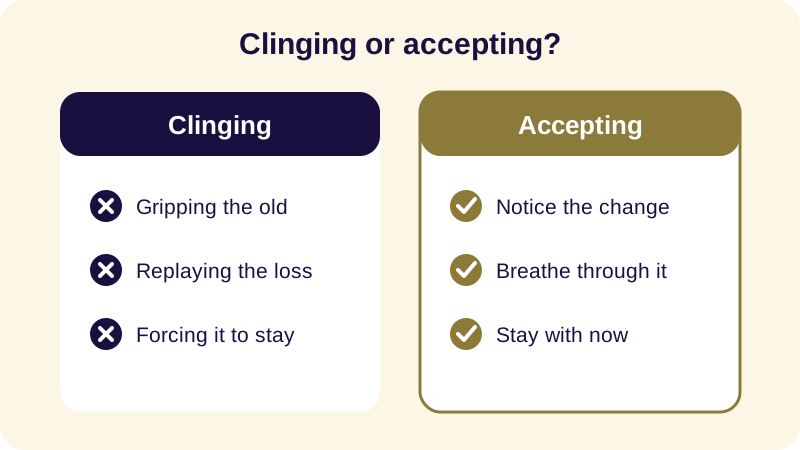
Not because change is unusual, but because the mind quietly expects things to hold still. A job, a relationship, a body at a certain age, a plan for the next ten years — we build a picture and then treat any departure from it as an error to be fixed or fought, rather than the normal next frame of an ever-moving picture. The tradition calls this grasping upadana, clinging, and names it as the step between an ordinary preference and real suffering.
There is also a second layer worth separating out. The change itself is one event; the story the mind adds on top — this shouldn't be happening, I should have prevented it, what does this mean about me — is another. The second arrow teaching makes exactly this distinction: the first arrow is the event, unavoidable; the second is the extra suffering added by resistance, and it is the one you have some influence over. The same distinction runs through the wider discussion of suffering and acceptance in Buddhist thought.
How can I practice accepting change tonight?
A short, repeatable sequence works better before sleep than trying to reason your way to peace about something large. The steps below are plain and can be done lying down, in the order given.
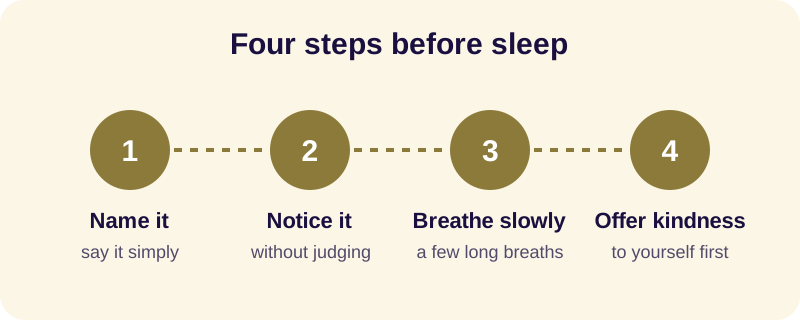
- Name the change plainly. One sentence, no commentary: "my routine has changed" or "this relationship is ending." Naming it in plain words takes it out of the vague, circling form it has at 2am.
- Notice the resistance itself. Where does the "this shouldn't be happening" show up in the body — tight chest, clenched jaw? Just notice it, the way the mindfulness for sleep approach asks you to notice any sensation, without trying to argue it away.
- Breathe with it, not against it. A few slow breaths, nothing forced. The point is not to feel differently right away; it is to stop adding effort on top of what is already there.
- Offer yourself a line of loving-kindness. Something simple, in the spirit of metta: "may I meet this gently." The four brahmaviharas — loving-kindness, compassion, joy and equanimity — are the traditional supports for exactly this kind of moment.
What story shows Buddhist wisdom about change?
The story of Kisa Gotami is the clearest example in the tradition. A grieving mother is sent to find a mustard seed from a household that has never known death, and discovers, house by house, that every family has lost someone. The lesson is not that grief doesn't matter; it is that change and loss are universal conditions, not a private failure or a punishment aimed at her alone.
A smaller, gentler version of the same idea appears in the broken bowl story, where a monk's attachment to an ordinary object becomes the occasion for seeing how tightly we can hold even small, replaceable things. Both stories work the same way a sleep story works generally: they give the mind a narrative shape to rest in instead of its own circling thoughts, which is also why they are told slowly, at night, rather than analyzed in daylight.
Is accepting change the same as giving up?
No, and this is the point people new to the teaching most often get wrong. The Middle Way sits between two extremes: white-knuckled control over outcomes, and flat indifference to everything. Accepting change does not mean you stop caring for people, stop making plans, or stop grieving what mattered. It means you stop requiring the plan to guarantee permanence, and you stop treating every shift as proof that something has gone wrong with you personally.
This connects to a wider teaching called dependent origination — the observation that nothing arises on its own, everything is conditioned by what came before it. Seen through that lens, change isn't an exception breaking the rules; it's the rules. The article on dependent origination goes into this in more depth for anyone who wants the fuller picture.
Practically, most people find it easier to hold this teaching through repetition than through a single insight. A short verse read at night, a story heard slowly in the dark, a few breaths taken with the resistance rather than against it — these small, repeated acts are what the tradition actually asks for, more than a dramatic change of heart in one sitting.
If tonight's unrest is tied to a specific change you keep replaying, the guide to a racing mind at night covers the same ground from the angle of the thinking itself, which pairs naturally with the practices above.
Frequently Asked Questions
What is the core Buddhist teaching on accepting change?
The core teaching is anicca, impermanence: everything conditioned arises and passes away, including health, relationships, moods and circumstances. Suffering comes less from change itself and more from expecting things to stay fixed. Seeing this clearly is the beginning of accepting change calmly rather than fighting it.
Does accepting change mean I shouldn't try to improve things?
No. The Middle Way rejects both rigid control and total passivity. You can still plan, care for people and work toward goals; acceptance means not demanding that effort guarantee permanence, and not treating every shift as a personal failure or threat.
How is accepting change different from suppressing my feelings about it?
Suppression pushes feelings away and they tend to return louder. Buddhist practice asks you to notice the feeling honestly, name it, and let it move through awareness without adding a second layer of resistance or self-criticism on top of it.
Can a short nightly practice really help with big life changes?
A short practice will not resolve a major change, but it can lower the nightly replay that keeps a mind alert. For change tied to grief, loss or ongoing distress, pair any practice with support from a doctor or counselor.
Where should I start if I'm new to this?
Start with one short teaching rather than the whole tradition at once. A simple nightly reading on impermanence, paired with a few slow breaths naming what has changed, is enough to begin; depth comes with repetition, not more material.