Published
Quick answer
A Buddhist story about overcoming fear tells how the Buddha faced a charging elephant with steady breath and loving-kindness instead of running. The same approach can steady an anxious mind at night.
Key takeaways
- The Buddha met a charging elephant with calm breath instead of running or fighting.
- Fear itself isn't the problem; the story and panic added on top of it is.
- Loving-kindness (metta) gives a frightened mind something steady to do instead of spinning.
- The same steady-breath approach can be used for ordinary worry and fear at night.
- Persistent or severe fear belongs with a doctor, not just a story or a practice.
A classic Buddhist story about overcoming fear tells of a murderous elephant let loose on a city street, and how the Buddha met it without running. The story is short, but it holds a complete lesson in what to do when a mind suddenly goes cold with dread.
What is the Buddhist story about overcoming fear?
The traditional account describes a royal elephant named Nalagiri, maddened with drink and driven down a narrow road where the Buddha was walking with his students. People scattered and climbed onto rooftops, certain they were about to watch a man be trampled. The Buddha did not run. He stood where he was, let his breath settle, and held toward the charging animal the same warmth he would offer anyone in pain. According to the story, the elephant slowed, lowered its trunk, and stopped in front of him.
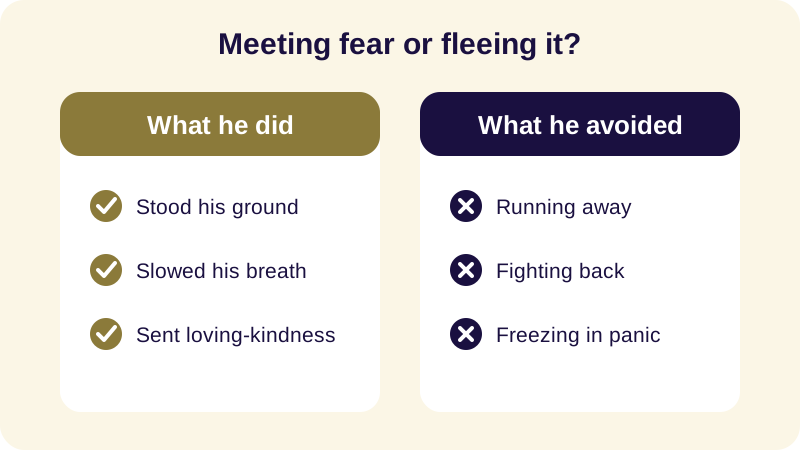
Nothing in the story claims the Buddha had some special immunity the rest of us lack. What is being described is a method: meeting danger with a steady body and an open heart rather than with flight, fight, or freeze. The tale is sometimes told alongside the episode of Mara under the Bodhi tree, where fear shows up not as an animal but as doubt, memory, and desire — and is met the same way, by staying present and awake rather than by arguing it away.
What does the story actually teach about fear?
The lesson is not "don't be afraid." Fear is a normal signal, and the story does not pretend the Buddha felt nothing as the elephant thundered toward him. What changes is the second layer: the story the mind adds on top of the raw alarm — the dread about the dread, the replaying, the certainty that this feeling means disaster. That second layer is where much of a person's suffering around fear actually lives, a point explored further in writing on Buddhism and anxiety.
See also: A Buddhist Story About Adapting to Change.
The elephant story also points to loving-kindness (metta, warm goodwill) as a practical response, not just a nice idea. Turning attention toward goodwill — even goodwill aimed at the source of the fear — gives the mind something steady to do besides spin. It is the same mechanism behind the four brahmaviharas, the four qualities of heart the tradition holds up as a way of steadying an agitated mind.
How does this story help with fear at night?
Fear at night rarely wears the shape of a charging elephant. It is usually smaller and quieter — a worry that will not resolve, a memory that will not settle, a vague sense that something is wrong. The shape is different, but the instructions drawn from the story still apply: do not run from the sensation by distracting harder, do not fight it by arguing with your own mind, and do not freeze by lying rigid and willing it to stop.
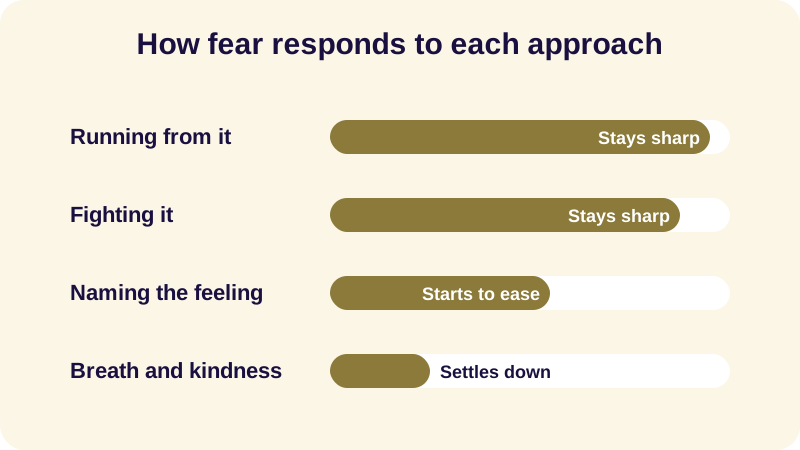
Instead, the story suggests something closer to staying: noticing the sensation in the body, slowing the breath on purpose, and — if it feels right — directing a small, quiet goodwill toward whatever is frightening you, even if it is only your own racing thoughts. This is close to the approach described in guidance on how to quiet a racing mind at night, which covers the same ground from the angle of ordinary restlessness rather than myth.
Are there other Buddhist stories about facing fear?
Yes. The tradition is full of them, because fear is one of the most common human experiences it addresses. The Jataka tales — the 547 stories of the Buddha's earlier lives — include animals and travelers who face predators, storms, and enemies, usually resolving the danger through patience or cleverness rather than force. One frequently told episode describes a feared bandit who, confronted calmly by the Buddha instead of attacked or fled from, puts down his weapon and changes course entirely — fear, in that story, dissolving the moment it is faced rather than avoided.
Zen literature tells its own, shorter versions of the same idea — a monk startled by a sound in the dark, a student convinced a shadow is something else. These brief exchanges are collected as koans rather than narratives, but the point lands the same way: look directly at the thing you are afraid of, and it is very often smaller, or different, than it seemed from a distance. Readers who like that compressed style may enjoy the Zen stories collected elsewhere on the site.
How can I use this story tonight?
- Read or listen to the story once, slowly, without trying to extract a lesson from it yet.
- Notice where in your body fear usually shows up first — chest, stomach, throat — so you recognize it sooner next time.
- When it arrives, name the sensation plainly instead of the story your mind is building around it.
- Slow your breath on purpose for a few rounds, the way the Buddha is described doing before the elephant reached him.
- Offer a small, specific phrase of goodwill — to yourself, or to whatever is frightening you — and let the mind rest there instead of spinning.
None of this requires belief in anything in particular. It is a sequence anyone can try, built on a story that has been retold for roughly 2,500 years precisely because the underlying situation — something frightening approaching, and a mind deciding how to meet it — has not changed much.
The app narrates this story and others like it — including the Jataka tales and episodes from the Buddha's life — slowly enough to listen to in the dark, paired with a sleep timer that stops the story for you. If you would rather start with something gentler before trying this one, the collection of Buddhist bedtime stories is a softer place to begin.
Frequently Asked Questions
What is the Buddhist story about overcoming fear?
It is the traditional account of an elephant named Nalagiri, maddened and sent down a street where the Buddha was walking. Instead of fleeing, he stood still, steadied his breath, and met the animal with loving-kindness. The elephant slowed and stopped in front of him, and the story is retold as a model for facing any fear directly.
Did the Buddha really face a charging elephant?
The episode comes from the oral and written tradition of the Buddha's life rather than from a verifiable historical record. Whether or not it happened exactly as told, it has been retold for roughly 2,500 years as a teaching story about meeting danger with steadiness rather than panic.
How does loving-kindness help with fear?
Loving-kindness, or metta, gives a frightened mind something concrete to do besides replay worst-case thoughts. Directing warmth toward yourself or even toward the source of fear occupies the same attention that would otherwise spiral, which is part of why it appears across the four brahmaviharas as a steadying practice.
Can this story actually help me fall asleep?
It can help the way any calming story helps: by giving a racing mind a slower, kinder thing to follow instead of its own alarm. It is not a treatment or a guaranteed fix, just a quiet habit to try alongside steady breathing when fear or worry shows up at night.
What if my fear at night is more than a passing worry?
If fear is constant, severe, or interferes with daily life, it belongs with a doctor rather than a story or a breathing practice. This article describes a calming habit for an ordinary restless evening, not a treatment for an anxiety condition.