Published
Quick answer
Calming stories to listen to before bed work best when they are slow-paced, low-conflict and end quietly, which is why many people choose simple Buddhist tales like the Jataka stories or the Dhammapada's verses to narrate them gently into sleep.
Key takeaways
- Slow, low-conflict stories settle a busy mind better than suspenseful or fast-paced ones.
- Jataka tales and Dhammapada verses give a predictable shape that's easy to drift off to.
- Starting the story early and using a sleep timer avoids reaching for your phone in the dark.
- Pairing a story with slow breathing or a body scan helps if the mind is still busy after it ends.
- Ongoing sleep trouble is worth raising with a doctor rather than relying on stories alone.
Calming stories to listen to before bed work by giving a busy mind something slow and steady to follow instead of the day's replay. A gentle, low-conflict story often loosens the loop of thoughts that keeps you staring at the ceiling better than a thriller, a true-crime episode or the news ever could.
Most advice about calming bedtime stories stops at "pick something boring." That is partly true, but it misses what actually makes a story settling rather than merely dull. The shape of the story matters more than its subject.
What makes a story calming enough for bed?
A calming story is slow, has few characters, and moves toward a quiet resolution instead of a twist. It asks nothing of you — no plot to track, no tension to resolve — so the part of your mind that likes to solve problems has nothing left to do.
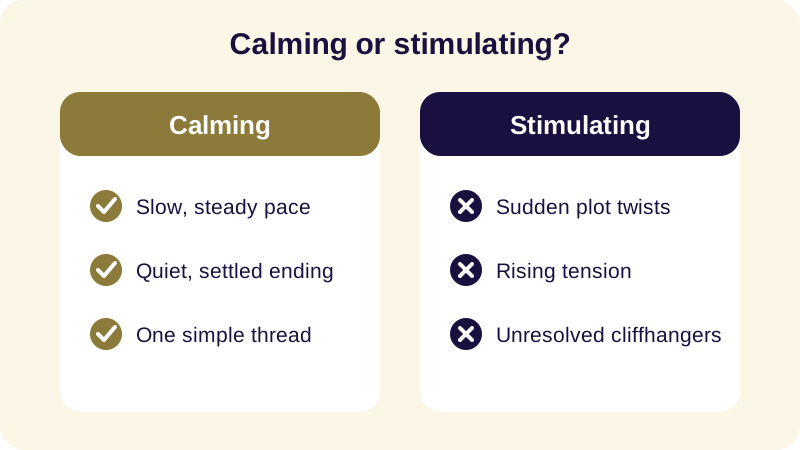
Buddhist stories were shaped for exactly this kind of listening long before anyone called it a sleep aid. Jataka tales, the 547 stories of the Buddha's past lives collected in the Pali tradition, were composed for recitation: a short situation, a simple choice, a settled ending. The Dhammapada's 423 verses work the same way, often attached to a brief story explaining why a particular line was spoken. Nothing in either collection is built to surprise you.
See also: How to Calm Down Before Sleep Without Medication.
This is also why a lot of generic "calm" content misses the mark. Ambient playlists and vague affirmations can feel flat because there is no narrative thread for a restless mind to hold on to. A short story gives it one thread, gently, and then lets that thread run out.
Which Buddhist stories work well as quiet stories before sleep?
A few traditions within Buddhist literature are especially suited to quiet stories before sleep, because they were already written short, slow and resolution-focused.
- Jataka tales — short fables of the Buddha's earlier lives as an animal, merchant or king, each centred on one virtue like patience or generosity. See the full Jataka tales collection for where to start.
- The Dhammapada's twin verses — the opening chapter pairs two short verses with a story about the mind, a fitting place to begin with the Dhammapada's twin verses read slowly.
- The Metta Sutta — a discourse on loving-kindness, often narrated alongside simple loving-kindness meditation phrases.
- Episodes from the Buddha's life — his time near the Bodhi tree, his encounters along the road — told as plain biography rather than drama.
For a longer list organised by theme, a broader guide to Buddhist bedtime stories covers ten options with more detail on each one, including a few short stories to calm the mind at night that run only a few minutes.
How do I actually listen to a calming story at night?
The mechanics matter almost as much as the story itself. A good routine removes the small decisions and screen taps that would otherwise pull you back toward wakefulness.
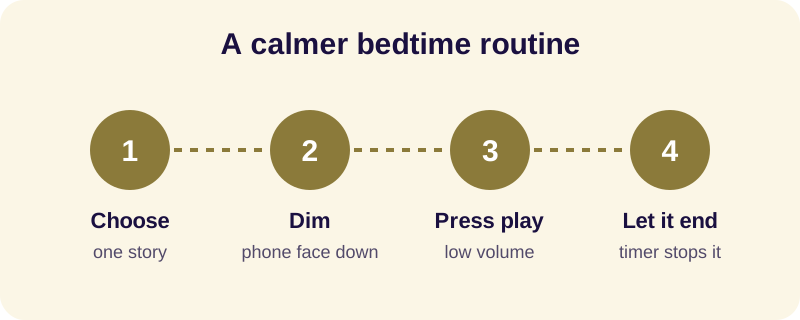
- Pick one story before you lie down, rather than scrolling for the "right" one once you're already in bed.
- Dim the room and set your phone face down or on a stand, screen off.
- Start the story and let the volume sit low enough that you have to listen for it, not loud enough to startle you.
- Set a timer so the story stops on its own instead of continuing, or cutting out, long after you've fallen asleep.
Layering the story with a steady background sound can help too. Soft rain, ocean waves or a distant singing bowl fill the silence between sentences, so a sudden gap in the narration does not pull your attention back. More on choosing one is in this guide to sleep meditation sounds.
What if a story alone doesn't settle me down?
Some nights a story helps immediately; other nights the mind keeps running underneath it. That is ordinary, not a sign the method has failed.
Pairing the story with something physical — a few slow breaths, or a simple body scan down through the shoulders, arms and legs — gives the body somewhere to land once the narration ends. A guide to quieting a racing mind at night covers a few of these in more depth, and if worry rather than noise is the main problem, a piece on Buddhism and anxiety looks at that specifically.
How does Buddha Story help with this?
Buddha Story narrates Jataka tales, episodes from the Buddha's life, Dhammapada verses and Zen parables slowly, in English, for exactly this kind of nighttime listening. Nothing is read for information or entertainment value — it is read for someone who may already be half asleep by the end.
Practically, that means a sleep timer (10, 20, 30 or 60 minutes) that pauses the story and any sounds once it ends rather than letting them run on, a sound mixer for layering rain or singing bowls underneath the narration, Offline Mode for nights without a signal, and background playback so the screen can stay off. There is no Kids Mode and no advertising breaking into a story halfway through. The app runs on Android and offers a 3-day free trial before its monthly or yearly plan.
None of this changes what a calming story actually does: give a tired, busy mind one slow thread to follow until it lets go of the day on its own.
Frequently Asked Questions
What makes a story calming enough to listen to before bed?
A calming story is slow, has few characters, and moves toward a quiet resolution rather than a twist. Buddhist tales such as the Jataka stories were shaped for recitation and repetition, so they rarely build tension the way a thriller does, which makes them easier to drift away from.
Are Buddhist stories only for Buddhists?
No. They are told here as plain narratives about patience, kindness and letting go. You do not need to hold any belief behind them to find the pacing and imagery calming at night; the stories work simply as gentle, structured listening.
How long should a calming bedtime story be?
There is no fixed length. Many people drift off well before a story ends, which is why Buddha Story's sleep timer can stop playback after 10, 20, 30 or 60 minutes rather than letting a device run all night.
What if a calming story doesn't help me fall asleep?
Try pairing it with slow breathing or a simple body scan, which gives the body something to settle into after the story ends. If sleeplessness is frequent or severe, it is worth discussing with a doctor rather than relying on stories alone.