Published
Quick answer
An app to help stop overthinking at night works by giving a racing mind a slow story to follow instead of its own loop. Buddha Story narrates Buddhist tales with calming sounds, guided meditation and a sleep timer for restless evenings.
Key takeaways
- A slow narrated story gives the mind something steady to follow instead of replaying the day.
- Breath awareness, a body scan or loving-kindness practice can quiet thoughts before a story even starts.
- Buddha Story's sleep timer (10, 20, 30 or 60 minutes) pauses the story and sounds for you, without fading.
- Offline listening and background playback mean the story can keep going with the screen off.
- Persistent sleep or worry problems are worth raising with a doctor; this is a bedtime habit, not a treatment.
An app to help stop overthinking at night works best when it replaces your looping thoughts with something slower to follow, like a narrated story. Buddha Story does this by narrating Buddhist tales, teachings and calming sounds for listening in the dark.
The trouble with overthinking at bedtime is rarely a lack of willpower. It is that an unoccupied mind defaults to unfinished business — the email you should have answered, the thing you said, tomorrow's schedule. Give that mind a story to follow instead, and it has somewhere else to go.
Why does my mind race the moment I lie down?
During the day you are busy enough that worry stays in the background. At night, with the lights off and nothing to do, the mind finally has room to run through everything it postponed.
See also: App for Short Guided Meditations at Night.
This pattern has a name in the old teachings: the second arrow. The first arrow is the day's actual events; the second is the mind re-living them over and over, which is where most of the restlessness gets added. The second arrow story describes this directly, and it is worth reading once so you recognise the pattern when it starts. Trying to force the thoughts to stop rarely works, because telling yourself "stop thinking" is still a thought, and it keeps the loop running. What tends to help is giving attention somewhere else to land — the breath, a sound, or a slow story — so the looping has less to feed on. A closer look at a racing mind at night covers why this happens in more detail.
What actually works to quiet overthinking at night?
A few simple habits make more difference than most people expect, and none of them require solving the thing you are worried about.
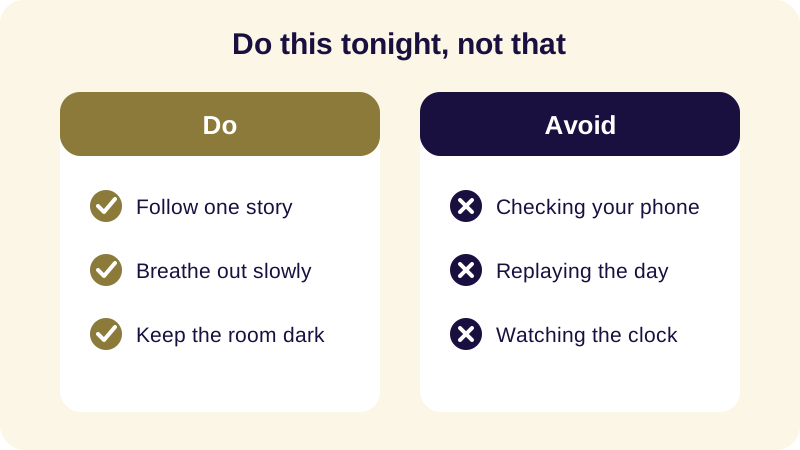
Breath awareness is the simplest starting point: counting slow exhales gives the mind one job instead of ten. A body scan works the same way from the body outward, moving attention through each part until there is less of you left over to worry with. Mindfulness for sleep covers both in more detail. Loving-kindness practice, or metta, is another option — silently wishing yourself and others well is a gentler occupation for the mind than rehearsing an argument. Metta meditation walks through the phrases.
How does a story app help an overthinking mind?
A narrated story does the same job as counting breaths, but with less effort from you. Following a plot — what happens next, who said what — is enough to occupy the thinking part of the mind without asking it to solve anything, which is exactly what an overthinking mind at 2am does not want to do.
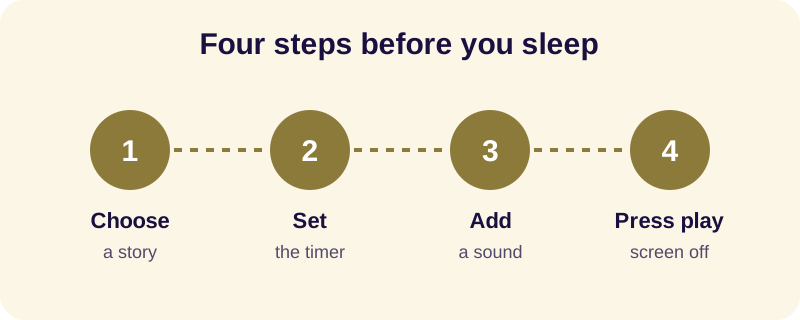
Buddha Story narrates Jataka tales, episodes from the life of Siddhartha Gautama, Dhammapada verses and Zen parables, all read slowly for listening in a dark room. Many of the stories settle toward the same kind of ending — a decision made, a lesson learned, a mind made calmer — which gives you somewhere quiet to land rather than a cliffhanger to stay awake for. Buddhist stories for sleep has more on why this works as well as it does.
- A sleep timer (10, 20, 30 or 60 minutes) that pauses the story and sounds for you, without fading them out.
- A sound mixer for layering a story with rain, ocean waves or singing bowls.
- Guided meditation for loving-kindness, body scan and breath awareness, for nights when you would rather sit quietly than follow a plot.
- Offline listening and background playback, so the story keeps going with the screen off.
What should I expect the first few nights?
Do not expect the loop to stop the instant you press play. The first few nights, you may notice your attention drifting back to your own thoughts and then returning to the story — that back-and-forth is normal, not a sign that it isn't working. Each time attention comes back to the narration is a small rep, the same way returning to the breath is the actual practice in sitting meditation, not a failure of it.
Over a few nights this tends to get easier, not because the worry itself has been solved, but because the mind has a more familiar, less effortful place to go when the lights go off. Some nights you will fall asleep within the first story; other nights you will listen through two or three and that is fine too — there is no pace you are supposed to keep.
If you want a few short teachings to sit with before you even open the app, Dhammapada verses for a restless mind has lines worth reading slowly at 2am. Either way, the aim for tonight is modest: one story, one timer, and somewhere other than your own thoughts for your mind to rest.
Frequently Asked Questions
Can an app really help stop overthinking at night?
An app cannot switch off thoughts directly, but it can give your attention somewhere steadier to go. A slow narrated story occupies the part of the mind that would otherwise keep replaying the day, which is often enough for the loop to loosen on its own.
What should I listen to when my mind won't stop racing?
A short, simple story works better than something fast-paced or suspenseful. Jataka tales and episodes from the Buddha's life have a clear beginning and a quiet ending, which is easier to drift away from than a plot that keeps you guessing.
Does the sleep timer stop the story automatically?
Yes. Buddha Story's sleep timer can be set to 10, 20, 30 or 60 minutes, and when it ends it pauses the story and sounds rather than fading them out, so you are not left reaching for your phone in the dark.
What if overthinking happens every single night?
An occasional restless night is ordinary, but worry or sleeplessness that is severe, persistent or affecting your days is worth discussing with a doctor. A story app is a bedtime habit that can accompany care like that, not a replacement for it.
Do I need to watch anything, or can I just listen?
Just listen. The app is designed for a dark room with the phone face down: narration, offline listening and background playback mean the story can keep going with the screen off, which keeps light from interrupting your wind-down.
