Published
Quick answer
How long should you meditate before bed depends on the night, but five to twenty minutes is a sensible range to start with. Stop when you feel calmer, not when a clock says so.
Key takeaways
- Five to twenty minutes is a reasonable starting length for a bedtime sit.
- A short, finishable sit often settles a tired mind better than a long one.
- Falling asleep during the sit is normal, not a failed meditation.
- A fixed length, like a sleep timer, removes the urge to check the clock.
- Persistent sleep trouble is a question for a doctor, not a longer meditation.
How long should you meditate before bed is less about hitting a target number and more about finding a length that settles you rather than winds you up. For most people, somewhere between five and twenty minutes is enough to quiet the evening's noise without turning into another task to finish.
This is practical guidance, not a medical rule, and it holds whether you are brand new to sitting still or have kept a daily meditation habit for years. If sleeplessness is a frequent, serious problem, that belongs with a doctor rather than with any evening practice.
How long should you meditate before bed?
Five to twenty minutes is a reasonable place to start, and it suits most ordinary restless evenings rather than any particular condition. A sit this short is easy to actually do at the end of a tiring day, and it rarely becomes one more effortful task competing with sleep itself.
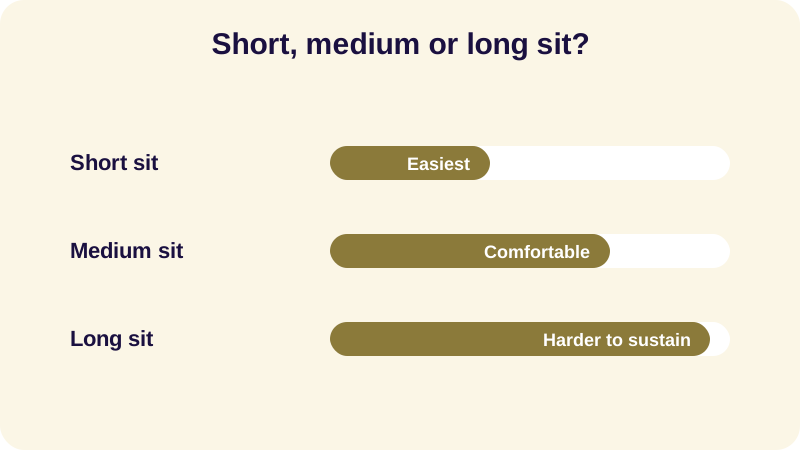
There is no single correct length, because the point of the sit is not completion, it is settling. Some nights five minutes of breath awareness is plenty; other nights you might sit for closer to twenty minutes because the mind needs longer to stop circling the day. Let how calm you feel, not the clock, decide when to stop.
The right length also shifts with the kind of day behind it. After a quiet evening, a few minutes of breath awareness might be plenty; after a day full of unfinished conversations or small worries, the mind may need the longer end of that range before it stops rehearsing them. Neither case is more correct than the other. The length you need simply reflects how much the mind carried into the room with you, and that will differ from one night to the next.
Does a longer sit work better than a short one?
Not automatically. A longer sit gives the mind more time to settle, but it also gives it more time to get bored, stiff, or newly alert, which can leave you more awake than when you started, not less.
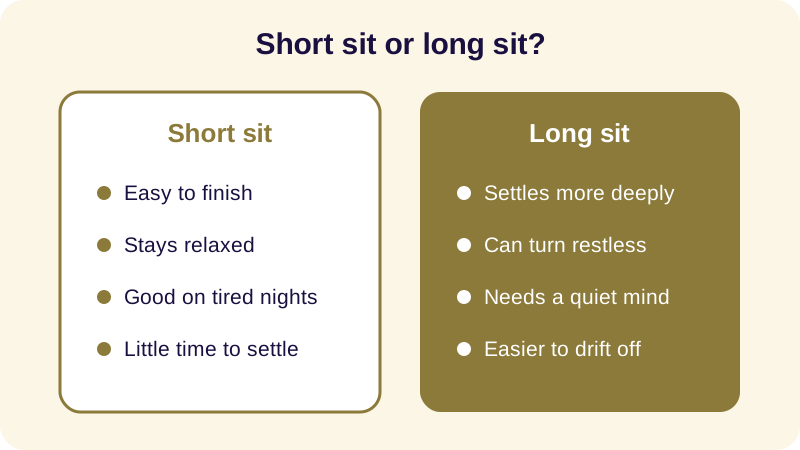
A short sit has its own advantage: it is finishable. You know roughly when it ends, so there is nothing to brace against, and the body can relax into it the way it relaxes into a familiar bedtime story. If you already feel calm after five minutes, stopping there is not giving up early — it is the practice doing its job. Posture plays a small part too: sitting up for a longer practice and only lying down afterward can keep a long sit from sliding straight into sleep before it has actually settled the mind.
What should you actually do during that time?
A bedtime sit works best when it is simple enough to follow with a tired mind. Pick one anchor and return to it gently whenever you notice you have wandered — there is nothing more to get right than that.
- Settle into whatever position you will actually fall asleep in, sitting up or lying down.
- Rest your attention on the breath, feeling it rise and fall rather than counting it.
- If the mind keeps pulling toward tomorrow, move attention slowly through the body instead, the way a body scan does.
- Offer a few lines of loving-kindness toward yourself and anyone the day left unsettled.
- Let the sit end whenever it wants to — there is no bell you need to wait for.
Any one of these on its own is enough for most nights. You do not need all five; pick whichever one actually calms you tonight, and try a different one the next night if it doesn't.
What if you fall asleep before finishing?
Falling asleep during a bedtime sit is not a failure of the practice — it is one of the most ordinary things that can happen. The whole point of sitting with the breath or scanning the body before bed is to let the mind stop working, and sometimes it stops so thoroughly that sleep simply arrives first.
If this happens most nights, it may just mean you were tired enough that almost any quiet activity would have had the same effect, which is useful information rather than a problem to fix. It is a small, repeatable example of why evening meditation works at all for a restless mind: not by forcing anything, but by giving it somewhere quiet to land.
How does a timer help you decide?
A set length removes the guesswork of "how much longer should I sit," and it stops you from checking the clock, which is its own small way of waking up. The Buddha Story app's Sleep Timer offers 10, 20, 30 or 60 minutes, and it pauses the story and sounds once the time is up rather than fading them out, so you are not left half-listening for the exact moment it ends.
Whichever length you settle on, consistency matters more than precision. A short, repeatable sit before bed, paired with something calming to listen to, tends to work better than chasing the perfect number of minutes — a racing mind rarely responds well to a brand-new routine every single night.
See also: Calming Stories to Listen to Before Bed.
If you are still deciding where to start, treat the first week as an experiment rather than a commitment: ten minutes of breath awareness, or a few minutes of loving-kindness, repeated nightly, until you notice what length actually leaves you calmer. Write down, if it helps, how you felt afterward on each of those nights, so the pattern becomes something you can see rather than something you have to guess at. That is the real answer to how long you should meditate before bed — whatever you can comfortably finish most nights, adjusted gently as your evenings change.
Frequently Asked Questions
How long should you meditate before bed?
Five to twenty minutes is a reasonable range for most ordinary restless evenings. There is no required length: some nights five minutes of breath awareness is enough, other nights the mind needs closer to twenty minutes before it settles. Let how calm you feel decide when to stop, rather than a fixed number.
Is it bad to meditate for too long before sleep?
A sit that runs much longer than feels comfortable can leave you more alert, not less, especially if the body gets stiff or bored. If a longer sit starts to feel like effort rather than rest, that is a sign to stop, not push through.
Is it normal to fall asleep while meditating at night?
Yes. Falling asleep during a bedtime sit simply means the mind stopped working before the sit was finished, which is often exactly what you wanted. It is not a sign you are doing the practice wrong.
Should I use a timer when meditating before bed?
A set length can help, since it removes the temptation to keep checking how much time is left. The Buddha Story app's Sleep Timer offers 10, 20, 30 or 60 minutes and pauses the story and sounds when the time is up, rather than fading them out.
What if a short meditation doesn't help me sleep?
An occasional restless night is ordinary and a short sit will not fix every one of them. If sleeplessness is frequent or severe, it is worth raising with a doctor rather than extending or intensifying an evening meditation practice.