Published
Quick answer
How to meditate offline without internet, in short: sit comfortably, breathe naturally and return attention to the breath whenever it wanders — no app or signal required. Guided audio can be downloaded ahead of time for nights with no connection at all.
Key takeaways
- Meditation needs only breath, posture and attention — no wifi or signal required at all.
- Download guided stories and meditations in advance so nothing has to stream later.
- The breath is always available offline; use it as the anchor when thoughts wander.
- A wandering mind is normal — noticing it and returning is the practice, not a failure.
- Persistent sleeplessness or anxiety deserves a doctor's attention, not just a meditation app.
You can learn how to meditate offline without internet with nothing more than a quiet spot, a comfortable seat and attention to your breath — no app, signal or data connection required.
That might sound obvious, but plenty of people put off starting a sitting practice because they assume they need a subscription, a library of recordings, or at least one bar of signal to do it "properly." Meditation predates the internet by 2,500 years. The method does not change just because the wifi is down.
What Do You Actually Need to Meditate Without Internet?
Three things, and you already have all of them: a body that can sit still for a few minutes, a breath that is already happening whether you notice it or not, and a willingness to catch your mind wandering and bring it back. You can meditate without wifi, without data, without any connection at all, because none of that was ever actually part of the technique.
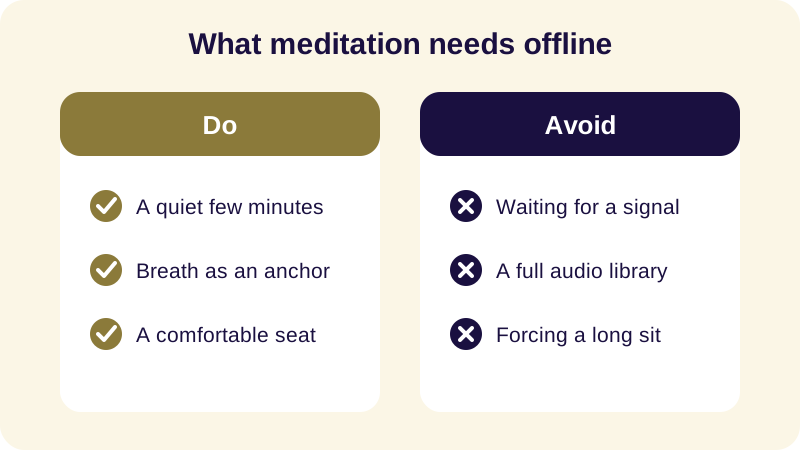
Where people get stuck is assuming meditation is the audio. It isn't. A narrated story or a guided meditation is a support — useful, pleasant, sometimes exactly what a tired mind wants at night — but the underlying practice, mindfulness of breathing, is described in the Satipatthana Sutta as simply sitting, breathing in, and knowing that you are breathing in. You can do that on a plane, in a tent with no bars at all, or in a bedroom where the router has gone quiet for the night.
If you want a structured place to start, meditation for beginners walks through posture and attention without assuming you have any equipment at all.
How Do You Meditate Step by Step, Offline?
The sequence below works anywhere, with or without a phone nearby. Read it once, then try it from memory — that's really the whole point of an offline meditation practice.
- Sit or lie down somewhere you won't be interrupted for a few minutes.
- Close your eyes and take one slightly slower breath than usual, just to settle.
- Rest your attention on the breath at the nostrils, chest or belly — wherever you feel it most clearly.
- When a thought pulls your attention away, notice it without arguing with it, then return to the breath.
- Keep going for as long as feels manageable, then open your eyes and let the sitting end quietly.
That's the entire technique. Nothing is needed to count the breaths or remind you to come back — the coming back, over and over, is the practice itself. For a longer walk-through of this exact method at home, breath awareness meditation at home covers posture and timing in more detail.
Can You Prepare Guided Audio to Use Without a Connection?
Yes, and this is the practical answer for anyone who likes narrated stories or spoken guidance but travels, camps, or keeps their phone on airplane mode at night. The trick is downloading what you want to hear while you still have a connection, so nothing has to stream later.
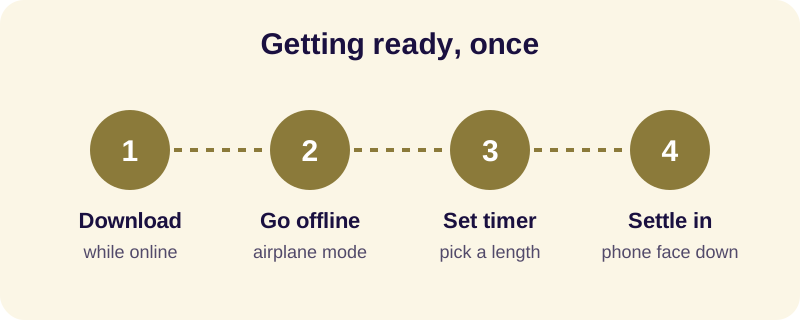
The Buddha Story app, for example, has an Offline Mode: you download a story, a Dhammapada reading or a guided meditation while connected, and it plays later with no data needed at all. Its Sleep Timer pauses the story once the chosen length is up, rather than fading it out, and background playback means you can lock the screen and let it continue while you settle into bed. The app offers more than 90 narrated stories and 28 guided meditations, in English narration, with no ads interrupting the playback once it starts. None of this needs a live connection once the file is saved.
This matters because meditating without an app or wifi stream removes one more small source of friction at exactly the moment you want fewer decisions to make, not more.
What Can Replace a Teacher or an App When There's No Signal?
Memory and repetition. Long before recordings existed, practitioners carried teachings exactly this way — a few lines repeated until they didn't need the page anymore. The Metta Sutta, the discourse on loving-kindness, is short enough that you can hold a handful of its phrases in mind and repeat them silently, which is the basis of the metta (loving-kindness) practice described in the four brahmaviharas.
The same is true of the ethical ground the practice rests on. The Five Precepts are five lines, not a book — easy enough to carry in your head. The Four Noble Truths and the Noble Eightfold Path are frameworks you can recall in outline even with your phone switched off entirely. None of it depends on being online; it depends on having heard or read it once and returned to it since.
What If Your Mind Keeps Wandering With No Guidance to Follow?
This is the part people worry about most before trying offline meditation practice — without a voice telling you what to do next, won't the mind just run off? It will, and that's normal, not a sign you're doing it wrong. The practice isn't keeping thoughts from arising; it's noticing when one has carried you away and returning to the breath, as plainly as that, as many times as it takes.
If the wandering turns into full rumination rather than ordinary drifting, that's usually a sign the mind has a specific worry to work through, not a meditation problem. How to quiet a racing mind at night goes into what helps when thoughts won't loosen their grip, with or without a connection.
Persistent sleeplessness or anxiety that doesn't ease with a quiet sit is worth raising with a doctor. Meditating offline, like meditating any other way, is a steadying habit — not a treatment, and not a substitute for medical care.
None of this requires preparation beyond a few minutes of attention. Sit, breathe, notice when you've wandered, and come back. Whether you do that with a downloaded story playing quietly in the background or in complete silence, the method is the same one people have used for 2,500 years, connection or none.
Frequently Asked Questions
Can I meditate without an app or any internet connection?
Yes. Meditation only requires a body, a breath and a few quiet minutes — no app, download or signal is involved in the sitting itself. Apps and recordings are optional supports for guidance; the practice itself has worked offline for 2,500 years.
What's the simplest offline meditation technique to start with?
Sit comfortably, close your eyes, and rest your attention on the breath wherever you feel it most clearly. When a thought pulls you away, notice it without judgment and return to the breath. That single loop, repeated, is the whole practice.
Can I still use guided meditation audio with no signal?
Yes, if you download it beforehand. Buddha Story's Offline Mode lets you save stories, Dhammapada readings and guided meditations while connected, then play them later with no data needed, including background playback while the screen stays locked.
Is offline meditation practice less effective than using an app?
No. The underlying technique — attention, breath, returning when the mind wanders — is identical whether or not audio is involved. An app offers structure and company for a tired mind; it doesn't change what the practice is actually doing.
What should I do if my mind won't settle without guidance?
Expect some wandering; it's normal, not a failure. Gently note the thought and return to the breath as many times as needed. If restlessness turns into persistent worry or sleeplessness, that's worth discussing with a doctor rather than relying on meditation alone.