Published
Quick answer
The best-known Buddhist story about kindness to strangers is the Sasa Jataka, where a hare offers his own body as food to a hungry traveler who turns out to be a god testing him.
Key takeaways
- The Sasa Jataka tells of a hare who gave his own life as food to a hungry stranger.
- The stranger's identity was unknown, so the kindness was offered without judging his worth.
- The story reflects metta, loving-kindness extended equally to friend and stranger alike.
- Recalling the tale before sleep can ease a mind busy weighing who deserves kindness.
- A short practice: send loving-kindness to one stranger you saw today before you sleep.
A classic Buddhist story about kindness to strangers is the Sasa Jataka, the tale of a hare who gives his own body as food to a hungry traveler he has never met. It is one of the 547 Jataka tales, the stories of the Buddha's past lives, and it is still told today as an answer to a simple question: how far does kindness reach when there is nothing in it for you?
Some tellings call it the hare in the moon story, for reasons that become clear by the end. It is short enough to read in a few minutes and plain enough to sit with at night, when the mind is busy sorting who deserves help and who does not. That is exactly the knot it loosens.
What happens in the story of the hare and the stranger?
Four animal friends share a riverbank: an otter, a jackal, a monkey and a hare. One day the hare suggests that each of them keep a day of fasting and give away whatever food comes to hand, to whoever asks for it. The others agree, more out of friendship than conviction, and each quietly sets aside a little extra, in case a hungry visitor turns up.
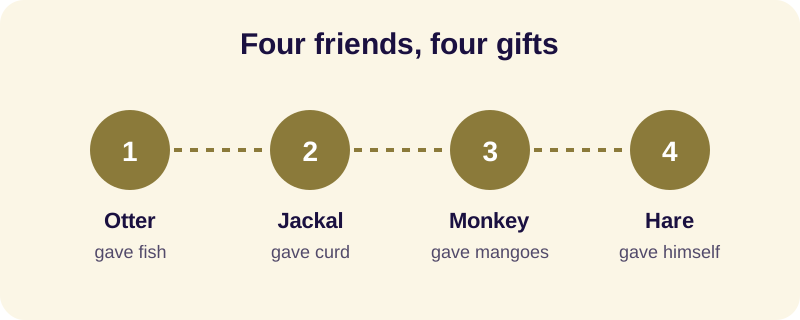
A traveler does turn up — tired, thin, and asking for food. He visits the otter first, who gladly offers fish pulled from the riverbank the night before. He visits the jackal, who hands over a lizard and a pot of curd set aside from a meal. He visits the monkey, who drops ripe mangoes into his hands. Then he comes to the hare.
The hare has nothing to give but grass, and grass is no food for a person. So the hare asks the traveler to build a fire, and when it is lit, offers the one thing he has left: himself. He steps into the flames, holding nothing back out of fear or calculation. The fire, the story says, does not burn him, because the traveler is no ordinary traveler. He is Sakka, ruler of the gods in this telling, testing the four friends' generosity. Moved by what he has seen, Sakka draws the shape of a hare on the face of the moon, so the gift would be remembered by anyone who looked up at night.
Why does kindness to a stranger matter in Buddhism?
The detail worth noticing is that none of the four animals knew who the traveler was. He was not a friend, not someone owed a favor, not someone who had proven himself trustworthy. He was simply hungry, and that was enough. Read this way, it works just as well as a Buddhist story about generosity: the stranger's anonymity is what makes the gift unconditional, since there was no relationship to repay and no reputation to protect.
See also: A Buddhist Story About a Lost Traveler and What It Teaches.
This is also the logic behind metta, loving-kindness, one of the four brahmaviharas — qualities of heart the tradition treats as a kind of training for the mind. Metta is practiced in stages that widen outward: yourself, someone you love, a neutral person, and eventually someone difficult. A stranger belongs in that middle stage, and this jataka tale about kindness is, in effect, a dramatized version of exactly that practice.
What does this story do for a restless mind at night?
A lot of what keeps people awake is unfinished social accounting: a tense exchange with someone at work, a stranger who was short with you in traffic, a request you are not sure you should have turned down. The mind goes back over these moments looking for a verdict, and it rarely reaches one by eleven at night.
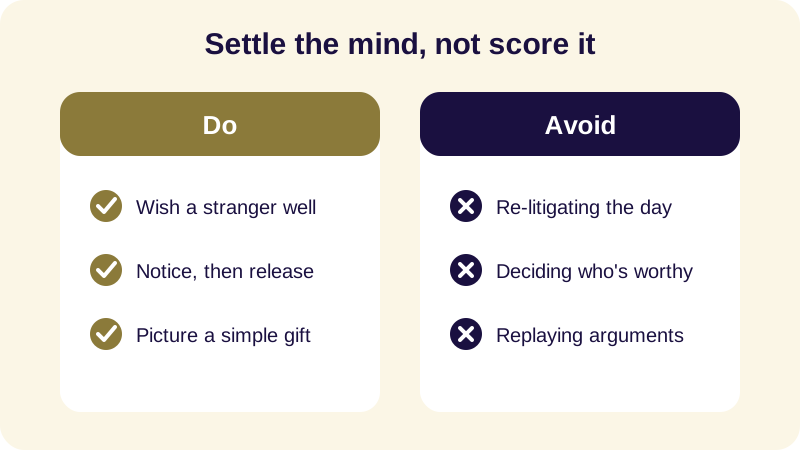
Sitting with a story like the hare's will not answer those daytime questions, and it is not meant to. What it offers instead is a different frame to rest in for a few minutes: a world where kindness toward someone unknown is simple, not because the stranger earned it, but because the hare had already decided, before the test ever arrived, what kind of creature he wanted to be. A decision made ahead of time takes some weight off the evening's accounting.
How can I practice kindness to a stranger before bed?
You do not need the drama of a fire to take something from this story. A short, quiet practice before sleep can do the same work on a smaller scale:
- Recall one stranger from the day. A cashier, a driver, someone who held a door. You do not need to know anything else about them.
- Silently wish them well. A simple phrase is enough: may you be safe, may you be at ease.
- Notice if you judged them. If you decided, even briefly, that they were rude or careless, let that verdict go rather than arguing with it.
- Widen it by one person. Think of someone you have never met, and offer the same wish with no information at all to base it on.
- Let the phrase repeat softly as you settle into bed, the way you would let a story carry you rather than a problem.
This is close to the structure used in formal metta practice, and it works well as a bedtime routine precisely because it asks nothing of you but attention. A fuller guided version is covered in metta meditation for sleep, and more short tales in this vein are gathered in Buddhist bedtime stories.
Where can I find more stories like this one?
The Sasa Jataka is one entry point into a much larger body of tales. The Jataka tales collection gathers hundreds of stories built around the same question — what does a good life look like when no one is watching — told through animals, kings, merchants and travelers rather than abstract instruction. They were composed to be heard, not studied, which is part of why they sit so naturally in a dark room at the end of the day.
If sleeplessness or anxiety is ongoing rather than occasional, that is worth raising with a doctor rather than solving through stories alone. What a tale like the hare's can offer on an ordinary restless night is smaller and more modest: a few minutes spent somewhere other than the day's unfinished judgments, and a reminder that kindness toward someone unknown does not need to be earned first.
How does the Buddha Story app use stories like this one?
The app narrates Jataka tales, including stories built around generosity and kindness to strangers, alongside episodes from the life of Siddhartha Gautama and verses from the Dhammapada. Each one is read slowly, built for listening in the dark rather than for study.
- Sleep Timer that stops the narration for you once you have drifted off.
- Guided Meditation for loving-kindness, body scan and breath awareness, for nights when a story is not quite what you need.
- Offline Mode so a story keeps playing even without a signal.
- Background playback and a sound mixer, for layering a tale with rain or singing bowls.
Kindness to a stranger, in the end, is one of the simplest teachings the tradition offers: give what you can, without first deciding who has earned it. The hare never knew who was asking. He gave anyway, and the story has outlasted him by a very long time.
Frequently Asked Questions
What is the Buddhist story about kindness to strangers called?
The story is usually called the Sasa Jataka, or the hare in the moon tale. It is one of the 547 Jataka tales, stories of the Buddha's past lives, and tells of a hare who gives his own body as food to an unknown, hungry traveler.
Why did the hare in the story give himself away?
The hare had nothing but grass to offer, and grass is no food for a person. Rather than send the hungry traveler away empty-handed, the hare chose to offer the only thing he had left: himself, asking the traveler to build a fire first.
Who was the hungry traveler in the story?
In the traditional telling, the traveler was Sakka, ruler of the gods, who had taken a humble disguise to test the generosity of four animal friends. Moved by the hare's gift, he drew the shape of a hare on the moon to honor it.
What does this story teach about kindness to strangers?
It suggests that real kindness does not wait to check whether someone deserves it first. The traveler was unknown to every animal in the story, and the hare's gift was given simply because there was a need, not because of who was asking.
Can listening to this story help me fall asleep?
It can offer a calmer frame to rest in: a simple scene of generosity rather than the day's unresolved judgments about people. It is not a treatment for insomnia, so if sleeplessness is ongoing or severe, it is worth discussing with a doctor.