Published
Quick answer
How to calm down before sleep without medication usually means a slow breath practice, a body scan and a quiet story in place of scrolling or worrying. These simple, drug-free steps settle the body and give a racing mind something gentler to follow.
Key takeaways
- A longer exhale than inhale signals the body to relax without any pill.
- A body scan moves attention from thoughts to sensation, which quiets rumination.
- A slow, familiar story gives a racing mind something gentler to follow than worry.
- Treat the routine as a nightly habit, not a one-time test of whether it works.
- Persistent insomnia or anxiety belongs with a doctor, not a routine alone.
How to calm down before sleep without medication comes down to three ordinary things: slow the breath, settle the body, and give the mind something gentler to follow than its own worries. None of it requires a pill, and none of it promises instant sleep — just a calmer way to lie there.
What actually calms a racing mind before sleep without medication?
A racing mind at night is usually not thinking about anything useful. It is replaying a conversation, rehearsing tomorrow, or trying to solve a problem that has no solution at eleven at night. The nervous system stays alert because the body hasn't been given a different signal to work with.
Three things reliably interrupt that loop without any drug: slowing the out-breath, moving attention through the body instead of through the thoughts, and putting a slow, undemanding story or teaching in the foreground so the mind has somewhere else to go. This is a natural way to calm down before bed that works whether or not you have ever meditated before, and it does not require medication to work.
See also: How Long Should You Meditate Before Bed?.
None of this is mystical. It is closer to redirecting attention on purpose, repeatedly, until the body gets the message that nothing needs to be solved right now. Mindfulness for sleep works the same way: attention rests on the breath or the body instead of on the story running in your head, and the same approach is explored further in how to quiet a racing mind at night.
What is the fastest step-by-step way to calm down before bed?
There is no single trick that works for everyone, but a short, ordered routine works better than scattered effort. The order matters more than any individual step: breath first, then body, then a quieter kind of attention.
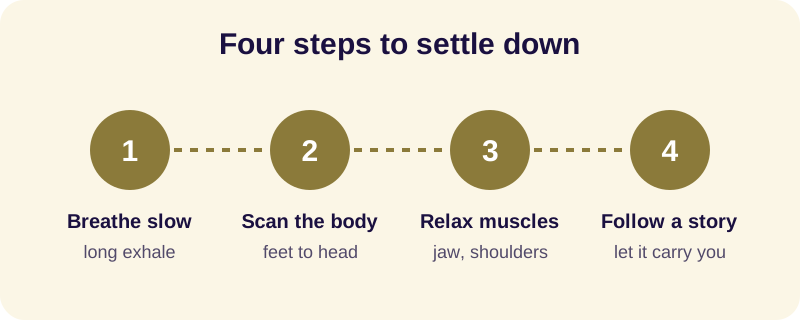
- Lie down and soften the jaw and shoulders. Let the mattress take your weight instead of holding it yourself.
- Lengthen the exhale. Breathe in for a count that feels natural, then let the breath out slower than it came in.
- Scan from feet to head. Notice each part of the body for a moment and let it go slack, without forcing relaxation.
- Name the thought, then return to the body. If a worry arrives, note it briefly and come back to the breath rather than following it.
- Let a slow story or teaching carry the rest. A narrated Jataka tale, a few verses of the Dhammapada, or a loving-kindness practice gives the mind somewhere gentle to rest once the body has settled.
This is not about reaching a particular state by a particular minute. It is a sequence you repeat, and on most nights the repetition itself is what does the calming.
What mistakes make it harder to calm down without medication?
A few habits quietly work against every technique above, and most people do at least one of them without noticing.
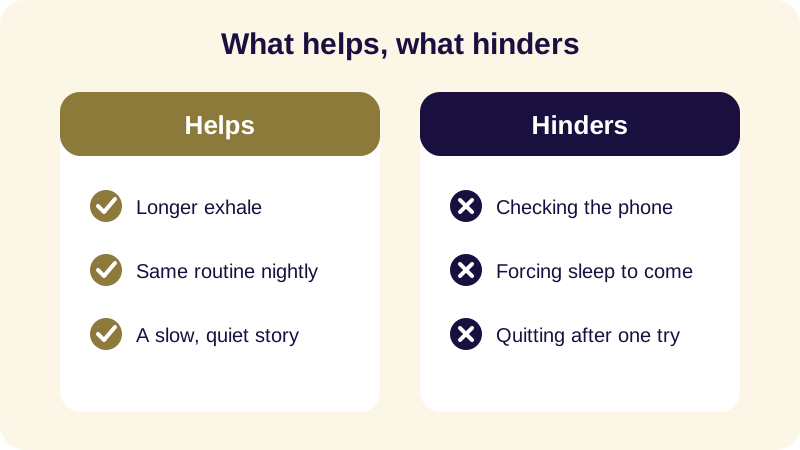
Checking the time or the phone resets the nervous system back toward alert, because light and notifications are exactly the kind of stimulation the body is trying to wind down from. Trying to force sleep — monitoring whether it is working yet — keeps the thinking mind in charge, which is the opposite of the goal. And treating the routine as a one-night fix, then abandoning it when it does not work immediately, misses that this is something the body learns over repeated, ordinary nights, not a switch that flips once.
Can a Buddhist story help you calm down before sleep?
Yes, in a very ordinary way: a slow, familiar narrative gives the mind something to follow that is not the day's unfinished business. This is different from entertainment — these stories are plain, unhurried, and resolve toward calm rather than suspense.
The tradition has a large library to draw from: the 547 Jataka tales of the Buddha's past lives, the 423 verses of the Dhammapada, and short episodes from the life of Siddhartha Gautama himself, from his sheltered youth to the night under the Bodhi tree. A loving-kindness practice built on the Metta Sutta works alongside this, offering simple phrases of goodwill instead of a plot — see metta meditation for restful sleep for how that works in practice.
These are drug-free ways to calm the mind before sleep, not a replacement for anything — just a quieter alternative to scrolling or lying there arguing with yourself. The app narrates stories like these slowly, in English, built for listening in the dark rather than reading. A sleep timer stops the story and sounds for you at the length you choose, instead of fading out, so you do not need to remember to turn anything off. If you want a specific place to start, ten short Buddhist bedtime stories is a reasonable first stop.
When should you see a doctor instead of trying this alone?
A nightly routine like this is meant for an ordinary restless evening, not for a sleep or mental-health problem that keeps repeating. Think of breath work, body scans and calming stories as non-medication sleep relaxation techniques for a busy mind — not treatment for a condition.
For many people, most nights are ordinary ones — a mind that is merely busy, not unwell. For those nights, the goal is simply to relax without medication, using the breath and the body as the switch, and more on why sleep does not always follow tiredness is covered in why you can't sleep even when tired.
Frequently Asked Questions
What is the fastest way to calm down before sleep without medication?
Lie down, soften the jaw and shoulders, then lengthen the exhale until it is slower than the inhale. Follow that with a brief scan of the body from feet to head. This short sequence is a reliable, drug-free way to settle an ordinary restless evening.
Does a body scan actually help you fall asleep?
It helps indirectly. Moving attention slowly through the body gives the mind something concrete to do instead of replaying the day, which is often what keeps a person awake. It does not guarantee sleep, but it reliably lowers the mental noise that gets in its way.
Can a Buddhist story really calm a racing mind?
Yes, in an ordinary way. A slow, familiar narrative — a Jataka tale or an episode from the Buddha's life — gives the mind somewhere unhurried to rest its attention, which is often enough to loosen a loop of worry without any effort to "make" sleep happen.
When is a restless night more than just a restless night?
If sleeplessness, worry or low mood is frequent, severe or affecting your days, that is no longer a one-night problem a routine can solve. It belongs with a doctor. Breathing and calming stories are for an ordinary busy evening, not a substitute for medical care.