Published
Quick answer
Why do Buddhists meditate before sleeping? To close the day deliberately: settling the breath, offering loving-kindness, and releasing unfinished thoughts rather than carrying them into sleep.
Key takeaways
- Evening meditation closes the day deliberately rather than aiming to force sleep.
- A typical session includes breath awareness, loving-kindness and a brief review of the day.
- Metta is emphasized at night because resentment and worry are the states most likely to keep you awake.
- Persistent insomnia or anxiety call for a doctor, not meditation alone.
- A short, repeatable routine works better than a long, ambitious one.
Why do Buddhists meditate before sleeping? Mainly to close the day deliberately, letting the mind set down what it has carried since morning before the body settles for the night.
Why do Buddhists meditate before sleeping?
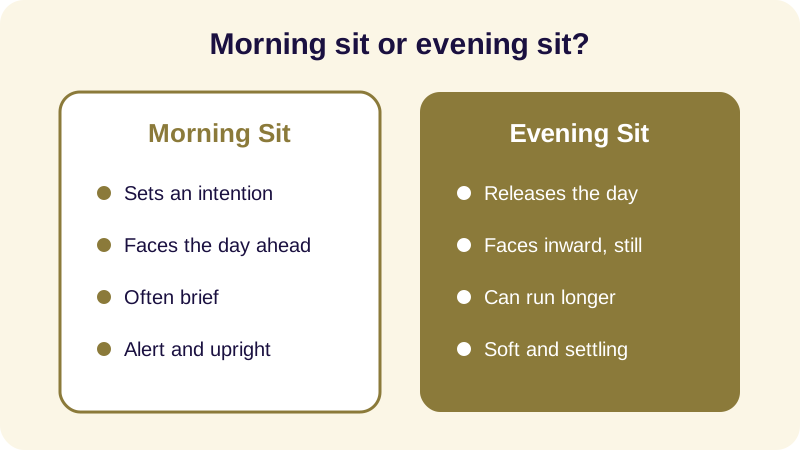
In many Buddhist communities, meditation is a nightly habit as much as a morning one: a short sit at dawn to set an intention, and another at dusk to let the day go. The evening sit isn't aimed at producing sleep. Its purpose is to finish the mind's activity for the day before the day technically ends, so that whatever follows — including sleep — follows a mind that isn't still mid-argument with itself.
This rests on a simple observation repeated throughout the Pali Canon: unexamined experience doesn't vanish at bedtime, it waits — in the body as tension, in the mind as replay. A nightly meditation habit is less about achieving calm on command and more about acknowledging the day rather than postponing it until the lights are off and there's nothing left to distract from it. It's also a small expression of the Middle Way: not forcing unconsciousness, not staying wired to solve everything, just a workable stillness between the two.
Monastics typically add two more deliberate layers to this evening practice: extending goodwill with lines close to the Metta Sutta, and recalling the Four Noble Truths as a reminder that today's irritations, like everything else, are not fixed. Neither is a sleep technique by itself; together they close the day with an open hand instead of a clenched one.
What does the purpose of evening meditation look like in practice?
There's no single required form; practice varies across traditions and households. But three elements recur often enough to count as typical: breath awareness, loving-kindness, and a brief, non-judgmental review of the day.
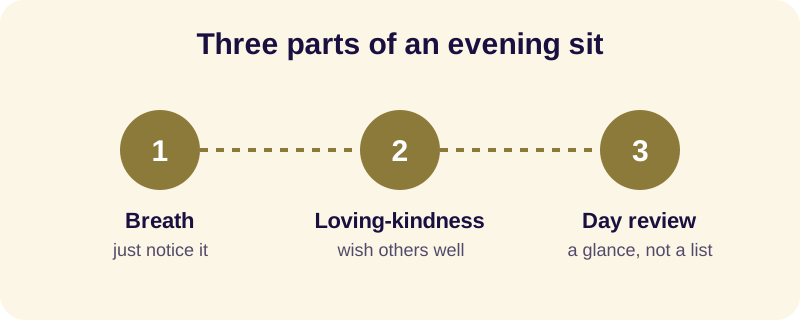
Breath awareness usually comes first and is the simplest: attention rests on the sensation of breathing, following the instruction in the Satipatthana Sutta to simply know the breath as it is, long or short, without trying to change it. Loving-kindness, or metta, follows — silently wishing oneself and then others well, drawn from the four brahmaviharas of loving-kindness, compassion, joy and equanimity. Last comes a short look back at the day — not an inventory of mistakes, just a plain glance, so little is left to surface uninvited later in the night.
Why metta carries extra weight at night
Metta gets particular emphasis in this nightly meditation habit because resentment and worry are the two states most likely to keep a mind awake, and metta works against both directly. It's hard to silently wish someone well while also rehearsing a grievance against them — the two don't sit in the mind at the same time. Many people find that an evening metta practice makes the day's people and events feel lighter by the time they actually try to sleep. The same logic shows up in the Five Precepts: a day lived without small dishonesties or unresolved harm leaves far less for an evening sit to untangle.
Does meditating before bed actually help you sleep better?
No Buddhist teaching claims that meditation switches sleep on, and it isn't meant to. What changes is the condition brought to bed: fewer unresolved loops, a body that's had a few minutes to stop bracing, and a mind that has already had its say about the day instead of saying it for the first time once the room goes dark. For someone dealing with a mind that won't settle most nights, that's a useful habit — not a treatment for anything.
The underlying logic shows up early in the Dhammapada, which opens with the observation that mind precedes all things — a restless day tends to produce a restless evening almost automatically. Interrupting that chain briefly before sleep isn't about forcing calm; it's about not adding more fuel to whatever is already burning.
How can you build a simple bedtime meditation practice tonight?
You don't need a cushion, a teacher, or any particular belief to try this — a short, repeatable routine works better than an ambitious one abandoned after three nights.
- Sit or lie down somewhere you won't be disturbed for a few minutes.
- Follow three slow breaths, noticing where you feel them most clearly — nostrils, chest or belly.
- Offer a few words of loving-kindness to yourself, then to one person from the day, difficult or otherwise.
- Let the day go without summarizing it — a brief mental nod is enough.
- Return to the breath until the thinking mind quiets, however long that takes.
Some people prefer a short story to silent sitting, especially on nights when stillness alone won't settle the mind — a Jataka tale, or an episode from the life of Siddhartha Gautama under the Bodhi tree, gives the mind something gentle to follow instead of something to fight. Either approach answers the same question of why meditate before bed in the same way: a day closed on purpose instead of a day left open.
For a fuller nightly sequence — what comes before and after the sitting itself — see the guide to a full evening routine for better sleep.
Whether the evening is spent in silence, in metta, or listening to a slow-narrated story, the aim stays the same: finishing the day before sleep tries to finish it without you.
Frequently Asked Questions
Do Buddhists meditate every night before bed?
Many lay Buddhists and monastics keep a short evening sit as part of a daily rhythm, alongside a morning sit, though there's no single rule about frequency. The habit matters more than strict nightly perfection — missing a night doesn't undo the practice, and returning to it the next evening is the point.
Is evening meditation different from morning meditation in Buddhism?
Morning meditation usually sets an intention for the day ahead and tends to be brief and alert. Evening meditation faces the other direction: it reviews and releases what already happened, often runs a little longer, and leans more on loving-kindness than on planning.
What should I focus on during a bedtime Buddhist meditation?
A simple sequence works well: a few slow breaths, a short loving-kindness phrase for yourself and one other person, then a brief, non-judgmental glance back at the day without replaying it in detail. There's no need to analyze or solve anything before letting it go.
Can meditating before sleep cure insomnia or anxiety?
No. Evening meditation is a calming habit, not a treatment. It can make an ordinary restless night a little easier by settling the mind's loose ends, but persistent insomnia, anxiety or low mood should be discussed with a doctor rather than addressed through meditation alone.