Published
Quick answer
What does Buddha say about death? He taught it is a natural event every being faces, not a punishment, and that accepting this impermanence eases fear and grief.
Key takeaways
- Death is named in the Four Noble Truths as part of ordinary dukkha, not a special curse
- The mustard seed story teaches that no household escapes death
- Impermanence (anicca) applies to the body, relationships and the mind itself
- The Buddha's own death was treated as an ordinary, expected event, not a tragedy to deny
- Persistent grief or fear of death is worth bringing to a doctor or counselor
What does Buddha say about death? He taught that death is a natural part of life, as certain as birth, and that wisdom lies in accepting it rather than fighting it.
What does Buddha say about death?
Death appears right at the start of the Buddha's core teaching. In the Four Noble Truths, he named birth, aging, sickness and death together as forms of dukkha — the unsatisfactoriness woven into ordinary existence. He was not being grim for its own sake. He was pointing out something most people spend a great deal of energy avoiding: that this body, like every conditioned thing, will end.
See also: Buddhist Teaching on Contentment: Finding Enough.
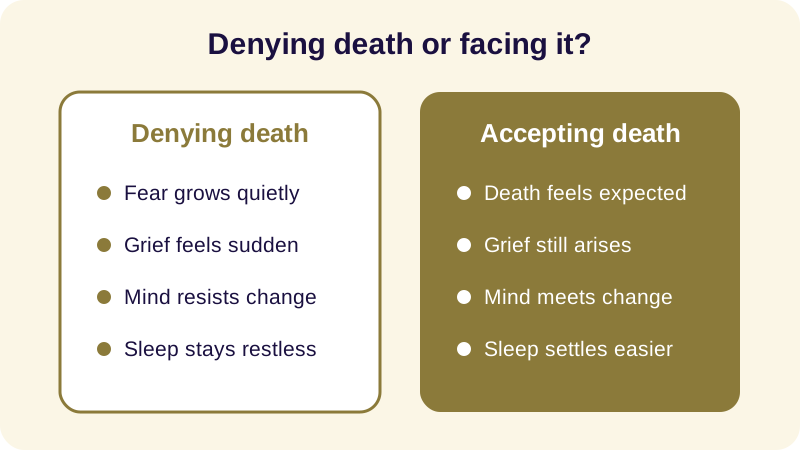
He also kept a notable silence on some of the bigger metaphysical questions — exactly what happens the instant after death, in precise detail, is not something he spent long debating. His focus was practical: understand impermanence clearly while you are alive, act with care, let go of unnecessary grasping, and the fact of death becomes something you can meet steadily instead of something that ambushes you.
What is the story of Kisa Gotami and the mustard seed?
One of the clearest Buddhist teachings on death is not a doctrine at all but a story. A young mother named Kisa Gotami lost her only child and, unable to accept it, carried the body from house to house asking for medicine to revive him. Someone eventually sent her to the Buddha.
He told her he could help, on one condition: she had to bring back a mustard seed, a common kitchen staple, from any household that had never known death. She went from door to door, full of hope at first. Every family had a seed to give her. Every single one had also buried a parent, a child, a sibling. By the time she had asked through the whole village, she understood what the Buddha had been showing her without a single argument: death touches every house without exception. Her grief did not vanish, but it stopped feeling like a cruelty aimed only at her. That shift — from "why me" to "this is what it means to be alive" — is the heart of the story, and it is retold in full as a story about letting go on this site.
How does impermanence change the way we think about death?
Death is the most dramatic example of a much larger teaching called anicca, or impermanence: the observation that nothing conditioned stays the same for two moments in a row. Bodies age, relationships shift, moods pass, even the mind that is reading this sentence is not quite the same mind it was a minute ago. Seen this way, death is not a strange exception breaking the rules of life. It is the rule, playing out at its largest scale.
This reframing shows up throughout the Dhammapada, where verses return again and again to the image of things arising and passing, and it is explored directly in the site's piece on impermanence. The practical use of this teaching is not to make you gloomy about change. It is to loosen the grip of surprise. A mind that has already made peace with "this changes too" has far less left to panic about when change actually arrives.
What did Buddha say about his own death?
Tradition describes the Buddha's own death, in old age, as an unremarkable event handled with the same steadiness he had taught for decades. He had awakened under the Bodhi tree as Siddhartha Gautama and spent the rest of his life teaching what he had found there. When his own body finally gave out, the accounts do not describe panic, bargaining or denial. He is remembered as reminding those gathered around him that all conditioned things pass away, and encouraging them to keep practicing carefully rather than to mourn in a way that lost sight of the work still in front of them.
That last instruction is consistent with everything that came before it. He never asked people to pretend death away. He asked them to look at it clearly enough that it stopped running their lives from the shadows.
How can these teachings help if thoughts of death keep you awake at night?
Thoughts about death often arrive at night precisely because the day's distractions are gone and the mind finally has room to raise the question it has been postponing. A short, deliberate reflection — rather than a long argument with the thought — tends to work better than trying to push it away.
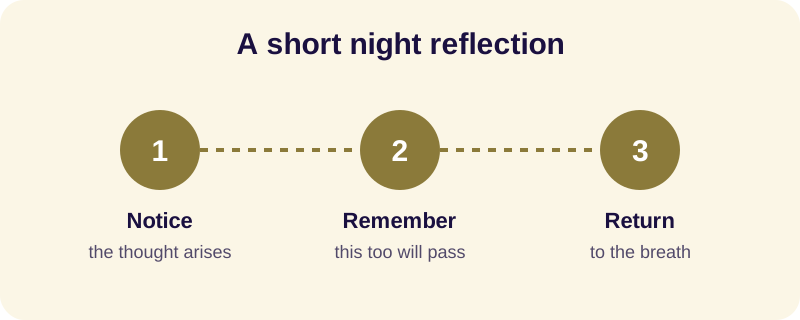
In practice, that can look like noticing the thought without arguing with it, quietly reminding yourself that everything you are afraid of losing is already in the process of changing, and then bringing attention back to the physical sensation of breathing. Pairing this with a slower practice earlier in the evening helps too — a mindfulness for sleep routine, or a short session of loving-kindness meditation aimed at yourself and the people you are afraid of losing, both work with the same underlying idea: meet the fear directly, in small doses, instead of avoiding it until it arrives at full strength at 2am.
None of this removes the fact of death or is meant to. It simply gives the mind something steadier to stand on while the fact sits there, which is often enough to let an anxious evening soften into an ordinary one.
The app narrates exactly this kind of material slowly, for listening in the dark — stories like Kisa Gotami's alongside episodes from the life of the Buddha, Dhammapada verses and quieter Zen parables, so the same teachings that calmed a grieving mother centuries ago can sit with you for a few minutes before you fall asleep.
Frequently Asked Questions
What does Buddha say about death in simple terms?
He taught that death is not a punishment or an accident but a natural event that comes to every living thing, just like birth, aging and sickness. He encouraged people to understand this clearly rather than deny it, since denial is what makes death so frightening.
Did the Buddha say death is the end of everything?
He did not teach death as a simple blank ending, nor did he spend much time answering speculative questions about what follows it. His focus stayed practical: understand impermanence now, act with care now, and let go of grasping now, whatever comes after.
What is the mustard seed story about death?
A grieving mother named Kisa Gotami asked the Buddha to cure her dead child. He sent her to find a mustard seed from any house untouched by death. She could not find one, and realized every family carries this same loss, which eased her grief.
Why does Buddhist teaching on death help with sleep?
Fear of death often shows up at night as racing, repetitive thoughts. Understanding death as ordinary and universal, rather than a personal threat singling you out, can quiet that specific loop, the same way naming any fear tends to shrink it.
Is thinking about death in Buddhism the same as being morbid?
No. The aim is not to dwell darkly on death but to look at it honestly enough that it stops being an avoided subject. A clear, calm look at impermanence is meant to free attention, not to feed anxious rumination.