Published
Quick answer
What did Buddha teach about suffering? He taught that it has a cause, craving, that it can genuinely end, and that the Noble Eightfold Path leads there — the Four Noble Truths.
Key takeaways
- Suffering (dukkha) covers more than acute pain — it includes ordinary loss and dissatisfaction
- The Buddha named craving, not fate or punishment, as the cause of suffering
- He taught that suffering can fully end, not just be managed day to day
- The Noble Eightfold Path is the practical route he gave to end suffering
- The second arrow teaching shows how reaction often adds suffering on top of pain
What did Buddha teach about suffering? He taught that suffering touches every life in some form, that it has a traceable cause, and that it can genuinely end — a teaching he summarized as the Four Noble Truths and spent the rest of his life unpacking.
This is not a grim verdict meant to make a hard day feel worse. It reads more like a doctor's explanation: here is the symptom, here is what produces it, here is what health looks like, here is the treatment. That plain, almost clinical shape is part of why the teaching has held up for 2,500 years, and part of why it can be quietly useful at night, when the mind is already running its own diagnosis of what is wrong.
What was the Buddha's first teaching about suffering?
The Buddha's first public teaching, given soon after his awakening under the Bodhi tree, opened with what is called the First Noble Truth: there is dukkha — usually translated "suffering," though it covers more ground than pain alone. It includes the ache of loss, the friction of things not going as planned, and the quieter unease of pleasant moments ending. Birth, ageing, illness and death are named as suffering; so, more subtly, is the simple act of holding onto anything that keeps changing.
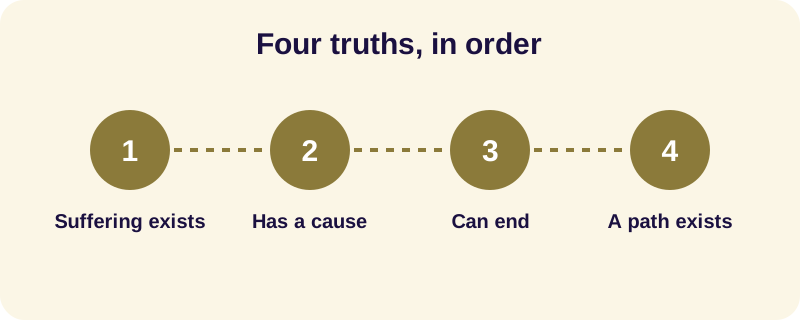
This is the first of the Four Noble Truths, and the set as a whole gives the full shape of the teaching: suffering exists, it has a cause, it can end, and there is a path to end it. The Buddha asked that this be understood, not accepted with resignation. Naming the problem precisely, rather than vaguely dreading it, was itself part of the remedy.
Why does suffering happen, according to the Buddha?
The Second Noble Truth names the cause: tanha, usually translated "craving" — the reflex of grasping at what is pleasant, pushing away what is unpleasant, and clinging to a sense of self that nothing will disturb. In this account, suffering is not punishment and not bad luck. It is the fairly mechanical result of craving meeting a world that refuses to stay still.
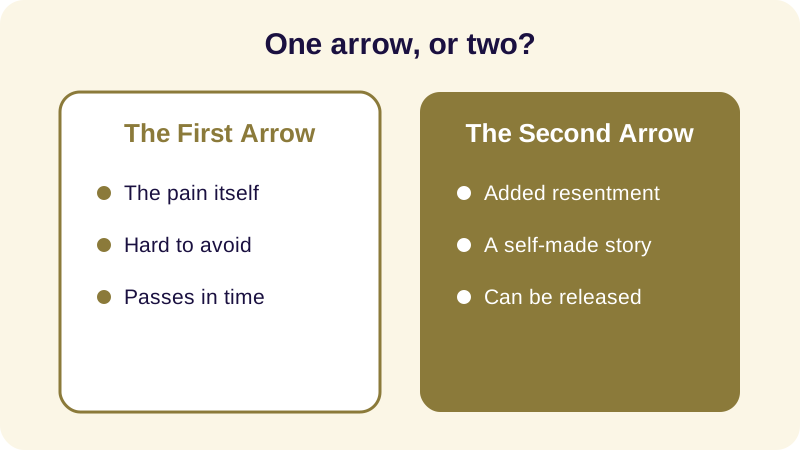
One of the clearest illustrations is the parable of the two arrows: pain is the first arrow, unavoidable and mostly outside our control, but the resistance, story and self-blame we pile on top is a second arrow we fire at ourselves. The second arrow story makes the distinction concrete — a stubbed toe hurts, full stop; an hour of resenting the table, replaying the moment, and feeling foolish is suffering we supplied ourselves. The teaching on dependent origination traces this further, showing how one reaction conditions the next in a chain, rather than suffering simply appearing from nowhere.
Can suffering actually end?
The Third Noble Truth is the one most easily missed: suffering can end. Not postponed, not merely managed, but genuinely stopped once the craving behind it is let go. This is the truth of nirodha, cessation — the Buddha did not describe suffering as a permanent feature of being alive, only as something with a cause, and anything with a cause can, in principle, stop.
The Fourth Noble Truth is the way there: the Noble Eightfold Path, a set of eight practical factors — right view, intention, speech, action, livelihood, effort, mindfulness and concentration — none of which is a belief to swear allegiance to, all of which is a way to act and a way to pay attention. The Buddha described this path as a Middle Way between indulgence and harsh self-denial, which is worth remembering on a night when you are tempted to treat your own tiredness as a personal failing.
How does this teaching help with an ordinary restless night?
You do not need to accept rebirth or any other doctrine for this framework to be useful at two in the morning. A racing mind is often craving at work in miniature — wanting the night to be different than it is, wanting sleep to arrive on command, wanting an unresolved worry to resolve itself right now. Seeing that wanting as the actual source of the tension, rather than the content of the thought, is often enough to loosen it a little.
The teaching on non-attachment is the same insight turned toward holding things loosely rather than refusing to feel them — it is not indifference, just a looser grip on a mind that keeps trying to pin things down. Practically, this can mean noticing a worry, naming it quietly as craving or resistance rather than as settled fact, and letting that noticing stand in for solving the whole thing before morning.
None of this replaces help for a genuinely difficult stretch. If sleeplessness, worry or low mood are persistent, that belongs with a doctor, not with a teaching applied as self-treatment. What the Four Noble Truths offer an ordinary restless evening is more modest than a cure: a way of seeing the shape of what is happening in your mind, instead of simply being carried along by it.
The Dhammapada, a collection of 423 verses attributed to the Buddha, returns to this theme again and again in short, memorable lines — useful to read or hear slowly when the mind is too wound up for a long argument.
Where can you hear this teaching at night?
The app narrates teachings like this one alongside Jataka tales, episodes from the life of Siddhartha Gautama, and Dhammapada verses, read slowly for listening in the dark rather than on a commute.
- Sleep Timer (10, 20, 30 or 60 minutes) that pauses the story and sounds when it ends, rather than fading them out.
- Guided Meditation for loving-kindness, body scan and breath awareness, drawing on practices like the four brahmaviharas.
- Offline Mode and background playback, so a weak signal does not interrupt the routine once a story has started.
- English narration across 90+ stories, with no ads once a story is playing.
The Buddha's teaching on suffering was never meant to be absorbed in one sitting. Returning to one piece of it — the first arrow, the shape of craving, the fact that it can end — on an ordinary restless night is enough. The rest can wait for morning.
Frequently Asked Questions
What are the Four Noble Truths the Buddha taught about suffering?
They are: suffering exists and touches every life; it has a cause, craving and clinging; it can end once that cause ends; and there is a practical path, the Noble Eightfold Path, that leads to that end. Together they form the Buddha's first and most central teaching.
Did the Buddha teach that life is nothing but suffering?
No. He taught that suffering is a real part of life, not its entire content, and that it has a traceable cause and a genuine end. Treating the teaching as flat pessimism misses the point: it is a diagnosis followed by a treatment, not a verdict.
What is the difference between pain and suffering in this teaching?
Pain is the first arrow — unavoidable, like a headache or a loss. Suffering often includes a second arrow we add ourselves: resentment, self-blame, or replaying the pain in our minds. The Buddha taught that the second arrow is largely optional, even when the first is not.
Can learning about the Buddha's teaching on suffering help me sleep?
It can give a restless mind a calmer way to look at its own worry, since much nighttime rumination is craving in miniature. It is not a treatment for insomnia or any condition; persistent sleep trouble is worth discussing with a doctor.