Published
Quick answer
Why is Siddhartha Gautama known as the Buddha? Because he reached enlightenment, meaning 'Awakened One,' through years of searching and a still night under the Bodhi tree, not a god's visit or popularity.
Key takeaways
- Buddha is a title meaning 'Awakened One,' not Siddhartha Gautama's family name.
- Mara is a Buddhist tempter figure, not a Hindu god, and followers came long after the awakening.
- By tradition he sat quietly for weeks after his awakening before teaching anyone.
- Leaving the palace exposed him to old age, sickness and death, not popularity.
- A long search preceded the single night of enlightenment under the Bodhi tree.
Why is Siddhartha Gautama known as the Buddha? He earned that title — "the Awakened One" — through years of searching that ended with one still night of meditation under the Bodhi tree, not because a god paid him a visit or because people simply liked him.
Why is Siddhartha Gautama known as the Buddha?
"Buddha" is not a family name. The meaning of the word Buddha is close to "the one who has woken up" — woken up, specifically, to the causes of suffering and a way past them. Siddhartha Gautama earned that title through his own long search, not because a deity handed it to him and not because a crowd happened to like him.
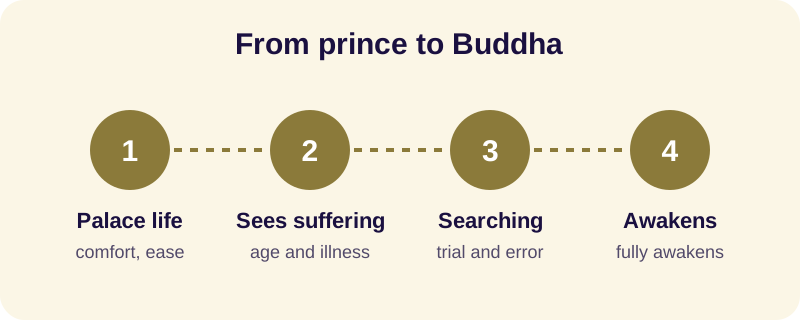
The story behind the title has a clear shape once the popular shortcuts are cleared away: a sheltered prince, a jolt of real suffering, a long search, and a quiet turning point that changed what people called him afterward. Each of those turns gets compressed or scrambled in the retelling, which is part of why Siddhartha Gautama is called the Buddha gets answered so inconsistently online.
He is called the Buddha because of what he discovered about suffering and its end — ideas later organized into teachings like the Four Noble Truths, the Noble Eightfold Path, and the everyday guidance of the Five Precepts — not because of any myth that grew up around the discovery afterward.
Did a Hindu god named Mara really speak to him?
No — and this is one of the more common mix-ups in the story of Mara and Siddhartha Gautama. Mara is not a Hindu god. In the Buddhist telling, Mara is a tempter figure, closer to a personification of fear, doubt and craving than a deity borrowed from an outside religion, and he appears to try to stop the awakening, not to recruit anyone toward it.
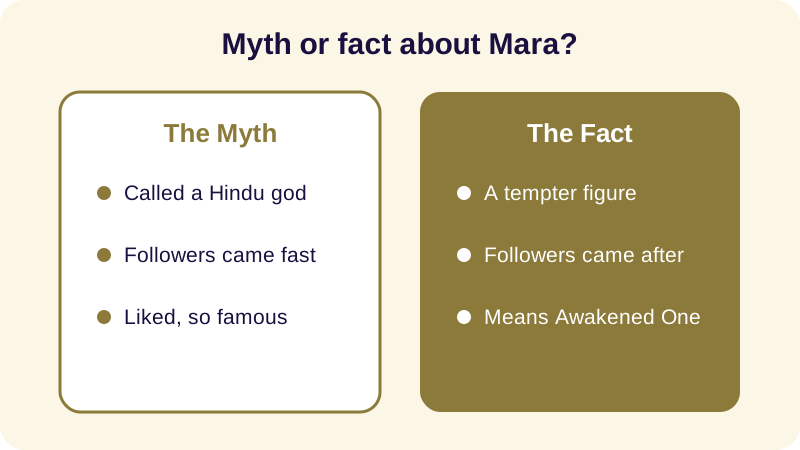
In some retellings this scene gets compressed into "a god visited him and people followed," which erases both halves of what actually happens in the texts: a direct confrontation with fear and doubt, and a response that has nothing to do with gathering a crowd.
Followers came later, slowly, once people heard what he had come to teach and tested it against their own experience. If the figure of Mara interests you, the wider cast of tempters, spirits and protective beings is covered in our guide to Buddhist mythology.
What really happened after his awakening under the Bodhi tree?
By tradition, he did not meditate without stopping in order to draw attention. After the awakening itself, he is said to have sat quietly for a stretch of weeks, staying with what he had just understood before he spoke to a single other person.
That detail usually gets flattened into "he meditated and became famous," but the order runs the other way. The sitting came first, and it was private; the teaching, and whatever following came from it, only started once he decided the insight was worth putting into words for someone else. The fuller account of that night and the weeks around it is told in our story of the Buddha's enlightenment.
Was leaving the palace about being liked, or something else?
Leaving the palace was not a popularity contest, and the traditional story doesn't turn on whether the people he met outside the walls liked him. What it turns on is what he saw there: an old man, a sick man, a corpse, and a wandering renunciant — ordinary sights that a sheltered upbringing had kept from him entirely.
- Old age, which showed him that strength doesn't last
- Illness, which showed him that health doesn't last
- Death, which showed him that life itself doesn't last
- A wandering renunciant, which showed him there was another way to live alongside all of it
That shift, from a life arranged to avoid discomfort to one that looked straight at it, is the real hinge of the story, far more than any warm reception along the way. It is also the seed of what later became the Middle Way — neither the comfort of the palace nor the extreme self-denial he tried next, but something steadier between the two. The long, often harsh period of searching that followed is usually shortened to "wandering"; what it actually involved is covered in our piece on what Siddhartha Gautama did during those years.
What does this story offer a mind that won't settle at night?
The use of this story at bedtime isn't really about correcting a handful of mixed-up details, though it helps to know what does Buddha mean and why the title was given at all. It's the shape of the whole arc that matters: comfort, a confrontation with discomfort, a long search, and a settling. That arc resembles what a restless mind is usually looking for at the end of a day, which is part of why it holds up to slow, unhurried telling rather than a quick summary.
The Buddha Story app narrates the fuller version of this account — the leaving of the palace, the years of searching, the night under the Bodhi tree — alongside Jataka tales, the life of the Buddha, Dhammapada verses and Zen parables, with a sleep timer that stops the story for you and relaxing sounds like rain or singing bowls underneath. The app also offers guided meditation for loving-kindness and breath awareness, offline listening, and background playback, so the story keeps going even after the screen locks.
For a broader overview of the whole life story in one place, see our summary of the life of the Buddha.
Frequently Asked Questions
Why is Siddhartha Gautama known as the Buddha?
Because 'Buddha' means 'the Awakened One,' a title he earned after years of searching ended with a single night of deep meditation under the Bodhi tree. It describes what he understood about suffering and its end, not a name he was born with or a reputation he built.
Is Mara a Hindu god who spoke to the Buddha?
No. Mara is a tempter figure from Buddhist mythology, not a deity from the Hindu tradition, and the story isn't about gathering followers. On the night of his awakening, Mara appeared to tempt and frighten Siddhartha Gautama away from enlightenment, and the Buddha simply stayed seated.
Did the Buddha meditate to gain attention?
By tradition, he sat quietly for a stretch of weeks after his awakening, not before it, and not to attract a crowd. He stayed with the experience privately; the teaching, and any following, came only once he decided to share what he had understood.
Did people like Siddhartha Gautama when he left the palace?
The traditional story isn't about being liked. When he left the palace walls, what struck him was suffering itself — old age, sickness and death — and that encounter, not anyone's approval, is what set his search in motion.
How long did Siddhartha Gautama search before his enlightenment?
The traditional accounts describe a lengthy period of deliberate searching and ascetic practice before he sat down under the Bodhi tree and reached enlightenment in a single night, after which he became known as the Buddha.
