Published
Quick answer
An app with guided meditation and sleep sounds combined lets a short guided practice settle your thoughts, then hands off to rain, ocean waves or singing bowls so the room doesn't go abruptly silent.
Key takeaways
- A guided meditation settles busy thoughts; a sound layer keeps the room from going suddenly silent afterward.
- Buddha Story's sleep timer pauses the story and sounds outright at 10, 20, 30 or 60 minutes, without fading.
- Keep one sound running all night rather than switching between rain, waves and bowls mid-session.
- Offline listening and background playback let the combination keep going once the screen is off.
- This pairing eases an ordinary restless evening; persistent sleeplessness is a matter for a doctor.
An app with guided meditation and sleep sounds combined gives you one place to follow a breath or body-scan practice and then rest inside rain, ocean or singing-bowl sound, instead of juggling two separate apps in the dark. That single-screen simplicity is the whole point once the lights are off.
What does an app with guided meditation and sleep sounds combined actually offer?
Most meditation apps give you a guided session and then stop. Most sound apps give you rain or waves and nothing else. Searches for a guided meditation and sleep sounds app are really asking for the thing in between: a short guided practice that leads directly into a bed of ambient sound, so the mind has somewhere to land once the instructions end.
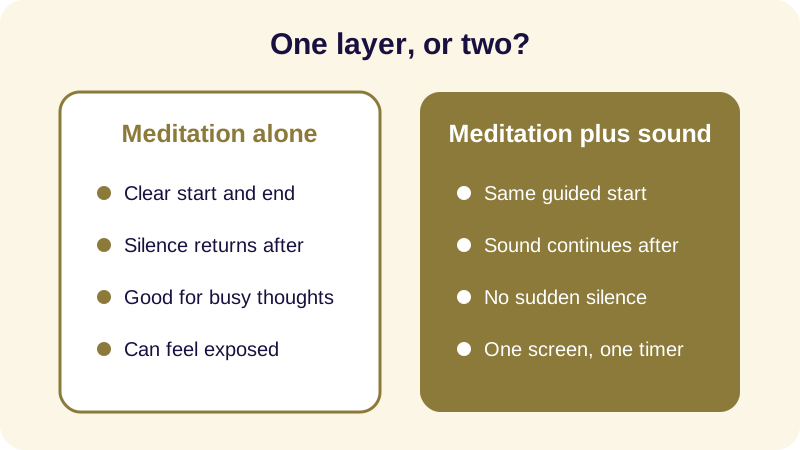
The two halves do different jobs. The guided part gives the mind something specific to do — count the breath, notice the body, wish someone well — which is useful early in the evening when thoughts are still looping. The sound part has nothing to follow at all. It simply fills the room once the instructions stop, so silence doesn't become the next thing you lie there listening to. A meditation and sound mixer app, done well, removes the gap between those two states entirely.
How does pairing meditation with sound actually settle a racing mind at night?
A mind that won't switch off at night is usually still trying to finish something — a conversation, a decision, tomorrow's plan. A racing mind doesn't stop because you tell it to; it needs somewhere else to put its attention. A guided meditation does that directly: breath awareness gives it a number to count, a body scan gives it a slow tour to take instead.
Once the guided part ends, sound takes over a different job. Silence after a voice stops can feel sudden, and a sudden change is exactly the kind of thing an alert mind notices and reacts to. A steady layer of rain, waves or a singing bowl keeps the room from going abruptly quiet, so attention has something low and constant to rest against instead of snapping back to the day's unfinished business.
This combined meditation and sleep sounds approach is not a cure for insomnia and it isn't meant to be one. If sleeplessness is frequent, severe or tied to a wider health concern, that belongs with a doctor, not an app. What this kind of practice does, on an ordinary restless evening, is give the mind two gentle places to put its attention instead of one empty room to lie awake in.
What's inside Buddha Story's combination of guided meditation and sleep sounds?
Buddha Story pairs Guided Meditation for loving-kindness, body scan and breath awareness with a sound mixer of rain, ocean waves and singing bowls, alongside narrated Buddhist stories — Jataka tales, episodes from the life of Siddhartha Gautama, and verses from the Dhammapada — for nights when a story suits you better than a formal sit.
A few practical details matter more at two in the morning than any feature list does:
- The Sleep Timer offers 10, 20, 30 or 60 minutes, and it pauses the story and sounds outright when the timer ends — it does not fade them out.
- Offline Mode and background playback mean the combination keeps running with the screen off and no signal needed.
- Narration is in English only, there is no Kids Mode, and the app is built for Android, available on Google Play with a 3-day free trial before choosing a Monthly or Yearly plan.
- There are no ads to interrupt a session once it has started.
If you'd like to see how different approaches to short guided meditation at night or rain sounds for sleeping compare before settling on one app, our comparison of Buddhist sleep apps walks through what each one actually includes.
How do you build an evening routine around meditation and sound together?
The order matters less than consistency, but a simple sequence works for most people: sit or lie down, run a short guided meditation first, then let the sound continue afterward without another decision to make.
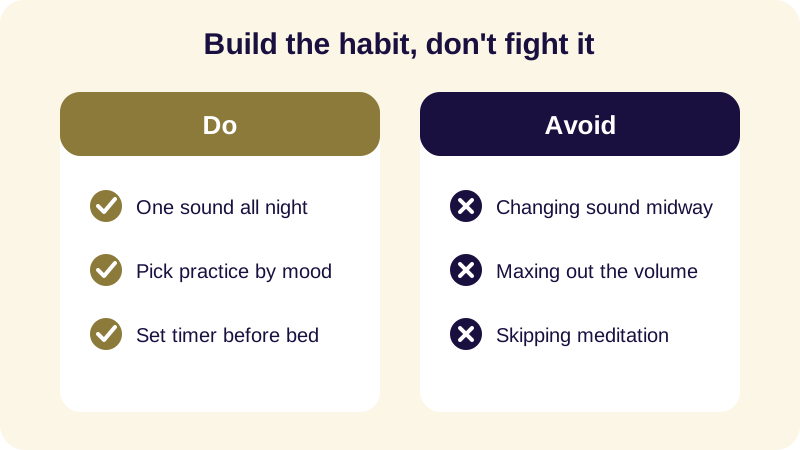
- Pick one guided practice for the night — breath awareness if your thoughts are busy, a body scan if your body is tense, loving-kindness if the day left you irritable.
- Choose one sound and leave it running. Switching between rain, waves and bowls partway through gives the mind something new to notice, which works against the point of the sound layer.
- Set the sleep timer for the length you actually need, not the longest option out of habit.
- Let the room go dark and don't check the screen again until morning.
Done most nights, this becomes a cue in itself. The body starts to recognise the particular meditation-then-sound sequence as the signal that the day is over, which is worth more over time than any single session. A bedtime meditation with ambient sound layered underneath works best when it's the same shape each night, not a different combination every time.
If you'd rather follow a slower narrated piece than a formal guided sit on some nights, mindfulness for sleep covers a gentler, less structured route to the same place — useful for the nights when even a short guided practice feels like one more task.
Frequently Asked Questions
What's the difference between guided meditation and sleep sounds?
Guided meditation talks you through a specific practice — breath awareness, a body scan or loving-kindness — with a clear beginning and end. Sleep sounds are ambient audio like rain or ocean waves with no instructions at all. Combined, the guided part settles your attention first and the sound fills the quiet afterward.
Does combining meditation and sound actually help you fall asleep?
It can make an ordinary restless evening easier by giving the mind a specific task first and a steady, low sound afterward instead of sudden silence. It is not a treatment for insomnia; persistent sleep problems are worth discussing with a doctor rather than solving with an app alone.
Can I use the sound without the guided meditation, or the other way round?
Yes. Many nights you will want only the sound running, and other nights only a short guided practice with nothing layered underneath. A combined app should let you use either on its own, not force both together every single time.
What does Buddha Story's sleep timer actually do?
It stops the story and sounds outright once the chosen length — 10, 20, 30 or 60 minutes — ends. It does not fade the audio down gradually; playback simply pauses, so you can set it and stop thinking about your phone.