Published
Quick answer
How to practice breath awareness meditation at home: sit upright, rest attention on the breath, and gently return when the mind wanders. Ten quiet minutes is enough to begin, and a dim, quiet room works well in the evening.
Key takeaways
- Breath awareness (anapanasati) needs no equipment, just a quiet seat and a few minutes
- Rest attention lightly on the breath at the nostrils, chest or belly, wherever it's clearest
- A wandering mind is normal; noticing it and returning is the practice itself
- Short, regular sessions build the habit faster than rare long ones
- Evening breath awareness can settle a restless mind, but ongoing sleep trouble belongs with a doctor
Breath awareness meditation needs no app, no incense and no special room. Here is how to practice breath awareness meditation at home, step by step, starting with where you sit.
What is breath awareness meditation?
Breath awareness meditation is the practice of resting your attention on the breath, just as it is, without trying to slow it, deepen it or control it in any way. In Pali it is called anapanasati — mindfulness of breathing — and it is described in the Buddha's Satipatthana Sutta, a discourse on the four foundations of mindfulness. The breath is used because it is always available, always happening now, and completely ordinary. You are not reaching for a special state; you are simply noticing something your body is already doing.
See also: The Difference Between Meditation and Mindfulness.
This makes it a useful entry point into meditation for beginners: there is nothing to learn beyond paying attention and starting over when attention drifts, which it will.
How do I set up a space to practice at home?
You do not need a meditation room. A chair, a cushion on the floor, or the edge of your bed will do, as long as your spine can stay upright without strain. Sit somewhere you will not be interrupted for a few minutes, keep the lighting low rather than bright, and put your phone somewhere out of reach so a notification does not pull you out of the session.
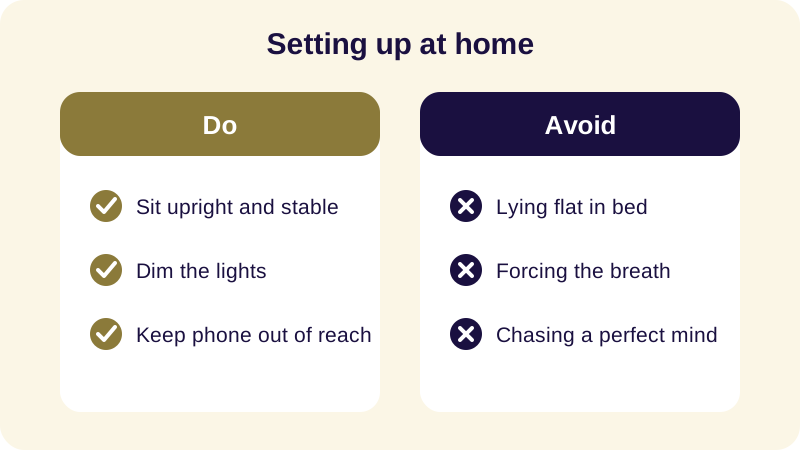
Lying down tends to invite sleep before the mind has had a chance to settle, which is fine if sleep is your goal at night but defeats the purpose of a seated practice session earlier in the day. Either way, a consistent spot — even just one corner of a room — helps the body learn what is coming when you sit there.
What are the steps of breath awareness meditation?
The sequence is short enough to remember without notes, and the same sequence works whether you have five minutes or thirty.
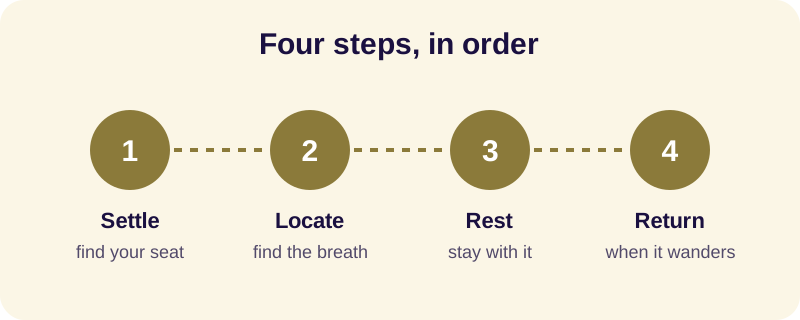
- Sit upright, close your eyes or let your gaze rest softly on the floor, and take one slightly longer breath to arrive in the room.
- Let the breath return to its normal rhythm, and find where you feel it most clearly — nostrils, chest or belly.
- Rest attention on that one spot, breath after breath, without counting, labelling or adjusting anything.
- When you notice the mind has wandered to a plan, a memory or a sound, simply return attention to the next breath, as many times as needed.
- When your set time is up, open your eyes, take a moment before standing, and let the ordinary noises of the room back in.
What should I do when my mind keeps wandering?
Expect it. A wandering mind is not a sign you are doing breath awareness meditation badly; noticing the wandering and returning is the whole exercise, repeated as many times as it takes. Some sittings will feel like one long return; others will feel settled almost immediately. Neither is a measure of success.
If the same worry keeps pulling you away, it can help to name it silently — "planning," "worrying" — and then go back to the breath, rather than following the thought to its conclusion. This echoes the wider theme in Buddhist practices for anxiety: the goal is not an empty mind but a mind that notices what it is doing and chooses where to rest.
How often should I practice to build the habit?
A short daily sitting, even five minutes, tends to work better than one long session a week, because the practice is really about training the moment of noticing and returning, and that moment needs repetition more than duration.
Building it into a daily routine
Attaching the practice to something you already do — after brushing your teeth, before checking your phone in the morning, or sitting on the edge of the bed at night — removes the need to decide each day whether to do it. For a fuller plan on turning this into a lasting habit rather than an occasional good intention, see our guide on how to start a daily meditation habit.
Can breath awareness meditation help me sleep at night?
It can help settle an ordinary restless evening by giving the mind one simple, undemanding thing to rest on instead of replaying the day. Many people practice it sitting up before bed, then shift to lying down once the mind has quietened, rather than trying to meditate and fall asleep in the same posture from the start.
For the evening specifically, some people prefer a few minutes of silent breath awareness followed by something that occupies the mind a little more gently, such as a short story. If the breath alone feels too quiet to hold your attention at first, a slow, narrated piece such as the ones in Buddhist meditation for insomnia can serve as a bridge into the same settled state.
Buddha Story includes guided meditation for breath awareness alongside its narrated stories and sounds, and its sleep timer stops the session for you at 10, 20, 30 or 60 minutes rather than letting it run all night. For anyone deciding between practicing silently on your own or following a guided voice, both approaches rest on the same simple instruction: find the breath, and come back to it.
Frequently Asked Questions
What is breath awareness meditation?
Breath awareness meditation, called anapanasati (mindfulness of breathing) in Pali, is the practice of resting attention on the natural breath without changing it. It comes from the Buddha's Satipatthana Sutta, a discourse on the foundations of mindfulness, and needs no belief system to be useful.
How long should I practice at home when starting out?
Five to ten minutes is plenty for a first sitting. The value comes from returning attention to the breath many times in a short session, not from sitting longer. You can lengthen the session gradually once it feels familiar rather than effortful.
Where should I focus attention during the practice?
Pick one spot where the breath feels clearest: the edge of the nostrils, the rise and fall of the chest, or the movement of the belly. Any of these works. Settle on one place for the whole session instead of switching between them.
What should I do when my mind wanders?
Notice that it wandered, without scolding yourself, and bring attention back to the next breath. This noticing and returning, repeated many times, is the actual exercise. A mind that never wanders would make the practice pointless, not perfect.
Can breath awareness meditation help me sleep?
It can help settle an ordinary restless mind before bed by giving it one simple thing to rest on instead of the day's leftover thoughts. It is not a treatment for insomnia or any medical condition; ongoing sleep problems are worth discussing with a doctor.