Published
Quick answer
This life of the Buddha summary for beginners covers Siddhartha Gautama's palace years, his renunciation, the night of enlightenment under the Bodhi tree, and decades teaching the Four Noble Truths before his death.
Key takeaways
- Siddhartha Gautama was born a prince and left the palace after seeing sickness, old age and death.
- Years of extreme ascetic practice did not bring him peace, so he tried a steadier middle path instead.
- He awakened under the Bodhi tree and gave his first teaching on the Four Noble Truths.
- He spent decades teaching before dying at an old age, surrounded by students.
- His story still shapes teachings and tales told quietly, for calm, roughly 2,500 years later.
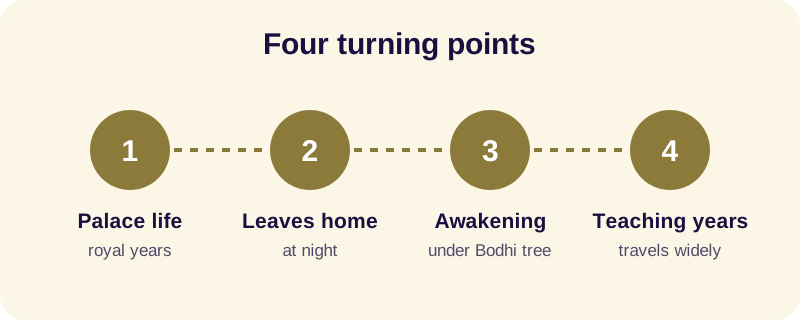
This life of the Buddha summary for beginners traces Siddhartha Gautama from a sheltered prince to the awakened teacher the world now calls the Buddha. It follows four moments that matter most: his palace years, his renunciation, his enlightenment under the Bodhi tree, and decades of teaching before his death.
Who was Siddhartha Gautama before he became known as the Buddha?
Siddhartha Gautama was born into a ruling family and raised inside a palace built, according to the traditional account, to keep anything unpleasant away from him. He married, had a son, and by most tellings lived a life of comfort for close to thirty years without ever seeing anyone old, sick or dead.
This early period is the setting for one well-known teaching image: a king told four men who had each touched a different part of an elephant that they were each describing the whole animal. It is often used to show how a sheltered view can feel complete while missing almost everything — a fitting note for a prince who had not yet seen the world outside his walls, and you can read the full blind men and the elephant story separately.
What made him leave the palace and search for answers?
According to the traditional account, Siddhartha left the palace grounds and encountered an old man, a sick man, and a corpse, then a wandering ascetic who had given up ordinary life to seek peace. These sights are usually called the Four Sights. They convinced him that comfort had not actually protected him from suffering, only delayed his noticing it.
He left the palace at night, gave up his title, and spent years training under different teachers and practising extreme fasting. By most accounts he brought himself close to starvation without reaching the clarity he was looking for.
How did he reach enlightenment under the Bodhi tree?
Siddhartha accepted a simple meal, abandoned the extreme fasting, and sat down beneath a tree, later known as the Bodhi tree, resolving not to move until he understood the cause of suffering clearly. Over one long night he is said to have seen his own past lives, the workings of cause and effect across all beings, and finally the end of craving itself. At dawn he was the Buddha, "the awakened one."
The fuller account of that night, including the challenges he is said to have faced while sitting there, is told in detail in the story of the Buddha's enlightenment, and the practical sequence of what he actually did is laid out in how the Buddha attained enlightenment.
What did the Buddha teach after his awakening?
His first teaching, given to five former companions, set out the Four Noble Truths: that life includes suffering, that suffering arises from craving, that it can end, and that a path leads there. That path is the Noble Eightfold Path, covering view, intention, speech, action, livelihood, effort, attention and concentration — a practical training rather than a creed to accept on faith.
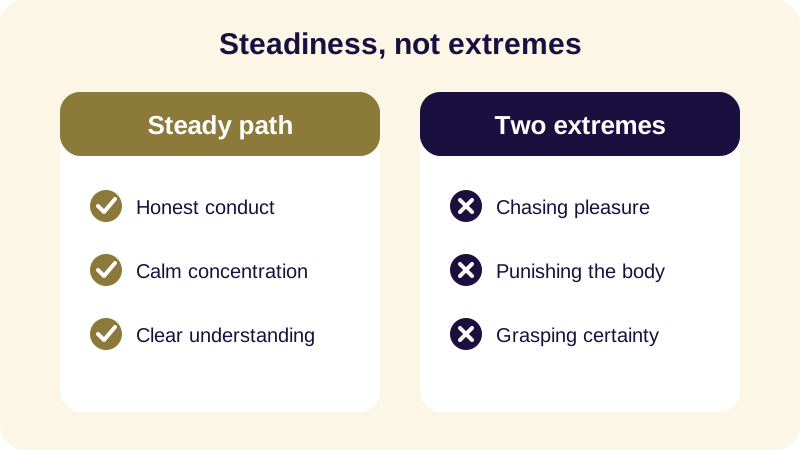
This balance is what the tradition calls the Middle Way, and the full set of truths is explained more slowly in the Four Noble Truths. Over time the Buddha also set out the Five Precepts as everyday ethical guidelines, and described the four brahmaviharas — loving-kindness, compassion, joy and equanimity — as attitudes worth cultivating deliberately rather than waiting for them to arise on their own.
How did the rest of his life unfold, and how did he die?
For roughly the next four decades the Buddha walked from town to town across northern India, teaching anyone who asked, forming a community of monks and nuns, and answering the same handful of human questions in different words each time: why do we suffer, and what can actually be done about it. Many of the stories told about this period are the Jataka tales, a collection of 547 accounts of his earlier lives, each pointing at a single virtue like patience, generosity or courage.
He died at an old age, reportedly from illness after a meal, surrounded by students. His last instruction, as it is usually recorded, was that everything made of conditions passes away, and that his followers should continue the work themselves rather than treat him as a permanent fixture. What the tradition says happens after death is explored separately in what happens after death in Buddhism.
Why does this story matter for a restless mind at night?
The shape of the story is part of why it settles a mind at the end of the day. It moves from comfort, to difficulty, to a clear and fairly plain resolution — the same arc that a body looks for before sleep, rather than a plot that keeps raising new tension. Hearing the life story slowly, in order, gives a racing mind one long, familiar thread to follow instead of the day's unfinished business.
The Jataka tales work the same way in miniature, each one a small episode from the same overall life. If you would rather read the words the Buddha is said to have spoken himself, the Dhammapada, a collection of 423 verses, sits alongside this biography as a second, shorter way into the same teaching.
The app narrates this life story slowly, in English, alongside the Jataka tales, Dhammapada verses and Zen parables, with a sleep timer that pauses the story and sounds when it ends rather than fading them out, offline listening, and background playback for a locked screen. None of this is presented as treatment for insomnia or anxiety; it is simply a quiet way to spend the last minutes before sleep, and ongoing sleep difficulties are worth raising with a doctor rather than a story.
Frequently Asked Questions
Who was the Buddha before his enlightenment?
He was Siddhartha Gautama, born a prince and raised inside a palace built to shield him from hardship. He married, had a son, and lived comfortably until, in his twenties or thirties, he saw old age, sickness and death for the first time and left to search for an answer to suffering.
What happened under the Bodhi tree?
After years of extreme fasting failed to bring him peace, Siddhartha sat beneath a tree, later called the Bodhi tree, and resolved not to move until he understood suffering clearly. Over one long night he reached enlightenment and became known as the Buddha, the awakened one.
What did the Buddha teach after he awoke?
His first teaching set out the Four Noble Truths: that life includes suffering, that suffering has a cause, that it can end, and that a path leads there. That path is the Noble Eightfold Path, a practical guide to ethics, attention and understanding rather than a set of beliefs to accept on faith.
How did the Buddha's life end?
He taught for roughly four decades, travelling and gathering students, before dying at an old age from illness. His last recorded instruction was simple: that everything conditioned passes away, so his followers should work out their own freedom with diligence.
Is this life story the same as the Jataka tales?
No. The Jataka tales are 547 stories about the Buddha's earlier lives, before this final birth as Siddhartha Gautama. The life story covered here is his last life, the one that ended in enlightenment and is usually what people mean by "the life of the Buddha."
