Published
Quick answer
No. Can meditation replace sleep? Meditation calms the mind and eases tension, but it cannot replace the body's physical repair during real sleep.
Key takeaways
- Meditation lowers stress and quiets thought but skips sleep's repair stages
- A short sit eases fatigue's edge without restoring lost sleep
- The Middle Way rejects sleep deprivation as a spiritual shortcut
- Treating meditation as a sleep substitute can hide a real sleep problem
- Short, gentle practice before bed helps you reach sleep, not replace it
Can meditation replace sleep? No: meditation can calm a busy mind and ease the body's tension, but it cannot substitute for the physical repair that only sleep provides.
That distinction matters most on the nights when sleep is short or missing entirely. Meditation is genuinely useful then, but knowing what it can and cannot do keeps you from leaning on it for something it was never built to supply. The question comes up often enough that it is worth separating what each activity actually does, rather than assuming one is simply a faster version of the other.
What does meditation actually give the body that sleep doesn't?
Sitting quietly and following the breath slows the stream of thought and lowers the body's sense of alarm. It does not, however, move the body through the deeper biological processes that happen during actual sleep — the repair work, the settling of memory, the cycles the brain and body complete on their own schedule, not on demand.
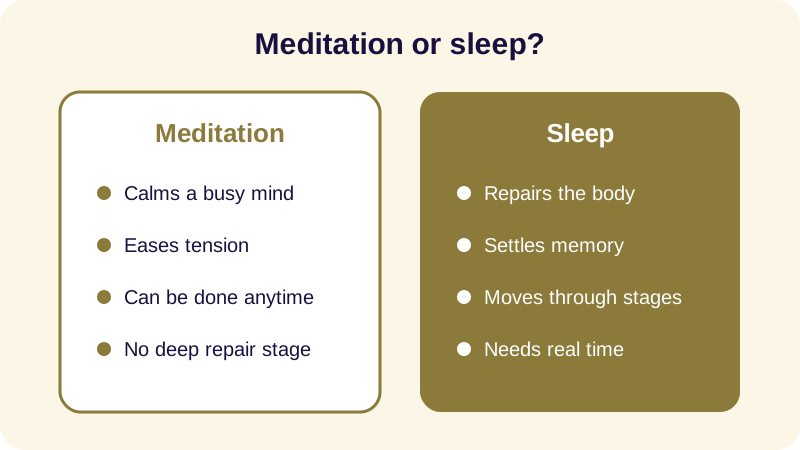
Mindfulness practice, including the kind of attention training described in the Satipatthana Sutta, trains awareness of breath, body and passing thought. That is valuable in its own right. It is a different activity from sleep, not a faster or lighter version of it, which is really the heart of the meditation vs sleep question: they sit side by side rather than standing in for each other.
This is also why using meditation instead of sleep as a regular strategy tends to backfire. A mind that is calm but a body that has not actually rested will still feel the effects of the missed hours, often later in the day rather than right away. Attention drifts, small irritations land harder, and the very stillness that meditation builds can start to feel brittle rather than steady. None of that means the sitting was wasted — it means it was doing a different job than the one it was asked to do.
Can meditation make up for a short night's sleep?
A short sitting session the next day can take the sharp edge off fatigue — the jitteriness, the short temper, the sense of being pulled in two directions at once. It will not restore whatever sleep was actually lost. If you are short one night, the steadier plan is still to sleep more the following night, not to meditate instead of it.
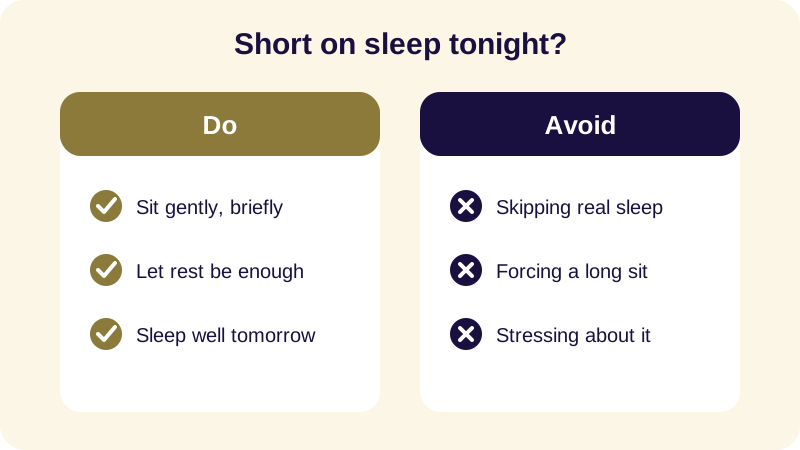
There is also a quieter risk worth naming. Treating sleep deprivation and meditation as a workable pair, night after night, can turn into a habit of shortchanging sleep on the idea that sitting will cover the gap. It generally doesn't, and the fatigue tends to accumulate rather than resolve, showing up as a kind of low background tiredness that a single good meditation session rarely clears on its own.
What did Buddhist teaching actually say about rest?
The tradition does not treat sleep deprivation as a virtue, and it does not suggest that meditation can equal sleep. Siddhartha Gautama's own account describes years of extreme fasting and austerity before his realization under the Bodhi tree, and he found that path as unworkable as indulgence had been. What he settled on instead was the Middle Way — a path between denying the body what it needs and overindulging it.
Monastic life, even in traditions known for early waking and long sitting, still sets aside time for rest alongside practice. The emphasis running through the Four Noble Truths, the Noble Eightfold Path and the Five Precepts is on a clear, steady mind, and a body deprived of sleep rarely produces that. Meditation sits beside rest in a balanced life; it was never offered as a way around it. The same spirit shows up in the four brahmaviharas, which ask for a settled, caring mind rather than a depleted one pushed past its limits in the name of discipline.
What should I actually do tonight if my mind won't settle?
If you are lying awake with a mind that will not quiet down, the aim for tonight is not to replace sleep with meditation but to use meditation to make sleep more reachable. A short breath awareness practice, or a loving-kindness (metta) phrase repeated slowly, gives a racing mind somewhere to rest instead of somewhere to argue. For more on this, see how to quiet a racing mind at night, or a fuller look at buddhist meditation for insomnia and at metta meditation for the heart practice itself.
See also: Buddhist Evening Routine for Better Sleep.
This is also where a narrated story can help more than silent sitting, especially when silence tends to leave room for worry. The Buddha Story app narrates Jataka tales, episodes from the life of the Buddha, Dhammapada verses and Zen parables slowly, in English, alongside relaxing sounds like rain and singing bowls and guided meditation for breath awareness or loving-kindness. Its sleep timer stops the story for you instead of fading it, so you are not reaching for a screen in the dark, and the stories and sounds can be downloaded for offline, background listening.
None of this replaces sleep either. It simply gives the mind something quieter to follow on the way there, which is the most that any practice — meditation included — honestly offers. A realistic plan treats meditation as the path toward rest, not a detour around the need for it, and that single shift in expectation tends to make both the sitting and the sleep that follows easier to settle into.
Frequently Asked Questions
Can meditation replace sleep entirely?
No. Meditation can calm the nervous system and quiet a busy mind, but it does not take the body through the physical repair and memory processes that happen during actual sleep. The two do different jobs and work best together, not as substitutes for each other.
Does meditation instead of sleep work for one bad night?
A short meditation session can ease the jitteriness and irritability of a short night, but it will not restore the sleep itself. The more reliable plan after a poor night is simply to sleep more the following night.
Is sleep deprivation part of traditional Buddhist practice?
No. The Middle Way specifically rejects extreme self-denial, including depriving the body of what it needs. Monastic schedules, even demanding ones, still set aside time for rest alongside sitting practice.
What should I do if I can't sleep and meditation isn't enough?
Keep any nighttime practice short and gentle rather than forcing a long session, and treat it as a way toward sleep rather than a replacement for it. If sleeplessness is frequent or severe, that is worth raising with a doctor.