Published
Quick answer
Why do ocean sounds help you relax? The steady, repeating rhythm of waves gives a busy mind one simple pattern to follow, softens sudden noises, and loosely matches the pace of slow breathing, which signals the body to settle for sleep.
Key takeaways
- Ocean sounds work mainly because their rhythm is steady and predictable, not because of a special frequency.
- A continuous wash of wave sound masks sudden noises that would otherwise pull attention back to alert.
- A slow, even sound pattern can loosely match slower breathing, helping the body feel safe enough to settle.
- Waves rising and passing offer a plain, physical picture of impermanence (anicca) in Buddhist teaching.
- Ocean sound is a backdrop, not a cure — ongoing sleep trouble is worth raising with a doctor.
Why do ocean sounds help you relax? Because the steady, repeating rhythm of waves gives a busy mind one simple pattern to follow instead of chasing its own thoughts.
There is nothing mysterious in this. Ocean sound belongs to the same family as rain or a fan running in another room: a continuous, low-grade sound that smooths out the sharp edges of a quiet house. What makes waves particularly good at this job, and what a slow, repeating sound has to do with an old Buddhist idea about things rising and passing away, is worth working through slowly — especially if you reach for this sound because your mind will not settle at bedtime.
What makes the sound of waves so calming?
A wave does not arrive on a fixed schedule, but it never arrives as a surprise either. It swells, breaks and recedes in a loose, familiar rhythm, somewhere between a few seconds and ten seconds from one wash to the next. A mind that is scanning for danger — which is what an anxious mind is doing, even at eleven at night — checks a sound like this, finds nothing sharp or sudden in it, and slowly stops checking.
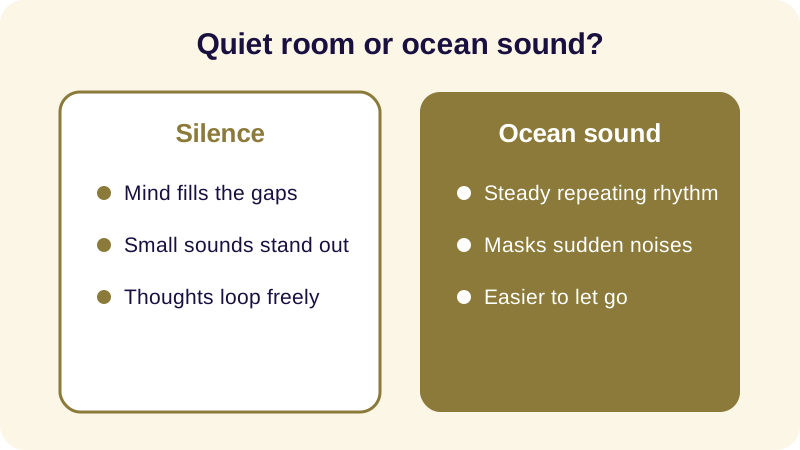
Ocean sound also does the job that sound engineers call masking. A continuous wash of noise sits underneath the sharper, more startling sounds of an ordinary house — a radiator ticking, a car outside, a floorboard settling — and keeps any one of them from standing out enough to pull your attention back to full alertness. You are not really listening to the ocean so much as not listening to everything else. This is also roughly why plain white noise and a fan have a similar, milder effect: the content of the sound matters less than its steadiness.
Does this connect to anything in Buddhist practice?
Loosely, yes. Each wave forms, peaks and dissolves, and the next one is already forming behind it — nothing stays, and nothing is lost either. That is a plain, physical version of impermanence (anicca), the observation at the centre of the Buddhist teaching on why nothing lasts: thoughts, feelings and even the tightness in your chest behave the same way, arising and passing on their own if you do not grab hold of them.
This is also roughly what breath awareness asks you to notice. In the Satipatthana Sutta, the discourse on the foundations of mindfulness, attention to the breath works the same way a wave does: one breath rises, peaks and falls away, and another begins, with no need to hurry it. Listening to waves can do a version of that work without any instruction at all, which is part of why it pairs so naturally with mindfulness practice at night — the ear doing quietly what the breath is meant to do.
See also: How to Play Ocean Sounds Overnight: A Simple Guide.
How can I use ocean sounds before bed?
Ocean sound rarely needs much setup, but a few adjustments make it work harder for you.
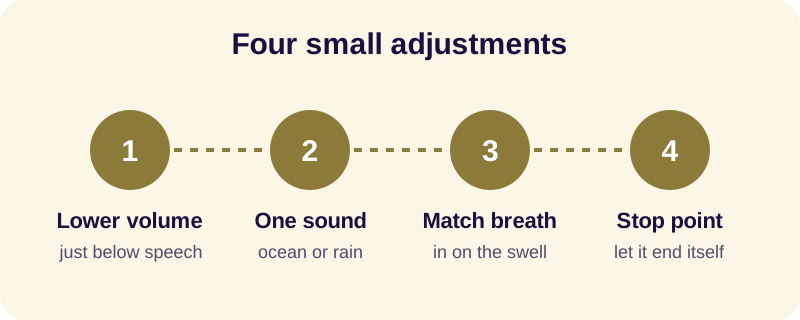
- Keep the volume low. Loud enough to notice, quiet enough that you could speak over it without raising your voice. Louder is not more calming; it just gives the mind something new to track.
- Give it a small job. Instead of only listening passively, let each wave mark one slow out-breath — a soft rise on the swell, a longer fall on the wash. This borrows directly from the breath-awareness idea above.
- Set a stop point. A sound that plays for hours can wake a light sleeper later in the night. A timer that stops it once you are likely asleep protects deeper sleep instead of quietly interrupting it.
Can ocean sounds replace meditation or a bedtime story?
Not exactly, though the two work well together. A sound is a backdrop; a story or a guided practice gives the mind something to follow, which helps on nights when it is especially restless and a wave alone is not quite enough to hold attention. If that is a familiar pattern for you, a slow-paced Buddhist meditation for a sleepless mind layered under the same ocean sound often works better than either on its own.
If your mind tends to spin through tomorrow's to-do list the moment the room goes quiet, it may help to read about what actually quiets a racing mind at night before you even reach for a sound at all. The sound helps most once the worrying has somewhere else to go.
How does the Buddha Story app bring these together?
The app's sound mixer blends ocean waves with rain or singing bowls, and sits alongside more than 90 narrated stories — Jataka tales, episodes from the life of Siddhartha Gautama, Dhammapada verses and Zen parables — for nights when a sound alone isn't quite enough. You can run the wave sound under a short guided meditation for breath awareness or a slow retelling of a single tale, rather than choosing only one or the other.
A sleep timer set to 10, 20, 30 or 60 minutes stops the story and the sounds for you, pausing cleanly rather than fading out, so you are not left guessing whether something is still playing somewhere in the house. Downloaded sound and story combinations keep working offline, continue in the background with the screen off, and the app carries no ads to break the mood halfway through.
Frequently Asked Questions
Why do ocean sounds help you relax at night?
Ocean sounds give a busy mind a steady, repeating pattern to follow instead of its own looping thoughts, and the continuous wash of sound masks the sharper noises in a quiet house that might otherwise pull your attention back to full alertness.
Is there a Buddhist reason ocean sounds feel calming?
Not a doctrine exactly, but each wave rising, peaking and dissolving mirrors impermanence (anicca), a core Buddhist observation that thoughts and feelings also arise and pass if left alone, and it loosely echoes the rhythm of a slow breath.
Do ocean sounds work better than other background sounds?
Not necessarily. Rain, a fan, and other steady background sounds work on the same principle of masking sharper noises with a continuous one. Ocean sound tends to feel pleasant to many listeners, but the underlying mechanism is the same predictable, repeating pattern.
Can ocean sounds help if I have ongoing insomnia?
They can make an ordinary restless evening more comfortable, but they are not a treatment. If sleeplessness is frequent, lasts for weeks, or affects your days, that pattern is worth discussing with a doctor rather than managing with sound alone.