Published
Quick answer
What is the Dhammapada about? It is 423 verses attributed to the Buddha on the mind, anger, craving and peace, arranged into short thematic chapters within the Pali Canon.
Key takeaways
- The Dhammapada collects 423 verses attributed to the Buddha, grouped into short thematic chapters.
- Its subject is the untrained mind: anger, craving, heedlessness, and how to work with each.
- It sits in the Khuddaka Nikaya of the Pali Canon, not told as a single continuous story.
- Each verse stands alone, so a reader can open to any page and find something complete.
- Its themes connect directly to the Four Noble Truths and the Middle Way.
What is the Dhammapada about? It is a collection of 423 verses attributed to the Buddha, grouped by theme — the mind, anger, craving, heedfulness and peace — rather than told as a single running story.
What is the Dhammapada about?
The short answer is: the untrained mind, and what happens once it settles. The Dhammapada belongs to the Khuddaka Nikaya, a section of the Pali Canon, and gathers 423 verses said to have been spoken by the Buddha on different occasions, to different people, over the course of his teaching life. Each verse stands on its own — a short saying built to be memorized and carried into daily life long before any of it was written down.
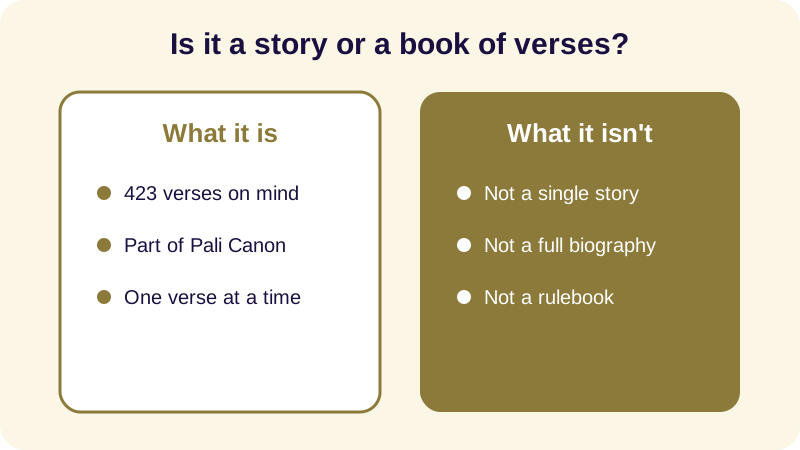
Because the verses were collected rather than composed as one connected work, the book reads less like a sermon and more like a book of proverbs. Some verses are famous and widely quoted; others are quieter and easy to pass over the first time. There is no plot, no characters beyond the occasional short anecdote that explains why a verse was spoken, and no requirement to read it in order. You can open the Dhammapada at any page and find a complete thought.
What does the word "Dhammapada" mean?
Dhammapada is a compound of two Pali words. Dhamma means the teaching, the truth, or the way things actually are — the same word at the root of the broader term dharma. Pada means a foot, a step, a verse, or a path. Put together, the title is usually translated as "verses of the teaching" or "the path of truth." Both translations point at the same idea: short steps, each one a complete piece of the path, meant to be walked one line at a time rather than read straight through like a novel.
What are the main themes of the Dhammapada?
The verses return again and again to a small set of concerns that most people recognize without needing any background in Buddhism. The opening chapter, sometimes called the Twin Verses, states the central claim plainly: the mind precedes all things, and a disturbed mind or a settled one shapes everything that follows from it. The rest of the book works through what that means in practice.
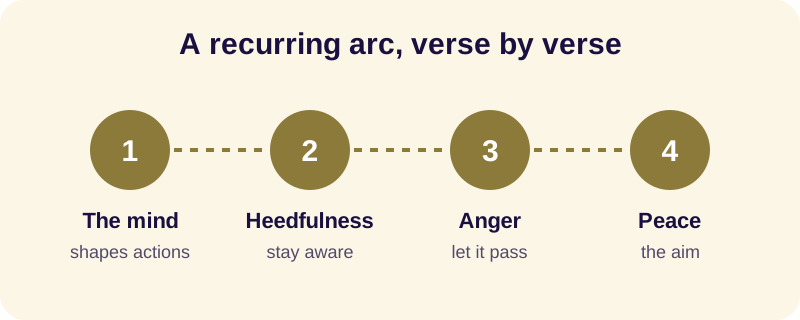
Taken together, the recurring themes include:
- The mind as the starting point — thoughts come before words and actions, so training attention matters more than controlling outcomes.
- Heedfulness — staying alert to one's own habits rather than drifting through the day on autopilot.
- Anger and ill will — several verses observe that hatred does not end by meeting it with more hatred, only by its opposite.
- Craving and attachment — wanting things to be other than they are is treated as a source of restlessness, not a character flaw to feel bad about.
- Impermanence and old age — a number of verses look plainly at aging and death, not to be morbid but to loosen the grip of small daily worries.
- A settled mind as the goal — the final verses describe the person who has trained the mind as calm, unmoved, and at ease.
These themes are not separate from the rest of the Buddha's teaching; they are a compressed, quotable version of it. The same concerns show up in the Four Noble Truths, in the Five Precepts, and in the Middle Way between indulgence and harsh self-denial. The Dhammapada is where those ideas get turned into lines short enough to remember on a hard day.
How is the Dhammapada organized?
The 423 verses are arranged into chapters by subject rather than by date or by story. One chapter collects verses on the mind, another on anger, another on old age, and so on. There is no overarching plot connecting the chapters, and no requirement to read them in sequence. This is part of why the book has survived so well as something to read aloud or recite from memory: any single verse is already complete, so a reader loses nothing by starting in the middle.
How can the Dhammapada help at night?
A racing mind at bedtime is usually doing exactly what the opening verses describe — running ahead, rehearsing arguments, building worries out of thoughts. A single short verse gives that activity somewhere quieter to land. It is not a fix for a sleep problem, and if sleeplessness is a persistent issue, that is worth discussing with a doctor rather than a verse. But as an ordinary evening practice, reading or hearing one verse and letting the mind rest on it is a smaller, more manageable task than solving tomorrow.
For a closer look at individual verses and what they mean, the Dhammapada guide covers the text in more depth, and verses for a restless mind collects lines suited to the hours when sleep will not come. If you would rather listen than read, an app for Dhammapada narration can carry the same verses slowly enough to settle into, instead of scrolling through a page in the dark.
The Buddha Story app narrates Dhammapada verses alongside Jataka tales and episodes from the life of the Buddha, with a sleep timer that stops the story for you and offline listening for nights when a page of text feels like one more task rather than a rest.
Frequently Asked Questions
What is the Dhammapada about?
It is about the untrained mind and what settles it. The Dhammapada gathers 423 verses attributed to the Buddha on anger, craving, heedlessness, self-discipline and peace, grouped by theme rather than told as a single narrative, so each short verse can be read and understood on its own.
How many verses does the Dhammapada have?
The Dhammapada has 423 verses, arranged into chapters by subject rather than by chronology. There is no single plot running through it; each chapter collects sayings on one theme, such as the mind, anger or old age, so a reader can dip into any chapter independently.
Is the Dhammapada a story or a set of teachings?
It is a set of teachings, not a story. Unlike the Jataka tales, which narrate past lives of the Buddha, the Dhammapada is a collection of short verses, closer to proverbs than to narrative, meant to be memorized and reflected on individually.
Do I need to be Buddhist to read the Dhammapada?
No. The verses address ordinary difficulties — anger, worry, attachment, an unsettled mind — in plain language that does not require any particular belief. Many people read it simply as practical reflection on how thoughts and habits shape a day, or a night.
