Published
Quick answer
Why can't I sleep even when tired? Usually because tiredness (body fatigue) and sleep readiness (a calm, alert mind) are different things, and a mind still replaying the day can stay awake inside an exhausted body.
Key takeaways
- Tiredness is physical fatigue; sleep readiness is a separate signal of mental calm.
- A busy, replaying mind is usually what keeps an exhausted body awake.
- Checking the clock or forcing sleep both raise alertness instead of lowering it.
- Breath awareness, a loving-kindness phrase or a slow story give the mind somewhere gentler to rest.
- See a doctor if the pattern persists most nights for weeks.
Why can't I sleep even when tired is one of the most common questions people type into a phone at midnight, and the short answer is that being tired and being sleepy are not the same state. A worn-out body can sit inside a wide-awake mind, and that mismatch, not any failure on your part, is usually what keeps you up.
Why can't I sleep even when tired?
Tiredness is a signal from the body: muscles heavy, eyes aching, the day's effort spent. Sleep readiness is a separate signal, built up through the day and released once the nervous system judges it safe to switch off. Most nights the two line up. Some nights they don't, and a body that is clearly exhausted lies next to a mind that is still fully online — scanning, planning, replaying.
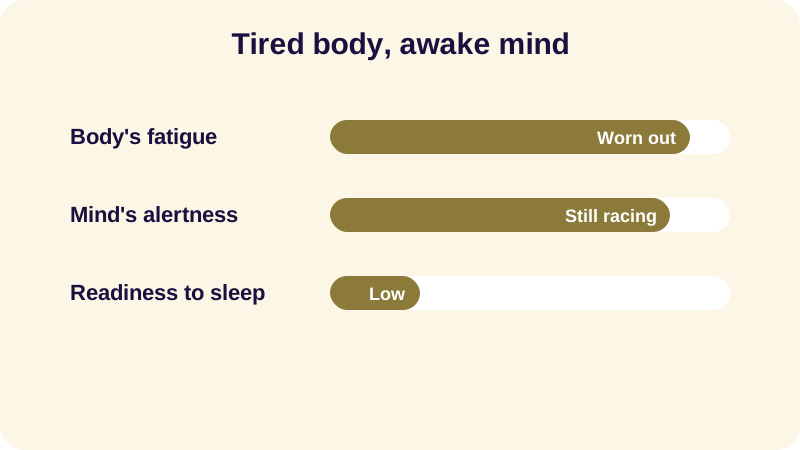
This gap matters because it changes what actually helps. Resting harder, or reminding yourself how tired you are, does nothing for an alert mind — sleep is not a reward you earn by wanting it enough. What helps is lowering the mind's level of arousal, which is a different job entirely from resting the body, and it is the part most people skip because it isn't obvious from the outside how busy a quiet, lying-down mind can be.
See also: Why Do Ocean Sounds Help You Relax? A Calm Answer.
What keeps a tired mind awake?
Usually it is unfinished business. A mind left over-stimulated by the day — a hard conversation, an unresolved worry, simple screen light late in the evening — keeps running the same loop it was running at six in the evening, just quieter and in the dark. The old texts have a plain name for part of this pattern: the "second arrow." The first arrow is whatever actually happened during the day; the second is the mind shooting itself again and again by replaying it. You can read more about this specific pattern in Buddhism and anxiety.
This is also why clock-watching backfires. Checking the time turns a vague worry ("I might be up a while") into a sharp, countable one ("it's the middle of the night and the hours left are shrinking"), which is exactly the kind of alert, problem-solving thought that keeps the nervous system switched on rather than settling it. A longer look at this specific pattern, and at what tends to make it worse, is in how to quiet a racing mind at night.
What can I do about it tonight?
The aim is not to force sleep but to lower arousal enough that sleep can arrive on its own. A few simple, old practices do this well, because each gives the mind one slow thing to follow instead of many fast ones competing for attention.
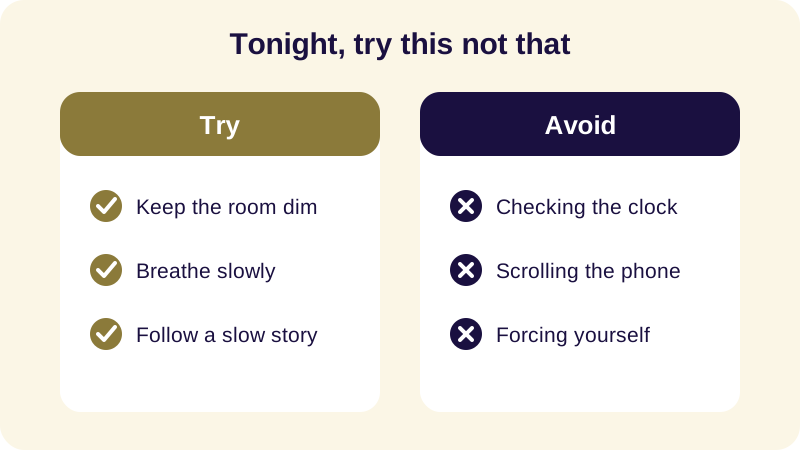
- Breath awareness. Counting or simply following each inhale and exhale gives a busy mind a single, undemanding task that leaves no room for the loop to keep running. More detail on this and the body scan is in Buddhist meditation for insomnia.
- Metta — loving-kindness. Silently repeating a short, kind phrase toward yourself and others is slow and repetitive by design, which calms in much the same way a story does. See metta meditation for restful sleep.
- A slow story. Following a gentle narrative — a Jataka tale, an episode from the life of the Buddha, a Dhammapada verse and its background — occupies the same attention that would otherwise be rehearsing tomorrow. See Buddhist stories for sleep or a short selection of Dhammapada verses for a restless mind.
- Mindfulness of the present moment. Noticing the weight of the body on the mattress, the temperature of the air, the quiet sounds of the house, pulls attention out of the loop and into the room you are actually lying in. More in mindfulness for sleep.
When is this worth seeing a doctor about?
An occasional wired night, even after a long and tiring day, is ordinary and not a sign that anything is wrong with you. It is worth talking to a doctor when the pattern is persistent — most nights for weeks, with daytime exhaustion, low mood, or other effects that aren't improving on their own. Buddhist practices, and the app built around them, can help settle an ordinary restless evening. They are not a treatment for insomnia or any medical condition, and a doctor is the right person to assess a problem that doesn't let up.
How can the Buddha Story app help on a wired night?
The app narrates exactly this kind of slow material for listening in the dark: Jataka tales, episodes from the life of Siddhartha Gautama, Dhammapada verses, and Zen parables, read slowly rather than performed for effect. It can be layered with rain, ocean waves or singing bowls through the sound mixer, paired with guided meditation for loving-kindness, body scan or breath awareness, and set to a sleep timer that stops it for you once you have drifted off. Everything works offline and keeps playing in the background, so a locked screen doesn't interrupt a story partway through.
None of this forces sleep, and it isn't meant to. It simply gives a tired body something calmer to listen to than its own replaying mind — which, on most nights, is enough to let the rest do its work.
Frequently Asked Questions
Why can't I sleep even when tired?
Tiredness is physical fatigue, but falling asleep depends on a separate signal of mental calm. When the mind is still busy processing the day, it stays alert even though the body is worn out, which creates the frustrating mismatch of exhaustion without sleep.
What is the difference between tired and sleepy?
Tired describes physical fatigue — heavy limbs, low energy. Sleepy describes the brain's actual readiness to drop off, built up through the day. You can be deeply tired and still have an alert, busy mind, which is why exhaustion alone doesn't guarantee sleep.
What can I do if my mind keeps racing at night?
Give it one slow thing to follow instead of fighting it directly: breath awareness, a loving-kindness phrase, or a gentle story. These occupy the same attention that would otherwise replay the day, which tends to lower alertness enough for sleep to follow naturally.
Is it normal to feel exhausted but wide awake at bedtime?
Yes, occasionally. An unusually stimulating day, late screen light, or an unresolved worry can leave the body depleted while the mind stays alert. It is worth discussing with a doctor only if the pattern persists most nights for weeks, not after one rough night.
Can the Buddha Story app help when I'm tired but can't sleep?
It narrates slow Buddhist stories, Dhammapada verses and Zen parables, pairs them with calming sounds and guided meditation, and offers a sleep timer. It gives a busy mind somewhere gentler to rest, though it is not a treatment for insomnia.