Published
Quick answer
The fastest way to learn how to fall asleep faster naturally is to slow your breath, release tension with a body scan, and give your mind a quiet story or verse to follow instead of its own loop. Dim the lights and put the phone away first.
Key takeaways
- A longer exhale than inhale slows the body faster than trying to force sleep.
- A body scan from head to feet releases tension you don't notice you're holding.
- Swapping phone scrolling for a slow story removes a major cause of lying awake.
- Dim light, a cool room and no late caffeine support a natural wind-down.
- Sleeplessness that lasts for weeks is a question for a doctor, not just a routine.
Learning how to fall asleep faster naturally starts with slowing the breath, relaxing the body and giving a racing mind something quieter to follow than tomorrow's to-do list. None of it requires pills, blinking gadgets, or trying harder — just a few ordinary steps done in the right order.
What actually helps you fall asleep faster, naturally?
The most reliable natural ways to fall asleep faster are physical, not mental: a longer exhale than inhale slows the heart rate, a slow body scan releases tension you didn't know you were holding, and a dim, cool, quiet room removes the small irritants that keep the brain half-alert. None of these force sleep — they just stop pushing it away.
See also: Calming Stories to Listen to Before Bed.
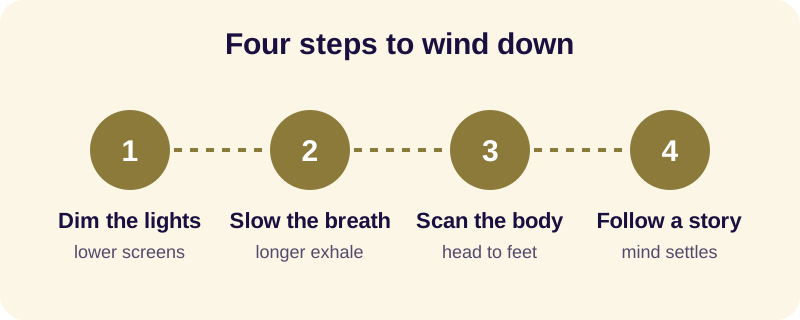
- Dim the lights for the last hour before bed, including screens.
- Put the phone face down, out of reach, or in another room.
- Breathe in for a slow count of four and out for a slow count of six, for about ten breaths.
- Run a slow body scan: notice and soften your jaw, shoulders, hands, and feet in turn.
- Follow a short, quiet story or a few familiar verses instead of your own thoughts.
- Let yourself be mildly bored. Checking whether it's working is itself a way of staying awake.
Why does slow breathing or a story work better than trying harder?
Trying hard to fall asleep keeps the analytical mind in charge, and an analytical mind is built to solve problems, not to rest. A slow breath or a gentle story gives that mind one undemanding thing to follow instead of the day's unfinished business, so it can loosen its grip without being told to let go.
A simple breathing technique for sleep, like counting four in and six out, works for roughly the same reason a story does: it gives attention a single, slow object instead of a dozen competing ones. If your mind usually starts racing the moment the lights go off, it helps to understand why before trying to out-think it — see how to quiet a racing mind at night for what actually helps and what tends to make it worse.
For a longer version of this approach, including a full body scan you can do lying flat in the dark, see mindfulness for sleep. Both the breath and the body scan are forms of ordinary attention training — nothing mystical, just practice at noticing without reacting. Neither one is about getting it "right"; the point is simply to give a busy evening mind somewhere calmer to rest than its own replaying thoughts, and to let the body follow once the mind has stopped bracing.
What should I avoid right before bed?
A few ordinary habits undo all of the above faster than almost anything else: checking the phone one more time, scrolling through news or messages, bright overhead light, caffeine late in the day, and replaying an argument or a worry from earlier in the evening. None of these are moral failings — they simply keep the nervous system in daytime mode.
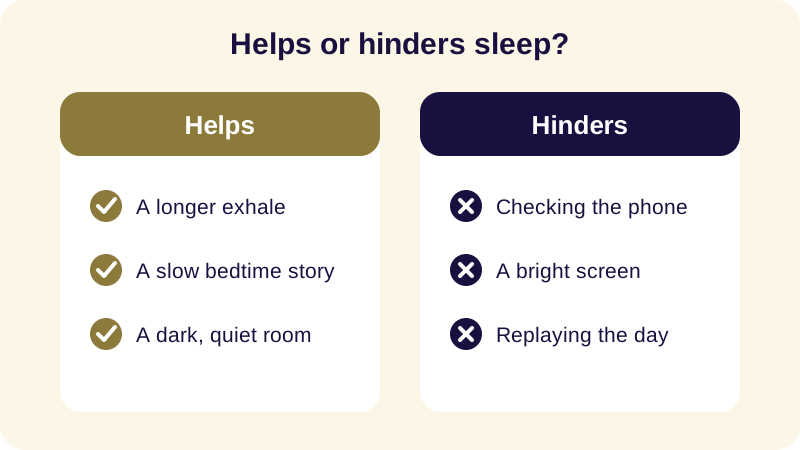
It helps to notice that most of these habits aren't really about sleep at all — they are ways of staying mentally occupied because lying still with an unoccupied mind can feel uncomfortable at first. That discomfort usually passes within a few nights of practice. The goal isn't to empty the mind completely, which is unrealistic for almost anyone, but to give it one slow, low-stakes thing to hold instead of several urgent ones.
How does a Buddhist story fit into a natural bedtime routine?
Buddhist communities have used slow, repeated teachings at the end of the day for some 2,500 years — not as entertainment, but as a way to settle the mind before sleep or meditation. A short Jataka tale, a few verses from the Dhammapada, or a quiet recitation of the Metta Sutta, a teaching on loving-kindness, works on the same principle as counting breaths: it gives the mind one gentle, familiar thing to follow instead of its own loop.
For someone looking to fall asleep without medication, swapping scrolling for a slow story is a small, repeatable change rather than a skill to master. Try a short tale from Buddhist bedtime stories, or build the story into a fuller wind-down with a Buddhist evening routine for better sleep.
If loving-kindness practice interests you, metta meditation pairs naturally with the breathing described above — a few silent phrases of goodwill toward yourself and others, timed to the breath, often does more to loosen a tight chest than trying to think your way calm. None of this requires any prior familiarity with Buddhism; the stories and phrases stand on their own as calming listening, whatever you believe.
The Buddha Story app was built for exactly this moment. It narrates Jataka tales, episodes from the life of Siddhartha Gautama, Dhammapada verses and Zen parables in slow English narration, alongside a sound mixer of rain, ocean waves or singing bowls. A sleep timer, set to 10, 20, 30 or 60 minutes, pauses the story and sounds when it ends rather than fading them out, so there is nothing left to do but stay still. Guided meditation, Offline Mode and background playback mean you can start a story, lock the screen and let the room go dark. It is available on Google Play for Android.
Falling asleep faster naturally is rarely about one trick. It is a short sequence — dimmer room, slower breath, looser body, quieter story — repeated enough nights that the body starts to recognise it as the signal to let go, not a performance to get right but a habit the nervous system slowly comes to trust.
Frequently Asked Questions
What is the fastest natural way to fall asleep faster?
Slow your breathing so the exhale is longer than the inhale, then run a slow body scan from your head down to your feet. Both signal to the body that nothing needs to be solved right now, which is usually what's keeping sleep away in the first place.
Does a breathing technique for sleep actually work?
Yes, in the sense that it gives a busy mind one simple, slow thing to follow instead of the day's leftover thoughts. Try breathing in for a count of four and out for a count of six; the longer exhale is the part doing most of the work.
What should I avoid if I want to fall asleep faster naturally?
Checking the phone one more time, bright overhead light, caffeine late in the day, and replaying an argument or a worry from earlier. None of these are failures of willpower — they simply keep the nervous system in daytime mode longer than it needs to be.
Can a short story really help me fall asleep without medication?
A slow, familiar story gives attention somewhere calm to rest, which is often enough to let go of the loop of planning and worrying that keeps people awake. It isn't a cure for anything, just a gentler alternative to scrolling or staring at the ceiling.
When is trouble sleeping a medical issue rather than a habit to fix?
If poor sleep lasts for weeks, disrupts your days, or comes with other symptoms, it belongs with a doctor rather than a bedtime routine. The habits in this article are for an ordinary restless night, not a diagnosis.
