Quick answer
How many Jataka tales are there? Buddhist tradition counts 547 of them, collected in the Pali Canon as birth stories of the Buddha's past lives, ranging from one-verse fables to long epics.
Key takeaways
- The traditional count of Jataka tales is 547, fixed in the Pali Canon.
- They are grouped into books by length, from one-verse tales to long epics.
- Each tale pairs a present-day story with a past-life story and a closing verse.
- You never need to read all 547 — a handful of short tales works well at bedtime.
- The Dhammapada, with its 423 verses, is a shorter companion collection from the same canon.
How many Jataka tales are there? The traditional count, fixed in the Pali Canon, is 547 birth stories describing the Buddha's past lives.
That number has held steady for roughly 2,500 years, even as the stories themselves have been painted on temple walls, carved into stone reliefs and retold in dozens of languages. Knowing the shape of the whole collection makes it easier to pick a handful for a quiet evening, instead of wondering whether you are missing something by not reading all of them.
How many Jataka tales are there, exactly?
The canonical figure is 547. These tales sit together as a single book inside the Khuddaka Nikaya, one section of the larger Pali Canon, and each one is framed as a story the Buddha told about something that happened to him in an earlier life, before he was born as Siddhartha Gautama and reached awakening under the Bodhi tree.
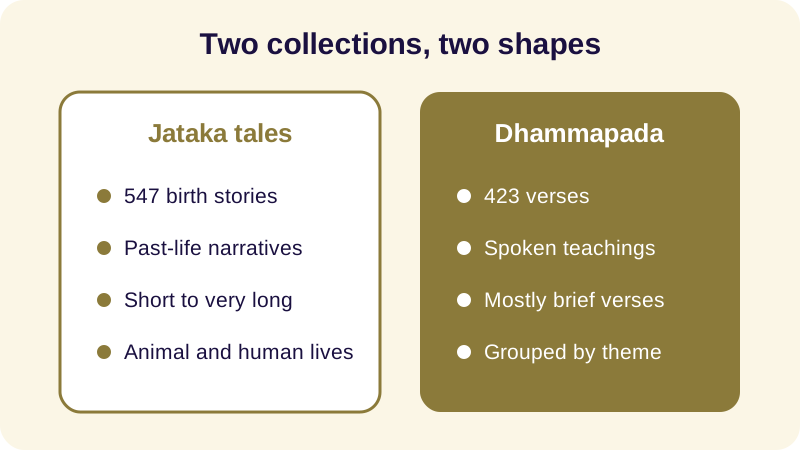
The tales are not scattered evenly. They are sorted into books called nipatas, roughly by length, so the earliest books contain brief, single-verse stories and the later books contain long, elaborate ones. The final and longest is the Vessantara Jataka, a story of extreme generosity that tradition places as the Buddha's last birth before this one. For a sample of these stories retold in plain language, the Jataka tales page is a good starting point.
Why don't all collections agree on the number?
The figure of 547 refers specifically to the canonical collection preserved in the Pali Canon, with its accompanying commentary that supplies the prose framing around each verse. Outside that canonical set, the broader Jataka genre is larger and looser: regional traditions across Southeast Asia have their own extended cycles, apocryphal additions and locally cherished favourites that are not part of the 547.
This is why you may see different totals quoted elsewhere. Some sources count only the verses attributed directly to the Buddha within the canon; others count the full prose-and-verse units as told by commentators; still others fold in later, non-canonical tales that circulate as Jataka-style stories without belonging to the fixed list. None of this changes the core answer — the number tied to the Pali Canon is 547 — but it explains why the genre as a whole feels larger than any single number suggests.
What's inside a single Jataka tale?
Nearly every Jataka tale follows the same basic shape, which is part of why they work so well as a bedtime form: nothing about the structure surprises you, so your attention can settle into the telling rather than brace for a twist.
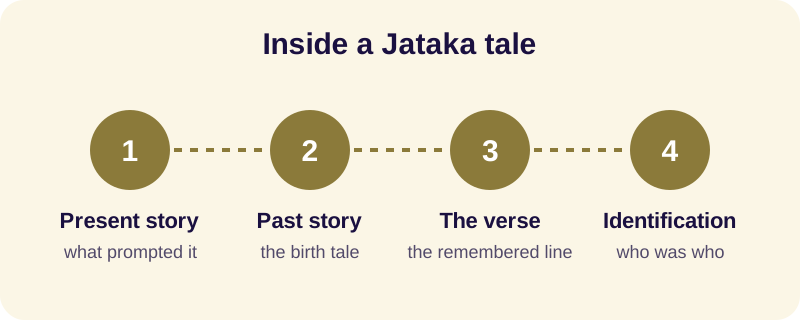
A short frame explains what happened in the Buddha's present life that prompted the story. Then comes the tale itself — a deer, a merchant, a foolish king, a patient ox — acting out a particular virtue or its absence. A verse, often the oldest surviving part of the tale, sums up the lesson. Finally the Buddha identifies which character in the past story corresponds to which person in his present life, closing the loop. This pattern repeats across all 547, which is part of what makes the whole collection feel so consistent despite its size.
Which Jataka tales are worth starting with?
You do not need to work through the collection in order, and trying to is a common way to lose interest. The books nearer the start contain brief, simple fables well suited to a first listen; the longer tales, including the Vessantara Jataka, are better saved for when you already enjoy the form.
- Short animal fables from the early books — easy to follow, often funny, usually under a few minutes when narrated slowly.
- Stories about generosity and patience — recurring themes across the collection, gentle rather than dramatic.
- The Vessantara Jataka — the longest tale, worth hearing once you have a feel for the pattern, ideally across more than one night.
For retellings organized this way, with morals spelled out plainly, see Jataka tales retold.
How can Jataka tales help at night?
The appeal at bedtime has little to do with the total count and everything to do with the shape of a single tale. Each one is short, resolves cleanly, and carries a single idea rather than a tangle of plot threads your mind might keep working on after the story ends. That predictability is useful precisely when you are trying to wind down rather than stay engaged.
Because the collection is so large, there is always another tale you have not heard, which avoids the staleness that can creep in with a small, repeated set of bedtime stories. If you are building an evening habit around this kind of listening, Buddhist bedtime stories covers ten short tales to begin with, and the broader dharma stories for sleep collection shows how these narratives sit alongside other teachings from the same canon.
Buddha Story narrates Jataka tales, the life of the Buddha, Dhammapada verses and Zen parables, so you can move between the 547 birth stories and shorter teachings without hunting for a new source each night. A sleep timer that fades the story out, offline listening and a choice of relaxing sounds mean the collection can simply run in the background while you settle. None of this is a substitute for addressing ongoing sleep difficulty with a doctor — it is simply a steady, unhurried thing to listen to once the lights are off.
Frequently Asked Questions
How many Jataka tales are there?
Buddhist tradition counts 547 Jataka tales. They form a book within the Pali Canon's Khuddaka Nikaya and are presented as stories the Buddha told about his own previous lives, long before his awakening under the Bodhi tree.
Are all 547 Jataka tales about the Buddha himself?
Yes, in the sense that each tale identifies one character as a past incarnation of the person who became Siddhartha Gautama. He appears as an animal, a merchant, a king or an ascetic, always shown developing a particular virtue.
What is the longest Jataka tale?
The Vessantara Jataka is generally considered the longest and most elaborate of the collection. It tells of a prince's extreme generosity and is traditionally placed last, as the final life before the Buddha's awakening.
Do I need to read all 547 Jataka tales before bed?
No. The collection is meant to be sampled, not finished in order. A few short tales, chosen for their calm tone rather than their place in the sequence, are enough for a regular bedtime habit.
How are the 547 Jataka tales organized?
They are grouped into books called nipatas, arranged roughly by length. Early books hold short, single-verse tales; later books hold longer, multi-verse stories, ending with the extended Vessantara Jataka.