Published
Quick answer
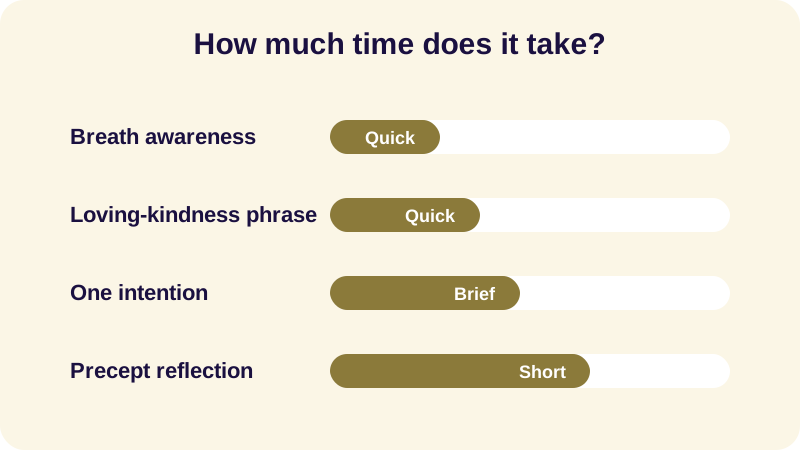
A Buddhist morning routine for peace is a short sequence of breath awareness, a brief loving-kindness phrase and one clear intention, done before checking the phone. It takes about ten minutes and needs no special equipment.
Key takeaways
- A Buddhist morning routine for peace can take as little as ten quiet minutes.
- Start with a few mindful breaths before checking the phone or the news.
- A short loving-kindness (metta) phrase sets a kinder tone for the day.
- One precept or intention, held lightly, shapes choices without rigid rules.
- Five calm minutes daily works better than one long session done rarely.
A Buddhist morning routine for peace does not require incense, robes or an hour of silence. Ten quiet minutes of breath awareness, one phrase of loving-kindness and a single clear intention are enough to set a calmer tone for the whole day.
Most people search for this after a few mornings spent reaching for the phone before their feet even hit the floor, scrolling through messages and news while the mind is still half-asleep. The habit is understandable and also costly: it hands the first minutes of the day to whatever happens to be loudest. A short, deliberate routine simply claims those minutes back.
What does a Buddhist morning routine for peace actually look like?
It is shorter and plainer than it sounds. A simple version has four parts: a few mindful breaths before doing anything else, a short phrase of loving-kindness directed at yourself and others, a brief reflection on one guiding intention for the day, and then getting up without rushing into the first task.
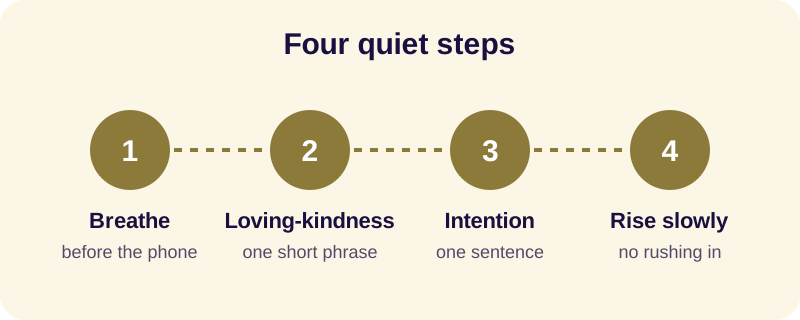
None of this is exotic. The breath awareness is the same attention taught in meditation for beginners: noticing the in-breath and out-breath without trying to change them. The loving-kindness phrase comes from metta practice, covered more fully in our guide to metta meditation, where a simple wish such as "may I be well, may others be well" is repeated slowly. The intention can be as small as "I will listen before I answer" or as broad as one of the four brahmaviharas — kindness, compassion, shared joy or equanimity — held in mind for the day ahead.
How do you build the routine step by step?
Start smaller than feels necessary. A routine that takes two minutes and actually happens every day beats a twenty-minute version that gets skipped after a week.
- Before reaching for your phone, sit up and take five slow breaths, noticing the air moving in and out.
- Silently repeat one loving-kindness phrase two or three times, such as "may I be at ease, may those around me be at ease."
- Name one intention for the day in a single plain sentence — a quality you want to bring, not a list of tasks.
- Notice anything in the body that is tense — jaw, shoulders, hands — and let it soften without forcing it.
- Get up at your own pace. If the first thing you do is check messages, let it be a choice rather than a reflex.
If sitting still first thing feels difficult, a short stretch of walking meditation across the room can serve the same purpose: slow, deliberate steps with attention on the feet and breath, done before the day's pace takes over.
Which teaching fits into just a few morning minutes?
You do not need to study a whole text before breakfast. Three strands of the tradition compress well into a short morning moment: the brahmaviharas as a one-line wish, the Five Precepts as a single reflection on how you want to act, and the Middle Way as a reminder not to over-plan or under-prepare the day ahead.
Choosing one precept to hold lightly for the day — perhaps truthful speech, or simply not taking more than your share of someone's patience — works like a quiet compass. It is not a vow carved in stone; it is a direction to lean toward, the way the Middle Way itself favors steady balance over either rigid effort or drifting along unexamined.
What if mornings are rushed or chaotic?
Some mornings there is no spare ten minutes — a child needs breakfast, a train has to be caught. On those days, shrink the routine to its smallest form: one slow breath and one loving-kindness phrase, said silently while still lying down or standing at the sink. The value is not in the length of the pause but in the fact that it happens before the day's demands take over the mind entirely.
It also helps to notice what the routine is protecting you from. Checking messages first thing often means starting the day already reacting to someone else's priorities. A few minutes of attention on your own breath and intention, however brief, puts you back in the position of choosing rather than simply responding.
Can a morning routine replace calming the mind at night?
No, and it is not meant to. A morning routine sets the tone for the day; it does not undo a poor night's sleep or settle a mind that is already anxious. If racing thoughts, persistent worry or insomnia are a regular problem, that is worth raising with a doctor rather than managing alone with any routine or app.
What morning and evening practice can do is work together. A calm morning intention tends to make the evening easier to wind down from, and a settled evening — covered in our guide to mindfulness for sleep — makes the next morning's breath and loving-kindness phrase easier to reach for. Together they bracket the day rather than fixing any single problem inside it.
For anyone building this as a genuine habit rather than a one-off experiment, our piece on how to start a daily meditation habit covers the practical side: timing, reminders, and what to do on the days it slips.
The app narrates guided meditation for loving-kindness, body scan and breath awareness, so the same practice that opens the morning can be picked up again at night, with relaxing sounds and a sleep timer that stops the audio when it is time to rest. Neither the morning routine nor the app is a cure for anything; both are simply a quieter way to meet the start and end of an ordinary day.
Frequently Asked Questions
How long should a Buddhist morning routine for peace take?
There is no fixed length. Many people manage it in five to ten minutes: a minute or two of breath awareness, a short loving-kindness phrase, and one sentence naming an intention for the day. Longer is fine too, but brevity is not a failure.
Do I need to meditate cross-legged on the floor?
No. Sitting on the edge of the bed, in a chair, or standing by a window works just as well. What matters is a few minutes of stillness and attention, not a particular posture or setting.
What if I keep forgetting to do it?
Attach it to something you already do every morning, like boiling water or brushing your teeth, so it becomes part of an existing habit rather than one more task competing for willpower.
Is this routine a form of Buddhist practice or just borrowed habits?
It draws on real elements of Buddhist practice — breath awareness, metta (loving-kindness), and reflection on a precept or intention — simplified for daily life. You do not need to be Buddhist for it to be useful.
Can a morning routine help with anxiety or poor sleep?
It can support a calmer, steadier start to the day, but it is not a treatment for anxiety, insomnia or any medical condition. Persistent sleep or mood problems are worth discussing with a doctor.