Published
Quick answer
Beginner mindfulness exercises for stress are short practices — counting ten breaths, scanning the body, walking slowly — that give a busy mind one plain task instead of several worried ones.
Key takeaways
- Breath counting, a body scan and slow walking are the three easiest beginner exercises to start with.
- Each takes only a few minutes and needs no equipment, cushion or special posture.
- The aim is one plain task for the mind, not a blank or silenced mind.
- A wandering mind is normal; the exercise is noticing it and returning, not avoiding it entirely.
- These practices ease ordinary stress; persistent or overwhelming stress is worth discussing with a doctor.
Beginner mindfulness exercises for stress are short, concrete practices — counting breaths, scanning the body, walking slowly — that give a busy mind one plain task to do instead of several worried ones. None of them require special equipment, a cushion or a particular belief, just a few quiet minutes.
This guide walks through three such exercises in plain terms: which one to try first, what each one actually does for a tense evening, and the one mistake almost every beginner makes early on. None of it is a cure for anything. It is a simple mindfulness practice for beginners who want a practical way to settle before the next task, the next meeting, or the next attempt at sleep.
What counts as a beginner mindfulness exercise for stress?
Mindfulness, in the plain sense used here, means paying full attention to one ordinary thing that is happening right now — the breath, a sound, the weight of your feet on the floor — rather than trying to stop thinking altogether. A beginner exercise should be short enough to repeat through a stressful day, require no particular posture, and have an obvious next step when your attention drifts, because it will drift.
See also: How to Practice Breath Awareness Meditation at Home.
Three exercises cover most of what a beginner needs:
- Breath counting — silently counting each exhale, a simple anchor when the mind is loud.
- The body scan — moving attention slowly through the body, noticing sensation without judging it.
- Mindful walking — feeling the actual movement of a few ordinary steps instead of walking on autopilot while the mind runs ahead.
Each is a quick mindfulness technique for stress rather than a long sitting practice, which is exactly why they suit a beginner: there is less to get wrong, and less time for the mind to object.
Which exercise should I try first?
Breath counting is the simplest entry point, because the breath is always there and needs no setup. You are not trying to breathe more slowly or more deeply — just to notice the breath that is already happening and give it a number.
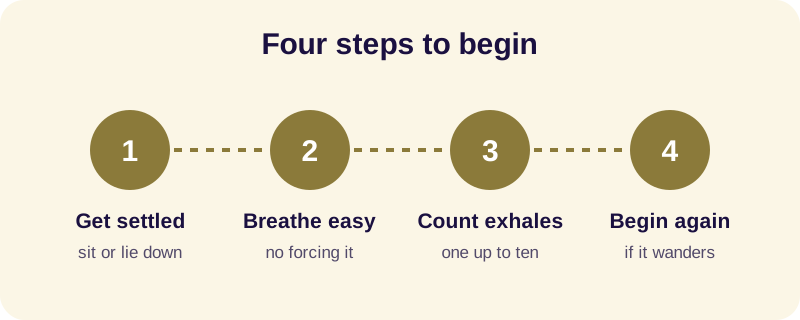
- Sit or lie in a comfortable position, eyes closed or with a soft, unfocused gaze.
- Let the breath happen as it normally does — no forcing it slower or deeper.
- Silently count each exhale: one, two, three, up to ten.
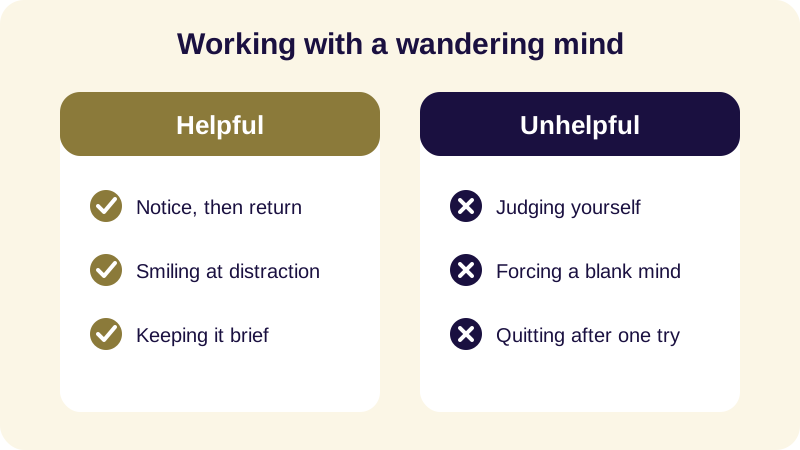
- If you lose count or notice your mind has wandered, simply start again at one.
- Repeat for a few rounds, or until the body feels noticeably steadier.
There is no failed round here. Losing count and starting over is not a sign the exercise isn't working; it is the exercise. For a fuller walkthrough of this and related practices, see meditation for beginners.
What does a body scan do for evening stress?
A body scan moves attention slowly and deliberately from one part of the body to the next — feet, legs, torso, shoulders, face — pausing briefly at each to notice whatever is there, tight or loose, warm or cool, without trying to change it. It gives the mind a concrete route to travel instead of looping through tomorrow's problems.
This is one of the more reliable mindfulness exercises for stress relief precisely because stress tends to live in the body as much as in thought — a tight jaw, raised shoulders, a shallow breath — and naming those sensations plainly, without judging them, often loosens them a little on its own.
If stress tends to show up most at bedtime rather than during the day, the same scanning technique is covered in more depth, alongside breathing patterns suited to lying down, in our guide to mindfulness for sleep.
What's the most common mistake beginners make?
The most common mistake is expecting the mind to go quiet. It won't, not reliably, and treating a wandering mind as a personal failure is the single fastest way to give up on a simple mindfulness practice for beginners within the first week.
Where does this practice come from, and can an app help?
Attending closely to the breath and the body is not a modern invention. It traces back to the teaching known as the Satipatthana Sutta, part of the wider path that includes the Four Noble Truths and the Noble Eightfold Path, attributed to Siddhartha Gautama in the centuries after his awakening under the Bodhi tree, some 2,500 years ago. The exercises above are a plain, secular slice of that much older attention practice — useful whether or not you take on any of the tradition around it. The Middle Way is a good description of the effort involved: not straining to force calm, not giving up at the first distraction, just a steady middle amount of attention.
Some people find it easier to be guided through these exercises by a voice rather than working from a written list, especially late in the day when reading instructions feels like one more task. The Buddha Story app includes guided meditation for breath awareness and body scan, alongside narrated Jataka tales and episodes from the life of the Buddha, with English narration, a sound mixer for layering rain or singing bowls underneath, offline listening, and a sleep timer that pauses the session for you rather than leaving it running all night. It runs on Android and is available on Google Play, with no ads interrupting a session.
Most evenings, though, the need is smaller than that: a mind still turning over an email, a conversation, a deadline. For that ordinary kind of tense evening, one round of breath counting, a slow pass through the body, or a few mindful steps across the room is often enough to loosen the grip a little. Start with whichever one feels least like effort tonight, and let it be that simple.
Frequently Asked Questions
What is the simplest mindfulness exercise for a beginner?
Breath counting is usually the easiest place to start. Breathe normally and silently count each exhale from one to ten, starting over whenever you lose count or notice your mind has wandered. It needs no posture, cushion or prior experience.
How long should a beginner mindfulness exercise take?
A few minutes is enough to begin with. Three to five rounds of breath counting, or a single slow pass of attention through the body, usually takes less time than scrolling a phone, and can be repeated whenever a stressful moment calls for it.
Do I need to sit cross-legged to practise mindfulness?
No. Any position that is reasonably alert works: sitting in a chair, lying in bed, or standing in a queue. The posture is not the point; the point is giving your attention one plain thing to rest on instead of several worried ones.
Can mindfulness exercises replace treatment for stress or anxiety?
No. These exercises can ease the tension of an ordinary difficult day, but they are not medical treatment. If stress is persistent, overwhelming or affecting daily life, that is worth discussing with a doctor rather than managing alone.