Published · Updated
Quick answer
An app with rain sounds for sleeping works best when steady rain is paired with a slow narrated story, giving a restless mind both quiet and a thread to follow. Buddha Story pairs rain, ocean waves and singing bowls with narrated Buddhist stories and a timer that stops them for you.
Key takeaways
- Rain sounds mask small noises but don't quiet racing thoughts on their own.
- Pairing rain with a slow narrated story gives a wandering mind something to follow.
- Buddha Story's Sleep Timer stops the story and sounds for you after a set length, so you don't need to reach for your phone.
- Offline Mode and background playback keep the sound going through a weak signal or a locked screen.
- Persistent insomnia or anxiety is worth raising with a doctor, not just solving with sound.
An app with rain sounds for sleeping works best when the rain is not the whole plan but the backdrop to something that gives your mind somewhere to go. On its own, steady rain covers the small noises of the night; paired with a slow story or a short teaching, it also gives a wandering mind a thread to follow.
What makes an app with rain sounds for sleeping actually work?
Rain sounds work mainly as masking noise: a steady hiss covers the small creaks, traffic and footsteps that would otherwise pull your attention back toward wakefulness. That part works well on its own for plenty of people, at least for a while.
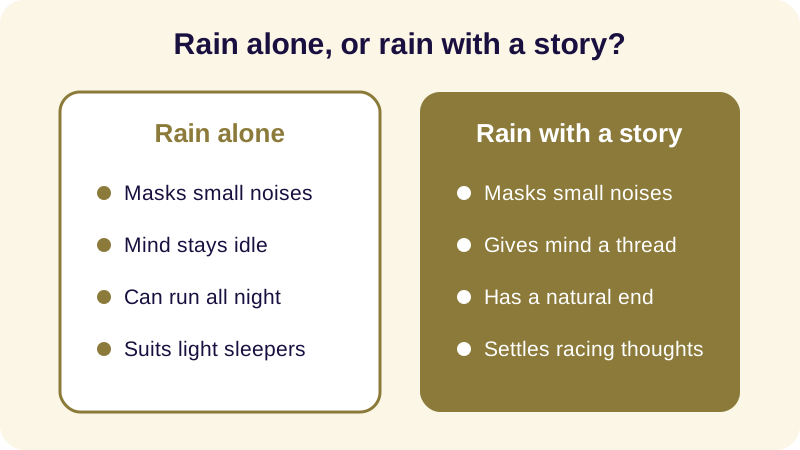
What steady sound does not do is anything about the content of your thinking. The running list of tomorrow's tasks keeps turning over quietly underneath it, which is one reason rain alone sometimes stops working right around the point a worry resurfaces.
Not all rain recordings are identical, either. A loop of light, consistent rain behaves differently from a track that swells into a sudden burst of thunder every few minutes — the second kind can do the opposite of its job, pulling attention back toward the sound instead of letting it fade from notice. A steady, textureless loop is what most people are actually after, even if it sounds less dramatic in daylight.
There is also a simpler reason rain works where silence sometimes does not. Total silence can make the ear strain, listening for the next small sound and finding every one of them louder than it should be. A steady, even sound removes that strain by filling the gap before it is noticed — which is one reason rain, ocean waves and the low tone of a singing bowl are such common choices for a wind-down routine rather than something more varied or musical. Evenness matters more than novelty when the goal is to stop noticing sound at all.
How do rain sounds pair with Buddhist stories for sleep?
In Buddha Story, rain is one of several relaxing sounds — alongside ocean waves and singing bowls — that sit underneath narrated Jataka tales, episodes from the life of Siddhartha Gautama, and short readings from the Dhammapada. Used this way, it functions as much as a buddhist rain sounds app as a sleep sounds and stories app: the rain and the narration are mixed together in one place rather than offered as two separate things.
See also: Sutara App: What That Search Is Really Asking For.
The stories themselves are chosen for pacing rather than plot. A tale about patience, or an account of Siddhartha Gautama sitting quietly near the Bodhi tree, does not ask anything of you; it simply unfolds. Buddhist stories for sleep are built this way on purpose — slow, unhurried, with nothing twisting at the end to keep you alert.
If rain is not quite the right texture some nights, the same sleep meditation sounds — temple bells, singing bowls, ocean waves — sit in the same mixer, so you are not locked into one sound for every evening. Some people prefer rain after a long, talkative day, when a steady roar feels like it absorbs the noise of the day along with the noise of the room. Others prefer the sparser sound of a single bell, which leaves more room for a story's words to stand out. Neither choice is more correct than the other; the point is simply to notice which one actually quiets you tonight.
What features should you check before you download a rain sounds app?
Not every rain sounds app for sleep is built the same way, and a handful of features make the difference between something you use once and something you reach for every night.
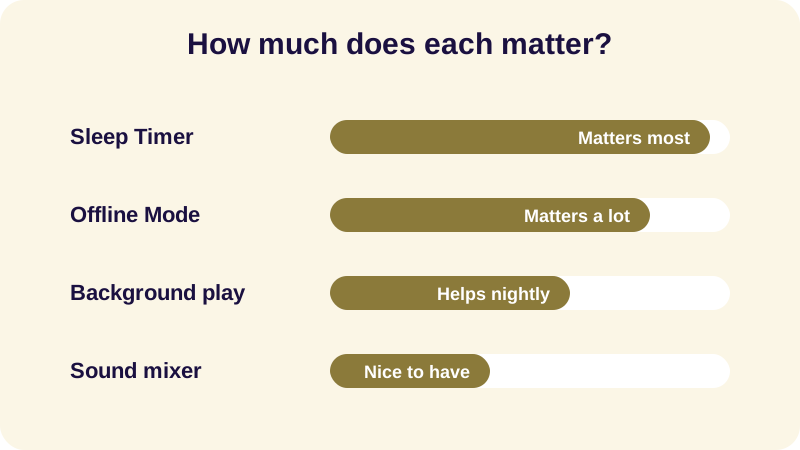
A Sleep Timer matters most of all, because an abrupt stop in the middle of the night is its own small jolt. Buddha Story's Sleep Timer runs for a set length — 10, 20, 30 or 60 minutes — and then pauses the story and the sounds together, so you never have to reach for the phone yourself to switch anything off.
Offline Mode means a weak signal or airplane mode never interrupts the sound partway through. Background playback lets you lock the phone and let the story continue in the dark, and no ads means nothing bright or jarring breaks in later on. Buddha Story includes all of these alongside 90+ narrated stories across Jataka tales, Dhammapada verses and episodes from the life of the Buddha.
Buddha Story also offers a 3-day free trial before you choose a monthly or yearly plan, which is enough time to notice whether rain, waves or a single bell actually settles you before committing to one.
A simple way to put these pieces together on an ordinary night looks something like this:
- Dim the lights and set the phone down somewhere you will not have to reach for it again.
- Pick one sound — rain, ocean waves or a singing bowl — rather than switching between several.
- Choose a short, familiar story instead of something new that might hold your attention too well.
- Set the Sleep Timer for the length you expect to need, then close your eyes and let it run.
For downloading ahead of a weak-signal night, see how to listen to sleep stories offline. If you are weighing several apps side by side, our overview of Buddhist sleep apps compares what each one offers.
Can rain sounds alone fix a restless or anxious night?
Rain sounds and a calm story can make an ordinary restless evening gentler, but they are not a treatment and they do not promise a particular night's sleep.
What a steady sound and a slow story can realistically do is more modest: give a racing mind one thing to settle on instead of several, and give the room one steady texture instead of silence that invites the ear to strain. That is often enough to turn a restless evening into an ordinary one, which is a reasonable thing to ask of an app and not much more.
Buddha Story is built around that modest aim rather than a bigger promise — rain and other relaxing sounds, narrated Jataka tales, Zen parables and readings from the Dhammapada, guided meditation for loving-kindness or breath awareness when a story is not what the evening needs, and a Sleep Timer that stops everything for you at the length you choose. None of this replaces ordinary good sense about bedtime — dim light, a consistent hour, a phone put down rather than scrolled on — but it can make the last few minutes before sleep noticeably calmer.
Frequently Asked Questions
Does the Buddha Story sleep timer stop suddenly?
Buddha Story's Sleep Timer runs for a set length — 10, 20, 30 or 60 minutes — and then pauses the story and the sounds together at the end. You choose the length that suits your evening, and playback stops on its own, so you are not left reaching for your phone in the dark.
Can I play rain sounds without a story?
Yes. The sound mixer lets you play rain, ocean waves or singing bowls on their own, with no narration layered over them, for nights when a steady background sound is all you want.
Will rain sounds alone help me fall asleep faster?
Rain can mask small noises and make a quiet room easier to settle into, but it does not address the content of racing thoughts. Pairing it with a slow story or a guided meditation gives a wandering mind a thread to follow, which many people find more settling than sound alone.
Is Buddha Story available offline and on which devices?
Buddha Story is an Android app available through Google Play, with a 3-day free trial before you choose a monthly or yearly plan. Offline Mode lets you download stories and sounds in advance, so a weak signal will not interrupt them partway through the night.
