Published
Quick answer
An app for adults who cant sleep works best when it offers something calming to listen to rather than a tool to force rest. Buddha Story narrates Buddhist stories, Dhammapada verses and ambient sounds, with a sleep timer and offline listening.
Key takeaways
- A calming app gives the mind a slow narrative to follow instead of silence to fight.
- Look for a timer that stops on its own, offline playback and background playback.
- Content and pacing matter more than library size or a flashy interface.
- Persistent sleeplessness or daytime exhaustion is a matter for a doctor, not an app.
- Buddha Story pairs narrated Buddhist stories with ambient sounds, guided meditation and a sleep timer.
An app for adults who cant sleep works best when it gives a restless mind something gentle to follow, instead of another problem to solve. The point isn't speed or a guaranteed knockout — it's a quieter way to spend the gap between turning out the light and actually drifting off.
Most people searching for this kind of app aren't managing a diagnosed sleep disorder. They're simply tired, a little wired, and tired of scrolling a bright phone at midnight. A calming audio app for sleep gives that same restless hand something quieter to do instead: press play, turn the phone face down, and listen to a voice instead of a feed.
What should an app for adults who cant sleep actually do?
A useful app does three plain things well: it gives you something calm to listen to, it stops on its own instead of looping all night, and it gets out of the way once you've actually fallen asleep. Everything else — theme, library size, extra modes — is a bonus, not a requirement.
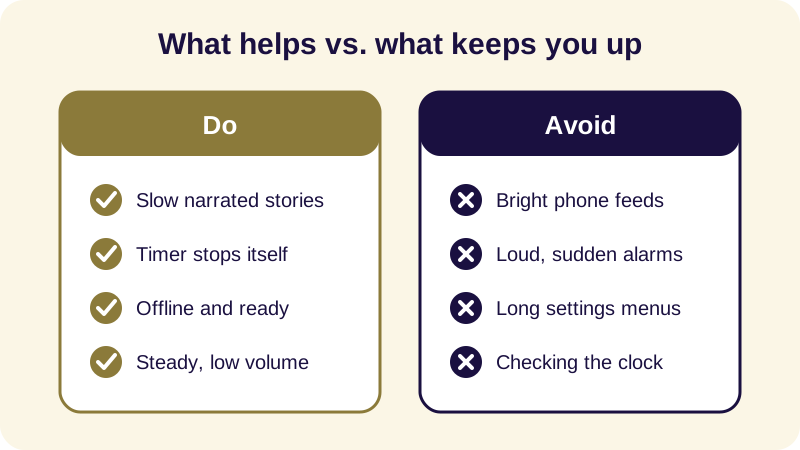
Content matters more than interface. Slow, even narration and a story that moves toward rest rather than suspense do more for a tired mind than a long settings menu or a flashy design. A bedtime app for restless nights should feel like a quiet voice in the room, not a piece of software you have to manage when you'd rather already be asleep.
Why does a calming story work better than scrolling at night?
A racing mind at night is usually still trying to finish something: a conversation replayed, a decision rehearsed, tomorrow's list reorganized for the third time. Scrolling adds more unfinished business to that pile, one bright notification at a time. A slow, narrated story does the opposite — it hands the mind a single thread to follow, with no ending that needs solving and nothing left over to carry into the dark.
This is part of why Buddhist stories for sleep have been used this way for a very long time. The Jataka tales and episodes from the life of Siddhartha Gautama move slowly toward a settled ending rather than a twist, which gives a tired mind permission to stop bracing for one. If you want to understand why this works on an attentional level, Buddhist meditation for insomnia walks through how breath and attention support the story rather than compete with it.
How do you build a bedtime routine around a narrated stories app for sleep?
Consistency does more of the work than any single feature on its own. The same rough sequence, repeated on most nights, teaches the body what's coming before the thinking mind has caught up and started negotiating about bedtime.
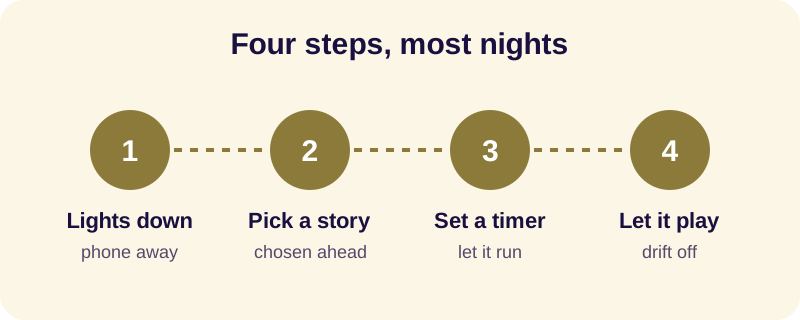
A workable version looks something like this: lights down, phone put away except for the one app you're using, a story or a short guided practice chosen in advance rather than scrolled for, and a timer set so you're not reaching for the screen again later. None of this needs willpower in the moment, because the decisions were already made earlier in the evening, while you were still thinking clearly.
If the harder part isn't falling asleep but waking in the night with a mind that won't stop, how to quiet a racing mind at night covers what helps in that specific window, and what tends to make it worse — bright screens, checking the clock, and trying to force sleep by sheer effort.
What if the sleeplessness doesn't let up?
An app, a story, or a breathing practice can make an ordinary restless evening gentler. None of it is a treatment for insomnia, anxiety, or any other condition, and it was never meant to be one — a calming routine and a medical problem are two different things, even when they sit on the same pillow.
For nights that are simply restless rather than clinically disrupted, mindfulness for sleep and a short body scan are reasonable places to start, used alongside whatever listening habit you've already built.
How does Buddha Story work as a sleep app for adults who cant sleep?
Buddha Story is a narrated storytelling app built around this exact moment — a sleep app for adults who want a quiet voice and a timer that stops on its own, not a gamified breathing coach or a loud alarm. It's available on Android through Google Play, with a 3-day free trial before you settle on a monthly or yearly plan.
- 90+ narrated stories drawn from the Jataka tales (547 in the traditional count), episodes from the life of the Buddha, Zen parables and the Dhammapada (423 verses).
- A Sleep Timer that stops the story once your chosen time runs out, rather than fading the sound out underneath you.
- Offline Mode and background playback, so a weak signal or a locked screen doesn't cut a story off halfway through.
- A sound mixer for layering rain, ocean waves or singing bowls under the narration.
- Guided Meditation for loving-kindness, breath awareness and a body scan, for nights when a full story feels like more than you want.
- No ads once a story has started, with narration in English.
It's worth being just as clear about what the app isn't. There's no Kids Mode, narration isn't offered in other languages, and the timer runs in fixed lengths — 10, 20, 30 or 60 minutes — rather than a custom countdown you set yourself. For a wider look at how different Buddhist-themed options compare, best Buddhist sleep apps lays the choices out side by side, and how to listen to sleep stories offline covers the download setup in more detail.
None of this guarantees a particular outcome on any given night, and it isn't meant to. What it offers is simpler than that: something slow and kind to listen to, in a dark room, instead of a bright screen and an open-ended scroll.
Frequently Asked Questions
What makes an app good for adults who can't sleep?
A good app gives you something calm to listen to, stops on its own instead of looping, and stays out of the way once you've fallen asleep. Content and pacing matter more than a long features list or a flashy design.
Do sleep apps actually help with insomnia?
Not on their own. An app or a narrated story can make an ordinary restless evening calmer, but it isn't a treatment for insomnia or anxiety. If sleeplessness is frequent or comes with daytime exhaustion, that's a matter for a doctor rather than an app.
What features should I look for in a bedtime audio app?
Look for a timer that actually stops instead of fading out, offline listening for when a signal drops, and background playback so a locked screen doesn't interrupt anything. Calm, slow narration matters more than a large library or a complicated settings menu.
Is Buddha Story free to try?
Buddha Story offers a 3-day free trial, after which you choose a monthly or yearly plan. It's available on Android through Google Play, with narrated Buddhist stories, guided meditation, ambient sounds and a sleep timer that stops on its own.