Quick answer
Buddhism keywords are the core Pali and Sanskrit terms people search to understand Buddhist teaching — words like dharma, karma, metta and the Four Noble Truths, explained plainly and grouped by what they describe.
Key takeaways
- Buddhism keywords cluster around teaching, ethics, heart practice and story, not a random list.
- The Four Noble Truths and Noble Eightfold Path sit behind most other terms.
- Learning one keyword at a time, inside a story, sticks better than memorising definitions.
- Stories carrying these words aloud at night are easier to hold onto than silent reading.
Buddhism keywords are the words and phrases people search for when they want a plain explanation of Buddhist teaching, practice or story — terms like dharma, karma, metta, or the Four Noble Truths. A handful of them, understood well, go further than a long list skimmed once and forgotten.
This guide pulls together the terms that recur most often, explains each one in plain language, and points to where the fuller version lives if you want to go deeper into any single idea.
What do people mean by "buddhism keywords"?
Most people who search this phrase are not looking for an academic index. They have heard a word somewhere — in a story, a yoga class, a quote shared online — and want to know what it actually means before they go further. Some are trying to make sense of a Dhammapada verse. Others are choosing between meditation resources and keep running into unfamiliar Pali or Sanskrit. Either way, the underlying need is the same: a short, honest definition, not a seminar.
A keyword, in this sense, is really a concept doing the work of several sentences. "Dukkha" carries more than "suffering" — it points to the unsatisfactoriness built into even pleasant experience, the way nothing quite holds still. "Metta" is not just "kindness" but a specific, practised wish for another being's wellbeing. Learning the word is a shortcut to learning the idea behind it, which is why these terms keep surfacing in searches long after the texts that first used them were composed, some of them close to 2,500 years ago.
Which buddhism keywords come up most often?
A small set of terms accounts for most of the searching. They cluster around four things: the Buddha's core diagnosis of suffering, the ethical guidelines for daily conduct, the practices used to train attention and warmth, and the figure of Siddhartha Gautama himself, who is said to have reached full awakening seated beneath the Bodhi tree.
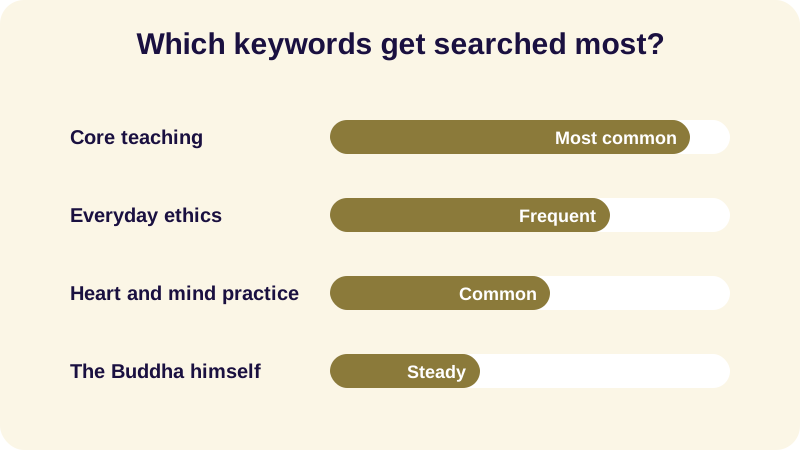
The Four Noble Truths and the Noble Eightfold Path sit at the centre of almost everything else — later terms usually turn out to be one of the eight path factors examined more closely, or one consequence of the first truth worked through in more detail. The Four Noble Truths page walks through that whole structure if you want the shape behind the single word.
How are buddhism keywords grouped by use?
Grouping helps more than any alphabetical list, because a keyword rarely stands alone — it belongs to a cluster, and the cluster usually explains the word faster than a dictionary definition would. A rough map of where most terms land:
| Group | What it covers | Example terms |
|---|---|---|
| Foundational teaching | The core diagnosis and path | dukkha, Four Noble Truths, Noble Eightfold Path |
| Everyday ethics | Guidelines for ordinary conduct | Five Precepts, sila, ahimsa |
| Heart practice | Training warmth and steadiness | metta, four brahmaviharas, Metta Sutta |
| Attention practice | Training the mind directly | Satipatthana Sutta, mindfulness, body scan |
| Story and scripture | Where the ideas are shown, not stated | Jataka tales, Dhammapada, parable |
Notice that the fifth group, story and scripture, is where most of the others get demonstrated rather than explained. The Jataka tales show generosity and patience in action across 547 stories of the Buddha's earlier lives; the Dhammapada compresses ethics and attention into 423 short verses. If a keyword feels abstract on its own, the story attached to it is usually the fastest way to make it concrete.
Do these keywords help at night, or only in study?
They do more work at night than most people expect, for a practical reason: a single, well-understood word gives a racing mind something small and finished to settle on, instead of an open-ended argument with itself. Turning over "what is dukkha, really" for thirty seconds is a different mental activity from turning over tomorrow's unanswered message, and it tends to run out of material much sooner.
This is also why Buddhist teaching travels so naturally as spoken narration rather than text on a page. A list of terms read silently tends to stay abstract; the same terms carried inside a slow, narrated story attach themselves to an image and a feeling instead. The app brings several of these keyword clusters together this way — 90+ narrated stories across 5 languages, with a Sleep Timer and Offline Mode so a late-night session isn't broken off by a dead signal or a dying battery. None of it replaces a full study of the texts; it is only a gentler way to meet them before sleep, and persistent sleep difficulties are a matter for a doctor rather than a story.
How should I start learning buddhism keywords without feeling overwhelmed?
The honest answer is slowly, and in an order that follows your own curiosity rather than a fixed syllabus. Chasing every unfamiliar word in one sitting is the single most common way people give up on the subject within a week.
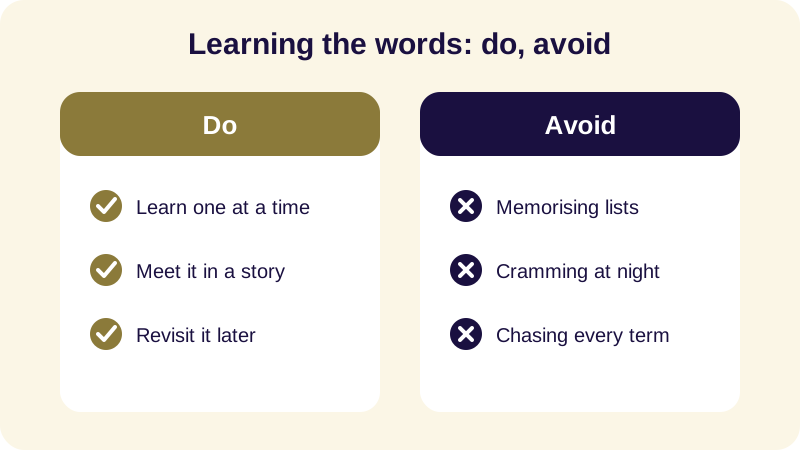
A workable approach: read or listen to one story a night, let one word from it stand out, and look that single word up the next day rather than mid-story. Over a few weeks the vocabulary accumulates on its own, attached to scenes you actually remember, which is a far stickier method than working through a glossary from the top down.
If you would rather start from a structured reference than from stories, Buddhist Words and Buddhism Vocabulary both lay the core terms out plainly, side by side, for whenever you want to look one up directly. Either path — story first or glossary first — tends to end up at the same place: a small set of words understood well enough to recognise instantly, whether in a Dhammapada verse, a Zen story, or a late-night search that finally gets a clear answer.
Frequently Asked Questions
What are buddhism keywords?
They are the words and phrases people search when they want a plain explanation of Buddhist teaching, ethics or practice — terms such as dharma, karma, metta, dukkha or the Four Noble Truths, usually met first in a story, a quote or a meditation app.
Why are so many buddhism keywords in Pali or Sanskrit?
The earliest texts, including the Dhammapada, were composed in these languages, and some concepts do not translate neatly into a single English word. Learning the original term alongside its plain meaning usually captures the idea more fully than translation alone.
Do I need to learn every buddhism keyword to understand the teaching?
No. A small set of terms, understood well and seen in context, covers most of what matters. Chasing every unfamiliar word at once is a common way to feel overwhelmed and give up within a week.
Can learning buddhism keywords help me sleep better?
It will not cure insomnia, but meeting one calm, well-understood term inside a slow story can give a restless mind something small to settle on instead of the day's unfinished business. Persistent sleep problems are best discussed with a doctor.